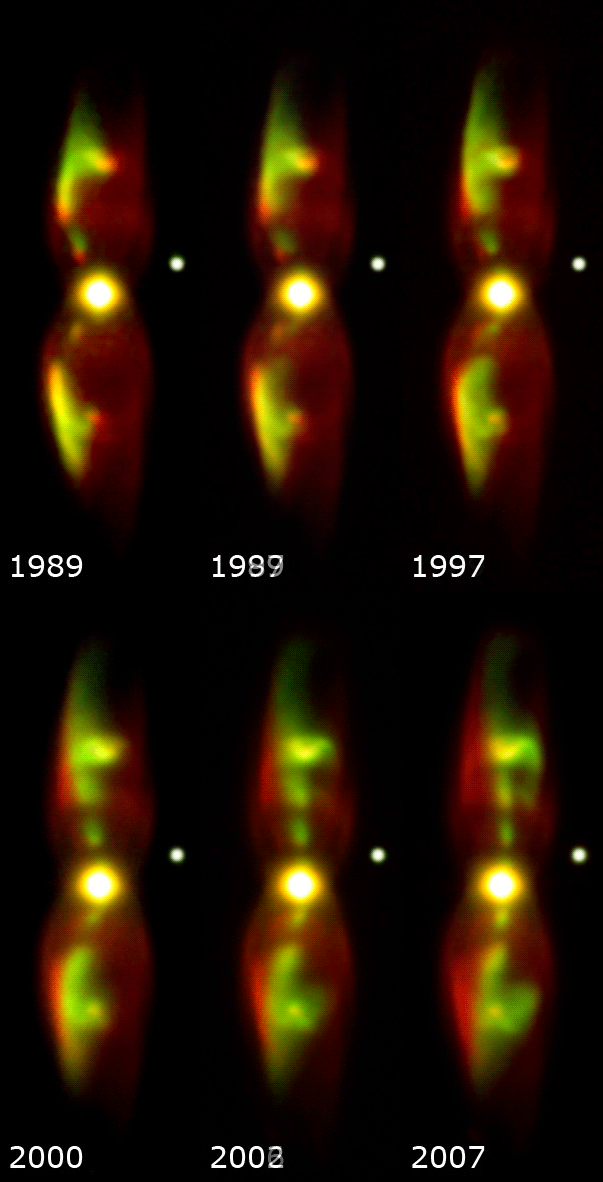
The shimmering colors visible in this NASA/ESA Hubble Space Telescope image show off the remarkable complexity of the Twin Jet Nebula. The new image highlights the nebula’s shells and its knots of expanding gas in striking detail. Two iridescent lobes of material stretch outwards from a central star system. Within these lobes two huge jets of gas are streaming from the star system at speeds in excess of one million kilometers (621,400 miles) per hour.
The M in this name refers to Rudolph Minkowski, a German-American astronomer who discovered the nebula in 1947. The PN, meanwhile, refers to the fact that M2-9 is a planetary nebula. The glowing and expanding shells of gas clearly visible in this image represent the final stages of life for an old star of low to intermediate mass. The star has not only ejected its outer layers, but the exposed remnant core is now illuminating these layers — resulting in a spectacular light show. However, the Twin Jet Nebula is not just any planetary nebula, it is a bipolar nebula.
Ordinary planetary nebulae have one star at their center, bipolar nebulae have two, in a binary star system. Astronomers have found that the two stars in this pair each have around the same mass as the sun, ranging from 0.6 to 1.0 solar masses for the smaller star, and from 1.0 to 1.4 solar masses for its larger companion. The larger star is approaching the end of its days and has already ejected its outer layers of gas into space, whereas its partner is further evolved, and is a small white dwarf.
The characteristic shape of the wings of the Twin Jet Nebula is most likely caused by the motion of the two central stars around each other. It is believed that as the dying star and white dwarf orbit around their common center of mass, the ejected gas from the dying star is pulled into two lobes rather than expanding as a uniform sphere. However, astronomers are still debating whether all bipolar nebulae are created by binary stars. Meanwhile the nebula’s wings are still growing and, by measuring their expansion, astronomers have calculated that the nebula was created only 1,200 years ago.
Within the wings, starting from the star system and extending horizontally outwards like veins are two faint blue patches. Although these may seem subtle in comparison to the nebula’s rainbow colors, these are actually violent twin jets streaming out into space, at speeds in excess of one million kilometers (621,400 miles) per hour. This is a phenomenon that is another consequence of the binary system at the heart of the nebula. These jets slowly change their orientation, precessing across the lobes as they are directed by the wayward motions of the binary system. Precession is a change in the orientation of the rotational axis of a rotating body.
The two stars at the heart of the nebula circle one another roughly every 100 years. This rotation not only creates the wings of the butterfly and the two jets, it also allows the white dwarf to strip gas from its larger companion, which then forms a large disc of material around the stars, extending out as far as 15 times the orbit of Pluto! Even though this disk is of incredible size, it is much too small to be seen on the image taken by Hubble.

Culorile strălucitoare vizibile în această imagine NASA / ESA din Telescopul spațial Hubble arată complexitatea remarcabilă a Nebuloaselor Twin Jet. Noua imagine scoate în evidență cochiliile nebuloasei și nodurile sale de expandare a gazului în detalii minunate. Două lobi irizați de material se întind spre exterior dintr-un sistem central al stelelor. În interiorul acestor lobi, două jeturi uriașe de gaz se strecoară de la sistemul stelar la viteze mai mari de un milion de kilometri pe oră. Fluturașul cosmic imaginat în această imagine NASA / ESA din Telescopul spațial Hubble are numeroase nume. Se numește Nebuloasa Twin Jet, ca și răspunsul la numele puțin mai poetic al lui PN M2-9. M în acest nume se referă la Rudolph Minkowski, un astronom germano-american care a descoperit nebuloasa în 1947. PN, între timp, se referă la faptul că M2-9 este o nebuloasă planetară. Cojile strălucitoare și expansive ale gazului vizibile în această imagine reprezintă etapele finale ale vieții pentru o stea veche de masă mică până la intermediară. Steaua nu numai că și-a scos straturile exterioare, dar miezul expunerii expuse le luminează acum aceste straturi – rezultând un spectacol spectaculos de lumină. Cu toate acestea, Nebuloasa Twin Jet nu este doar o nebuloasă planetară, ci o nebuloasă bipolară.
Obișnuitele nebuloase planetare au o stea în centrul lor, nebuloasele bipolare au două, într-un sistem binar. Astronomii au descoperit că cele două stele din această pereche au fiecare aproximativ aceeași masă ca soarele, variind de la 0,6 la 1,0 mase solare pentru steaua mai mică și de la 1,0 la 1,4 mase solare pentru companionul său mai mare. Steaua mai mare se apropie de sfârșitul zilelor sale și deja a scos straturile exterioare de gaz în spațiu, în timp ce partenerul său este în continuare evoluat și este un mic pitic alb.
Forma caracteristică a aripilor din Nebuloasa Twin Jet este cel mai probabil cauzată de mișcarea celor două stele centrale unul în jurul celuilalt. Se crede că, în timp ce steaua moartă și orbita pitică albă în jurul centrului lor comun de masă, gazul ejectat de la steaua muribundă este tras în două lobi, în loc să se extindă ca o sferă uniformă. Cu toate acestea, astronomii încă dezbat dacă toate nebuloasele bipolare sunt create de stele binare. Între timp, aripile nebuloasei sunt încă în creștere și, măsurând expansiunea lor, astronomii au calculat că nebuloasa a fost creată abia acum 1200 de ani.
În interiorul aripilor, pornind de la sistemul stelar și extinzându-se pe orizontală spre exterior ca venele, există două patch-uri albastre slabe. Deși acestea pot părea subtile în comparație cu culorile curcubeului nebuloasei, acestea sunt, de fapt, jetoane gemene violente care se strecoară în spațiu, la viteze mai mari de un milion de kilometri (621.400 mile) pe oră. Acesta este un fenomen care este o altă consecință a sistemului binar în inima nebuloasă. Aceste jeturi își schimbă încet orientarea, precesându-se peste lobi, așa cum sunt îndreptate de mișcările ciudate ale sistemului binar. Precesiunea este o schimbare în orientarea axei de rotație a unui corp rotativ.
Cele două stele din inima nebuloasă se învârt în jurul valorii de fiecare 100 de ani. Această rotire nu numai că creează aripile fluturelui și celor două jeturi, ci îi permite și piticului alb să-și alunge gazele de la companionul său mai mare, care apoi formează un disc mare de material în jurul stelelor, extins până la 15 ori mai mare decât orbita din Pluto! Chiar dacă acest disc are o dimensiune incredibilă, este mult prea mic pentru a fi văzut pe imaginea făcută de Hubble.

 Mihail stories