It looks like we’ve bagged another win for gravitational wave astronomy. A new gravitational wave detection is the best candidate yet for a type of cosmic collision never seen – the elusive merger between a black hole and a neutron star. The event, called S190814bv, was detected by the LIGO and Virgo interferometers at 11 minutes past 9 pm UTC on 14 August.
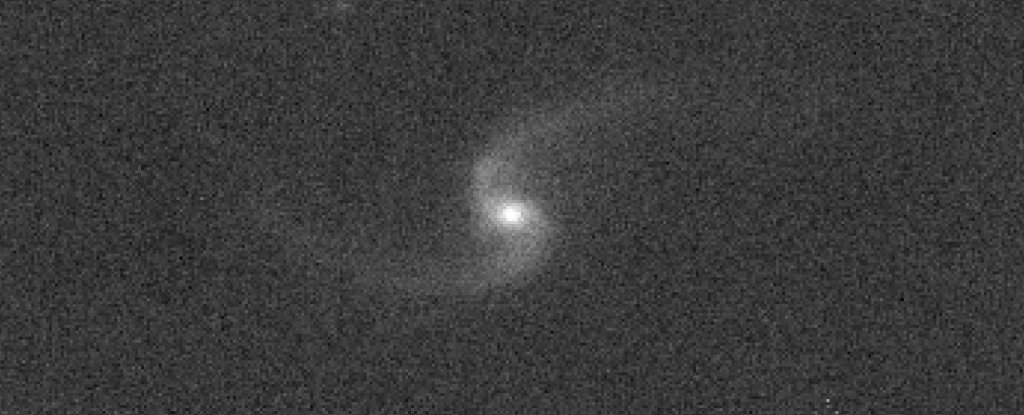
And, based on initial analysis, there’s a 99 percent chance that it’s a neutron star-black hole kaboom. Even as you read this, scientists are poring over data and staring hard at the sky, looking for the light that may have been left behind by the neutron star as it is absorbed into the black hole.
„It’s like the night before Christmas,” astronomer Ryan Foley of the University of California, Santa Cruz told ScienceAlert. „I’m just waiting to see what’s under the tree.”
Since that amazing first gravitational wave detection – a collision between two stellar mass black holes – was announced in February 2016, the field has been only growing stronger. The technology is so sophisticated it can detect collisions between two neutron stars – objects much less massive than black holes. Both neutron stars and black holes are the ultradense remains of a dead star, but we’ve never seen a black hole smaller than 5 times the mass of the Sun, or a neutron star larger than around 2.5 times the mass of the Sun.
But a collision between a black hole and a neutron star has evaded us. One detection looked like it might have been such an event, earlier this year, but the odds were just 13 percent. And the signal to noise ratio was so low, astronomers didn’t follow it up. That’s not the case with S190814bv. The signal is really strong, and astronomers are excited – if it really is a collision between a neutron star and a black hole, it will be the first time such a binary system has ever been seen.
This would mean that such binary systems, hypothetical until now, are indeed possible. We could even get clues as to their formation – did they form as a binary, living, growing and dying together? Or did the black hole capture a passing neutron star into its orbit? Believe it or not, we can learn that from the gravitational wave signal – ripples in spacetime caused by a massive collision, like a rock dropped in a pond – if it’s strong enough. Clues to the formation of the binary are encoded in the waveform, along with the masses of the individual objects, their velocity and acceleration.
„From the gravitational wave signal, one can get information about the spins of the individual objects and their orientation compared with the axis to the orbit,” physicist Peter Veitch from the University of Adelaide in Australia and OzGrav (the Australian branch of the LIGO Scientific Collaboration) told ScienceAlert. „[We’re] looking to see whether the rotational spin of the individual objects are aligned with each other, which might suggest that they were initially in a binary system. Whereas if one compact object was captured by another as galaxies merged, for example, then you might expect these objects have different spins pointing in different directions.”
Foley and his colleagues are currently using the Keck Observatory to study a galaxy around 900 million light-years away. That’s where they think the signal might have originated. They’re looking for electromagnetic radiation that might result from the collision involving a neutron star and of course, there’s the burning question: what do neutron star guts look like?
„We would love to observe a black hole ripping a neutron star apart as they come together,” says theoretical physicist Susan Scott of the Australian National University and OzGrav. „This would give us vital information about the material which makes up the densest stars in the Universe – neutron stars – which remains a very big open question in the field.”
If there’s no electromagnetic radiation detected, that could mean astronomers are simply looking in the wrong place. Or it could mean that the electromagnetic radiation is too weak to be detected. It could also mean a neutron star isn’t involved – which would be very interesting, because the signal suggests that the smaller object is less than three times the mass of the Sun. If it’s not a neutron star, it might instead be the smallest black hole we’ve ever detected.
Or it could mean that the dynamics between a neutron star and a black hole as they smoosh together into a slightly bigger black hole are even weirder than we knew.
„My favourite way to think about it (for the moment) is that if a black hole is much more massive than a neutron star, then when they merge, the neutron star will be torn apart inside the event horizon of the black hole! In that case, even if there’s plenty of light generated, none will escape the black hole for us to see,” Foley told ScienceAlert. „That is about as close to science fiction as you get.”

Astronomia a marcat o nouă victorie în elucidarea misterului valurilor gravitaționale. Undele gravitaționale au fost detectate în cazul unui tip de coliziune cosmică niciodată văzută până acum- fuziunea evazivă dintre o gaură neagră și o stea cu neutroni. Evenimentul, numit S190814bv, a fost detectat de interferometrele LIGO și Virgo pe 14 august ora 9 și 11 minute UTC.
(imaginea principală a articolului)
Și, pe baza analizei inițiale, există șanse de 99 la sută ca acesta să fie un kaboom a unei gauri neagre cu o stea neutronică. Chiar în timp ce citiți acest lucru, oamenii de știință se aruncă peste date și se uită din greu la cer, căutând lumina care poate a fost lăsată în urmă de steaua neutronică, pe măsură ce este absorbită în gaura neagră.
„Este ca noaptea dinainte de Crăciun”, a spus astronomul Ryan Foley de la University of California, Santa Cruz. „Abia aștept să văd ce se află sub brad.”
De când a fost anunțată acea primă uimitoare detectare a undelor gravitaționale – o coliziune între două găuri stelare de masă neagră – în februarie 2016, câmpul a crescut mai puternic. Tehnologia este atât de sofisticată încât poate detecta coliziuni între două stele de neutroni – obiecte mult mai puțin masive decât găurile negre. Atât stelele neutronice, cât și găurile negre sunt rămășițele ultradense ale unei stele moarte, dar nu am văzut niciodată o gaură neagră mai mică de 5 ori decât Soarele, sau o stea cu neutroni mai mare cu aproximativ 2,5 ori mai mult decât masa Soarelui.
Dar o coliziune între o gaură neagră și o stea cu neutroni ne-a dat pe spate. O detectare părea să fi fost un astfel de eveniment, la începutul acestui an, dar șansele au fost de doar 13 la sută. Și raportul semnal la zgomot a fost atât de scăzut, astronomii nu l-au putut urmări. Nu este cazul S190814bv. Semnalul este cu adevărat puternic, iar astronomii sunt încântați – dacă este într-adevăr o coliziune între o stea cu neutroni și o gaură neagră, va fi prima dată când a fost văzut un astfel de sistem binar.
Aceasta ar însemna că astfel de sisteme binare, ipotetice până acum, sunt cu adevărat posibile. Am putea chiar obține indicii cu privire la formarea lor – s-au format ca un binar, trăind, crescând și murind împreună? Sau gaura neagră a capturat o stea neutronică care trecea pe lângă orbita sa? Credeți sau nu, putem afla din semnalul valului gravitațional – ondulații în spațiu-timp cauzate de o coliziune masivă, precum o rocă căzută într-un iaz – dacă este suficient de puternică. Indiciile pentru formarea binarului sunt codificate în forma de undă, împreună cu masele obiectelor individuale, viteza și accelerația acestora.
„Din semnalul de unde gravitaționale, se pot obține informații despre rotirile obiectelor individuale și orientarea lor în comparație cu axa către orbită”, a declarat fizicianul Peter Veitch de la Universitatea Adelaide din Australia și OzGrav (filiala australiană a LIGO Științific) a declarat pentru ScienceAlert. „[Cautăm] să vedem dacă rotirea, spinul, obiectelor individuale este aliniată între ele, ceea ce ar putea sugera că acestea au fost inițial într-un sistem binar. În timp ce dacă un obiect compact a fost capturat de altul, în timp ce galaxiile s-au contopit, de exemplu , atunci este posibil să vă așteptați ca aceste obiecte să aibă rotiri diferite orientate în direcții diferite. ”
Foley și colegii săi folosesc în prezent Observatorul Keck pentru a studia o galaxie aflată la aproximativ 900 de milioane de ani lumină. Acolo cred că s-a produs semnalul. Caută radiații electromagnetice care ar putea rezulta în urma coliziunii care implică o stea cu neutroni și, desigur, există întrebarea arzătoare: cum arată mațele unei stele neutronice?
„Ne-ar plăcea să observăm o gaură neagră care sfâșie o stea cu neutroni în timp ce se ciocnesc”, spune fizicianul teoretician Susan Scott, de la Universitatea Națională din Australia și OzGrav. „Acest lucru ne-ar oferi informații vitale despre materialul care formează cele mai dense stele din Univers – stele neutronice – care rămâne o foarte mare întrebare deschisă în domeniu.”
Dacă nu este detectată radiația electromagnetică, asta ar putea însemna că astronomii se uită pur și simplu într-un loc nepotrivit. Sau ar putea însemna că radiația electromagnetică este prea slabă pentru a fi detectată. Poate însemna, de asemenea, că nu este implicată o stea cu neutroni – ceea ce ar fi foarte interesant, deoarece semnalul sugerează că obiectul este mic, doar de trei ori mai mare decât masa Soarelui. Dacă nu este o stea cu neutroni, ar putea fi în schimb cea mai mică gaură neagră pe care am detectat-o vreodată.
Sau ar putea însemna că dinamica dintre o stea cu neutroni și o gaură neagră este chiar mai ciudată decât știam.
„Modul meu preferat de a mă gândi la asta (deocamdată) este că, dacă o gaură neagră este mult mai masivă decât o stea neutronică, atunci când se contopesc, steaua neutronică va fi sfâșiată în interiorul orizontului de eveniment al găurii negre! În acel caz, chiar dacă există o mulțime de lumină generată, nimic nu va scăpa din gaura neagră pentru ca și noi să vedem „, a declarat Foley pentru ScienceAlert. „E aproape sci-fi!”.
***

 Mihail stories