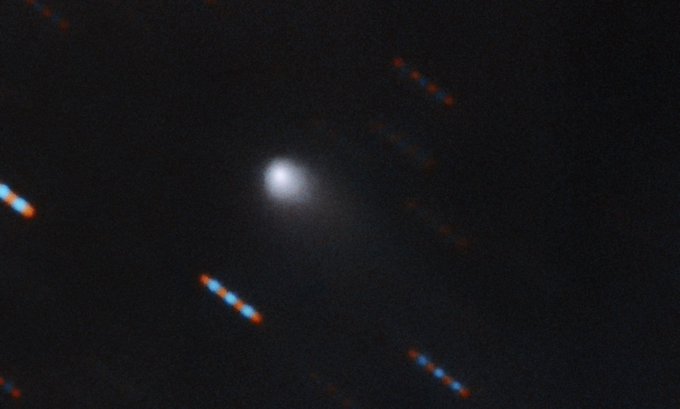
On August 30th, amateur astronomer Gennady Borisov spotted a comet of extrasolar origin passing through our Solar System. This is the second time in as many years that an interstellar object has been observed (the last being ‘Oumuamua 2.0 in 2017). Thanks to the Gemini Observatory, we now have pictures of this comet, making it the first object of its kind to be successfully imaged in multiple colors!
The comet, designated C/2019 Q4 (Borisov), was captured by the Gemini North Telescope’s Gemini Multi-Object Spectrograph on the night of September 9-10th. The image showed a very pronounced tail, which is indicative of outgassing and confirms that the object is a comet. This is another first, where C/2019 Q4 is the first interstellar visitor to clearly form a tail as a result of outgassing.

Andrew Stephens, an astronomer with the Gemini Observatory, was responsible for coordinating the observations. As he explained:
“This image was possible because of Gemini’s ability to rapidly adjust observations and observe objects like this, which have very short windows of visibility. However, we really had to scramble for this one since we got the final details at 3:00 am and were observing it by 4:45!”
The color image was produced by combining the Gemini observations, which were taken in two color bands. These were obtained as part of a project led by Piotr Guzik and Michal Drahus at the Jagiellonian University in Krakow (Poland), which seeks to capture images of astronomical “targets of opportunity”.
At present, C/2019 Q4 is close to the apparent position of the Sun and is therefore difficult to observe. Over the next few months, its hyperbolic flight path will bring it to more favorable observing conditions. It is this same path that led astronomers to conclude that it is likely to be interstellar in origin, and follow-up observations are expected to reveal more about its composition.

Since asteroids and comets are believed to be leftover material from the formation of a system, knowing what this comet is composed of will allow astronomers to learn a great deal about where it came from. This is one of the greatest benefits of interstellar objects, in that they allow us to learn more about distant star systems without actually having to send robotic spacecraft there.
In the case of C/2019 Q4, astronomers also have the benefit of knowing about it in advance. When ‘Oumuamua was first detected, it had already made its closest pass to the Sun and flew by Earth on its way out of the Solar System. In other words, the most opportune times to study it had largely passed by the time it was spotted.
And if there is even the slightest chance that this interstellar visitor is an extra-terrestrial probe (as was suggested about ‘Oumuamua), then future studies will reveal far more than we ever expected! But let’s not get ahead of ourselves here…

Pe 30 august, astronomul amator Gennady Borisov a descoperit o cometă de origine extrasolară care trecea prin sistemul nostru solar. Aceasta este a doua oară în tot atâția ani în care a fost observat un obiect interstelar (ultimul fiind „Oumuamua” 2.0 în 2017). Datorită Observatorului Gemeni, avem acum imagini cu această cometă, ceea ce o face primul obiect de acest fel care a fost fotografiat în culori, cu succes!
Cometa, denumită C / 2019 Q4 (Borisov), a fost capturată de Gemini Multi-Object Spectrograph de la Telescopul Nord Gemeni în noaptea de 9-10 septembrie. Imaginea arăta o coadă foarte pronunțată, ceea ce confirmă faptul că obiectul este o cometă. Acesta este un alt prim, în care C / 2019 Q4 este primul vizitator interstelar care formează clar o coadă ca urmare a emanației de gaze.
Andrew Stephens, astronom cu Observatorul Gemeni, a fost responsabil pentru coordonarea observațiilor. După cum a explicat:
„Această imagine a fost posibilă datorită capacității Gemenilor de a ajusta rapid observațiile și de a observa obiecte ca acestea, care au ferestre de vizibilitate foarte scurte. Cu toate acestea, a trebuit cu adevărat să ne căutăm pentru asta, deoarece am obținut detaliile la 3:00 am și am observat-o până la 4:45! ”
Impresia de culoare a fost produsă prin combinarea observațiilor Gemenilor, care au fost luate în două benzi de culori. Acestea au fost obținute ca parte a unui proiect condus de Piotr Guzik și Michal Drahus la Universitatea Jagiellonian din Cracovia (Polonia), care urmărește să surprindă imagini cu „ținte ale oportunității” astronomice.
În prezent, C / 2019 Q4 este aproape de poziția aparentă a Soarelui și, prin urmare, este greu de observat. În următoarele câteva luni, traseul său de zbor hiperbolic o va aduce în zone de observare mai favorabile. Aceasta este aceeași cale care i-a determinat pe astronomi să concluzioneze că este probabil să fie de origine interstelară și se așteaptă că observațiile ulterioare vor dezvălui mai multe despre compoziția sa.
Deoarece se crede că asteroizii și cometele sunt materiale rămase de la formarea unui sistem solar, știind din ce este compusă această cometă va permite astronomilor să învețe foarte multe despre locul din care a venit. Acesta este unul dintre cele mai mari beneficii ale obiectelor interstelare, prin faptul că ne permit să aflăm mai multe despre sistemele de stele îndepărtate, fără a fi nevoie să trimitem acolo nave spațiale robotizate.
În cazul C / 2019 Q4, astronomii au, de asemenea, avantajul de a ști despre aceasta în avans. Când „Oumuamua” a fost detectată pentru prima oară, ea își făcuse deja trecerea pe lângă Soare depășise Pământul și se îndrepta spre ieșirea din Sistemul Solar. Cu alte cuvinte, momentele cele mai potrivite pentru studierea ei au trecut în mare măsură față de momentul în care a fost observată.
Și dacă există chiar și cea mai mică șansă ca acest vizitator interstelar să fie o sondă extraterestră (așa cum a fost sugerat despre „Oumuamua”), atunci viitoarele studii vor dezvălui mult mai mult decât ne-am fi așteptat vreodată! Dar să nu anticipăm …
***

 Mihail stories