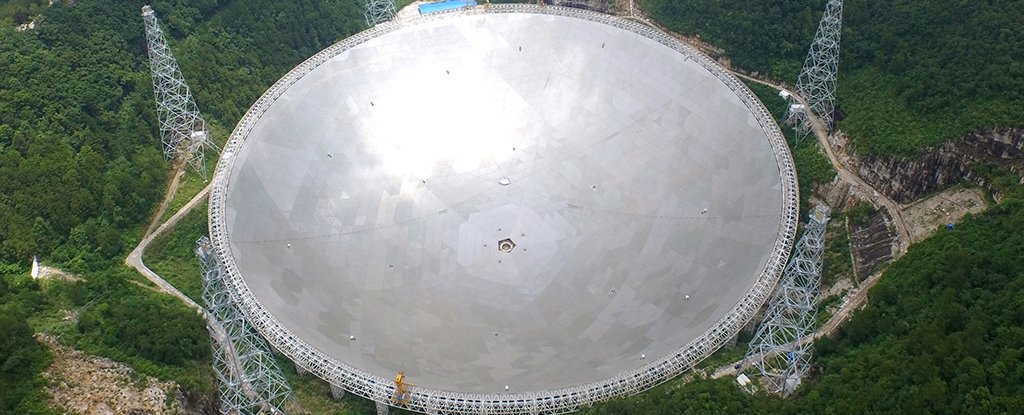

Vă amintiți, presupun, de acel spectaculos telescop de dimensiuni gigantice ascuns într-o vale înconjurată de munți în China, din urmă cu câțiva ani? Ei bine, Five-hundred-meter Aperture Spherical Radio Telescope (FAST) a recepționat un semnal spațial misterios cunoscut sub numele de explozie radio rapidă.
Exploziile radio rapide sau FRB sunt impulsuri de energie scurte, dar puternice, sosite din cele mai îndepărtate adâncimi ale cosmosului. Primul a fost reperat în 2007 și, de atunci, am descoperit din ce în ce mai multe.
Deși astronomii au făcut recent progrese interesante în urmărirea FRB-urilor, pur și simplu nu știm exact ce sunt aceste semnale sau cum au fost produse. Poate că sunt cauzate de găuri negre sau stele de neutroni, numite magnetars.
Ceea ce este interesant în ceea ce privește detectarea de FAST este faptul că această explozie rapidă de unde radio este un semnal repetitiv. Explozia este cunoscută oficial sub denumirea de FRB 121102: înregistrată pentru prima dată în 2012 la Observatorul Arecibo din Puerto Rico, și a apărut de atunci de mai multe ori .
Cercetătorii remarcă faptul că semnalul a parcurs aproximativ 3 miliarde de ani-lumină prin Univers pentru a ajunge până la noi.
FAST s-a fixat pe FRB 121102 pe 30 august, înainte de a înregistra zeci de impulsuri ulterioare (în ziua de 3 septembrie, au fost detectate peste 20 de impulsuri). Deci, acesta pare a fi un FRB deosebit de persistent.
The 19-beam receiver de pe FAST este deosebit de sensibil la semnalele radio, acoperind intervalul de frecvență de 1.05-1.45 GHz, ceea ce îl face perfect pentru a-l urmări pe FRB 121102.
Cu cât putem face mai multe observații cu privire la aceste FRB, cu atât cresc șansele noastre de a reuși să rezolvăm dilema a ceea ce sunt. O idee ar fi că FRB sunt produse de dezintegrarea crustelor anumitor tipuri de stele neutronice.
O altă ipoteză susține că diferite FRB au de fapt cauze diferite, ceea ce poate explica de ce se repetă FRB 121102, iar altele nu par să facă acest lucru. Măcar acum putem să identificăm de unde provin aceste explozii misterioase de radiații electromagnetice.
Putem adăuga datele culese de FAST la baza noastră de date în creștere cu cunoștințe despre aceste fenomene spațiale atât de intrigante. Echipa de astronomi a reușit deja să elimine interferențele produse de aeronave și sateliți din măsurătorile lor.
„Cred că este atât de uimitor că natura produce ceva de genul acesta”, a spus fizicianul Ziggy Pleunis de la Universitatea McGill, pentru ScienceAlert, după ce a ajutat la detalierea a opt noi FRB-uri într-o lucrare publicată luna trecută.
„De asemenea, cred că există o informație foarte importantă în acea structură, pe care trebuie doar să vedem cum să o decodificăm și este foarte distractiv să încercăm să ne dăm seama exact care este aceasta.”
***

 Mihail stories