Japan’s Hayabusa 2 mission to asteroid Ryugu has reached one of its final milestones, if not its climax. The sample-return spacecraft has launched the Minerva-II2 rover at the asteroid. This is the last of four rovers that Hayabusa 2 is deploying on Ryugu.
Minerva-II2 is actually two components in one, and the launch procedure has distinct phases.
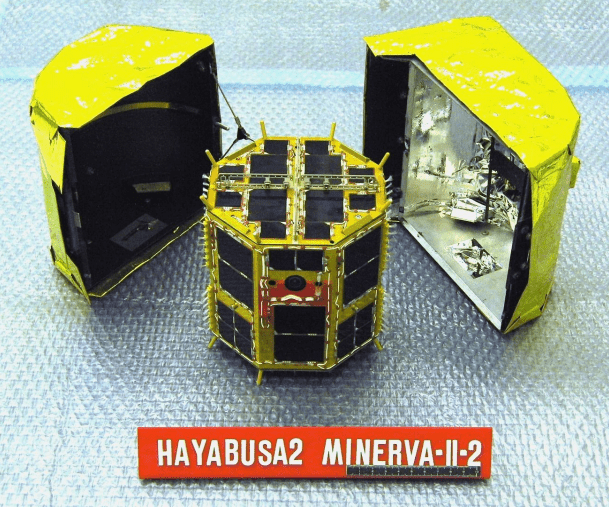
Minerva-II2 is an octagonal-prism shaped container that holds the actual rover, named Rover 2. The container only weights about 1 kg (2.2 lbs) and carries an accelerometer, a thermometer, and dual cameras. It also has both optical and ultraviolet LEDs.
Hayabusa 2 launched Minerva-II2 on September 28th from an altitude of about 20km, and the container descended slowly. At 1 km altitude, Rover 2 separated from the Minerva-II2 container. At that point, Rover 2 continued on its way to Ryugu’s surface, while Hayabusa 2 followed it part way. Hayabusa 2 is now climbing to an observing height of about 10 km to watch Rover 2’s descent.
By October 8th, Rover 2 should land.
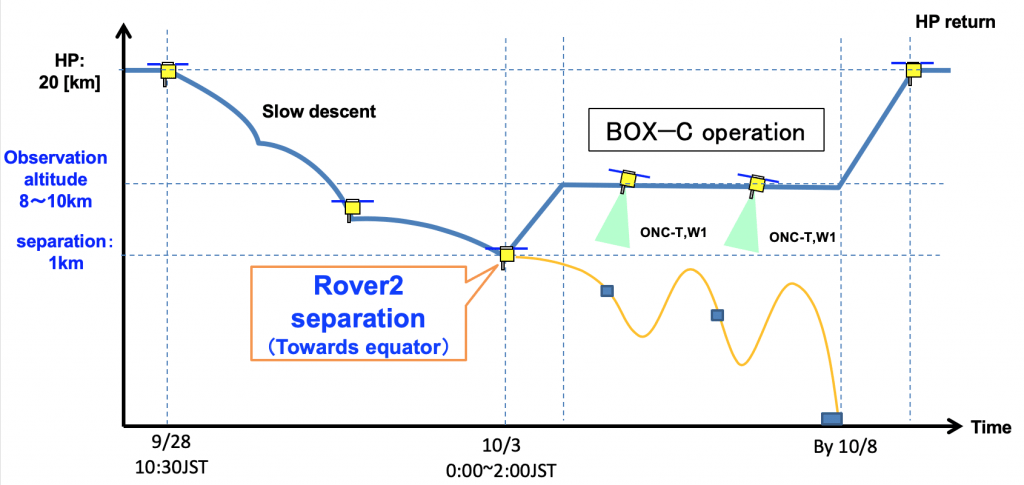
Rover 2 is slightly different from the other rovers on Hayabusa 2. It was developed by a consortium of Japanese universities. It’s different from Minerva-II1 because its primary goal was to confirm navigation around a low-mass, low-gravity body like Ryugu. That’s why it was deployed from a much higher altitude then Minerva-II1, (1 km vs 50 meters) and that ‘s why Hayabusa is watching its long, slow descent from about 10 km (6.2 miles) away.
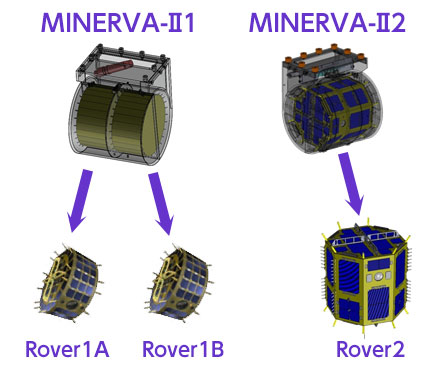
The rover itself, Rover 2, was added as an ‘outreach payload’ for Japanese Universities, according to JAXA. But there might be a problem.
According to JAXA, Rover 2’s CPU might be experiencing problems, and may not be able to communicate data back to Hayabusa 2 from the surface of Ryugu. JAXA is deploying it anyway, since its descent to Ryugu is a significant part of its mission.
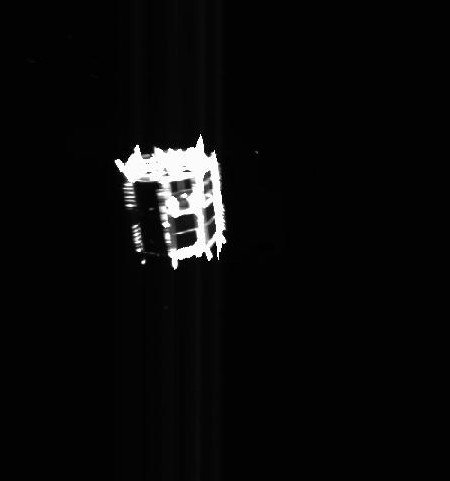
JAXA tweeted a picture of Minerva-II2 after separation. They also tweeted a photo of the team at mission control celebrating the moment.
Now it’s a waiting game. By October 8th we should know if Rover 2 landed successfully, and if it’s transmitting data properly. If it is, it’s another achievement in this important mission to understand ancient asteroids and what they can teach us about planet formation in the early Solar System.

The big prize is the asteroid samples, though. Hayabusa 2 is primarily a sample-return mission. Those samples have been collected, both surface and sub-surface, and they’ll be returned to Earth in December 2020.

Misiunea japoneză Hayabusa 2 cu destinație asteroidul Ryugu a atins una dintre etapele sale finale, dacă nu chiar punctul culminant. Nava spațială a lansat roverul Minerva-II2 spre asteroid. Acesta este ultimul rover pe care Hayabusa 2 îl lansează cu destinația Ryugu.
Minerva-II2 are în componență două piese distincte, iar procedura de lansare are două faze diferite.
Minerva-II2 este un container în formă de prismă octogonală care deține rover-ul propriu, numit Rover 2. Containerul cântărește doar aproximativ 1 kg și poartă un accelerometru, un termometru și camere duale. De asemenea, are LED-uri în spectrul optic și ultraviolet.
Hayabusa 2 a lansat Minerva-II2 pe 28 septembrie de la o altitudine de aproximativ 20 km, iar containerul a coborât încet. La 1 km altitudine, Rover 2 s-a separat de containerul Minerva-II2. În acel moment, Rover 2 a continuat drumul spre suprafața lui Ryugu. Hayabusa 2 urcă acum până la o înălțime de aproximativ 10 km pentru a urmări coborârea lui Rover 2.
Până pe 8 octombrie, Rover 2 ar trebui să aterizeze.
Rover 2 este ușor diferit de celelalte rover de pe Hayabusa 2. El a fost dezvoltat de un consorțiu de universități japoneze. Este diferit de Minerva-II1, deoarece obiectivul său principal era să confirme navigarea în jurul unui corp cu masă redusă, cu o gravitație scăzută, precum Ryugu. Acesta este motivul pentru care a fost ejectat de la o altitudine mult mai mare decât Minerva-II1 (1 km față de 50 de metri) și de aceea Hayabusa urmărește coborârea lungă și lentă de la aproximativ 10 km (6,2 mile).
Rover în sine, Rover 2, a fost adăugat ca o „sarcină utilă de informare” pentru universitățile japoneze, potrivit JAXA. Dar ar putea exista o problemă.
Potrivit JAXA, este posibil ca CPU-ul Rover 2 să aibă probleme și să nu poată comunica date înapoi la Hayabusa 2 de pe suprafața Ryugu. JAXA îl desfășoară oricum, deoarece descendența sa către Ryugu este o parte semnificativă a misiunii sale.
Acum este un joc de așteptare. Până la 8 octombrie, ar trebui să știm dacă Rover 2 a aterizat cu succes și dacă transmite corect datele. Dacă da, atunci aceasta este o altă realizare în această misiune importantă de a înțelege asteroizii antici și ce ne pot învăța despre formarea planetei în sistemul solar timpuriu.
Marele premiu vor fi mostrele culese de pe asteroid. Hayabusa 2 este în primul rând o misiune de retur-probă. Eșantioanele respective au fost colectate atât la suprafață, cât și din adâncime și vor fi returnate pe Pământ în decembrie 2020.
***

 Mihail stories