NASA is currently working on the first practical field test toward the possibility of faster than light travel.
Traveling faster than light has always been attributed to science fiction, but that all changed when Harold White and his team at NASA started to work on and tweak the Alcubierre Drive. Special relativity may hold true, but to travel faster or at the speed of light we might not need a craft that can travel at that speed. The solution might be to place a craft within a space that is moving faster than the speed of light! Therefore the craft itself does not have to travel at the speed of light from it’s own type of propulsion system.
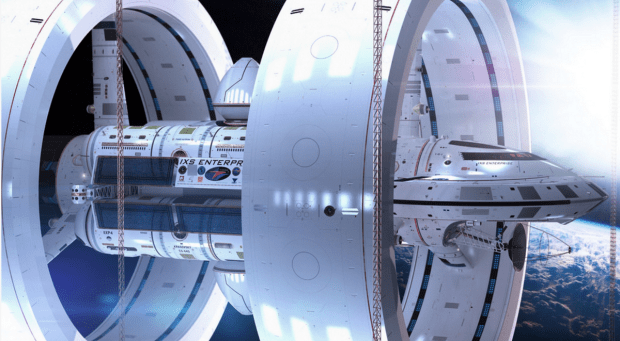
It’s easier to think about if you think in terms of a flat escalator in an airport. The escalator moves faster than you are walking! In this case, the space encompassing the ship would be moving faster than the ship could fly, keeping all the matter of the ship intact. Therefore, we can move faster than light, in a massless cloud of space-time.
What is the Alcubierre Drive? It’s actually based on Einsteins field equations, it suggests that a spacecraft could achieve faster-than-light travel. Rather than exceed the speed of light alone in a craft, a spacecraft would leap long distances by contracting space in front of it and expanding space behind it. This would result in faster than light travel (1). Physicist Miguel Alcubierre was the first that we know to identify this possibility. He described it as remaining still on a flat piece of space-time inside a warp bubble that was made to move at “superluminal” (faster than light) velocity. We must not forget that space-time can be warped and distorted, it can be moved. But what about moving sections of space-time that’s created by expanding space-time behind the ship, and by contracting space-time in front of the ship?
This type of concept was also recently illustrated by Mathematician James Hill and Barry Cox at the University of Adelaide. They published a paper in the journal proceedings of the Royal Society A: Mathematical and Physical Sciences (3).
It was once believed that Einsteins theory of special relativity means that faster than light travel is just not possible. This is a misconception, special relativity simply states that the distance you travel depends on how fast you move, for how long you’re moving for. So if you are driving at 70 mph you will have covered 70 miles in one hour. The confusing part is that, no matter how fast you are moving you will always see the speed of light as being the same. It’s similar to sound, if you close your eyes and imagine that the only sense you have is hearing, you will identify things by how they sound. So if a car is driving at a rapid speed and honks its horn, we know that the horn is always tooting the same tone, it’s just the car’s motion that made it appear to change.
Special relativity also showed us that the atoms and molecules that make up matter are connected by electromagnetic fields, the same stuff light is made up of. The object that would break the light speed barrier is made up of the same stuff as the barrier itself. How can an object travel faster than that which links it’s atoms? This was the barrier.
The only problem with our modern day science is that creating distortions in space-time require energy densities that are not yet possible for humans, or so they say. NASA scientists are currently working on tweaking Alcubierre’s model.
Faster-than-light travel, also known as hyper space or “warp” drive from what the masses know for sure is currently at the level of speculation. Although there is already a lot of evidence that shows it is possible and has already been accomplished, mainstream science is still catching up. We are at the point right now where faster-than-light travel is still theoretical, but possible.
At the same time, we have to look at other factors that are now coming to light. As former NASA Astronaut and Princeton Physics Professor Dr, Brian O’leary Illustrates. This topic has recently had another media explosion and congress recently discussed and looked at evidence for Earth like planets recently found by Kepler Telescopes. Three “super-Earths” to be exact that are most probably teeming with life (4). Furthermore, former congressmen and women recently participated in a citizens hearing on the subject of UFOs a few weeks ago. You can read more about that here. I’ve used this video in many articles before, but it’s just a great clip from when Dr O’leary was still with us.
UFOs and the technology behind it should not be subject to speculation. Odds are we have retrieved some of that technology, or manufactured some ourselves. Some of our science may not be so theoretical after all.
“We now have the technology to take ET home” – Ben Rich
Sources:
http://ntrs.nasa.gov/archive/nasa/casi.ntrs.nasa.gov/20110015936_2011016932.pdf
NASA lucrează în prezent la primul test practic pe teren, cu privire la posibilitatea unei deplasări mai rapide decât viteza luminii.
Călătoria mai repede decât lumina a fost întotdeauna atribuită ficțiunii științifice, dar toate acestea s-au schimbat atunci când Harold White și echipa sa de la NASA au început să lucreze și să regleze unitatea Alcubierre. Relativitatea specială poate fi adevărată, dar pentru a călători mai repede sau cu viteza luminii, s-ar putea să nu avem nevoie de o ambarcațiune care să poată călători cu viteza respectivă. Soluția ar putea fi să amplasăm o ambarcațiune într-un spațiu care se mișcă mai repede decât viteza luminii! Prin urmare, ambarcațiunea în sine nu trebuie să circule cu viteza luminii prin propriul sistem de propulsie.
Este mai ușor să înțelegeți dacă vă gândiți că urcați pe o scară rulantă într-un aeroport. Scara rulantă se mișcă mai repede decât mergeți! În acest caz, spațiul cuprinzând nava s-ar muta mai repede decât ar putea zbura, păstrând intactă toată materia navei. Prin urmare, ne putem mișca mai repede decât lumina, într-un nor fără masă de spațiu-timp.
Ce este Alcubierre Drive? Se bazează de fapt pe ecuațiile lui Einstein, care sugerează că o navă spațială ar putea realiza o călătorie mai rapidă decât lumina. În loc să depășească viteza luminii singură într-o ambarcațiune, o navă spațială ar sări distanțe lungi contractând spațiu în fața ei și extinzând spațiul din spatele ei. Astfel ar rezulta per total o viteză superioară luminii (1). Fizicianul Miguel Alcubierre a fost primul care a identificat această posibilitate. El a descris-o ca rămânând nemișcat într-o bucată de spațiu-timp în interiorul unei bule warp care a fost făcută pentru a se deplasa cu viteza „superluminică” (mai rapidă decât lumina). Nu trebuie să uităm că spațiul-timp poate fi deformat și distorsionat, poate fi mutat. Dar ce se întâmplă cu mutarea secțiunilor de spațiu-timp create prin extinderea spațiului-timp în spatele navei și prin contractarea spațiului-timp în fața navei?
Acest tip de concept a fost, de asemenea, recent ilustrat de matematicianul James Hill și Barry Cox de la Universitatea din Adelaide. Au publicat o lucrare în lucrările jurnalului Royal Society A: Mathematical and Physical Sciences (3).
S-a crezut cândva că teoria relativității speciale a lui Einsteins înseamnă că pur și simplu nu este posibilă călătoria ultraluminoasă. Aceasta este o concepție greșită, relativitatea specială afirmă pur și simplu că distanța pe care o parcurgeți depinde de cât de repede vă deplasați, pentru cât timp vă deplasați. Așadar, dacă veți conduce la 70 km / h, veți fi parcurs 70 km într-o oră. Partea confuză este că, oricât de rapid te miști, vei vedea întotdeauna viteza luminii ca fiind aceeași. Este similar cu sunetul, dacă închideți ochii și vă imaginați că singurul simț pe care îl aveți este auzul, veți identifica lucrurile după cum sună. Așadar, dacă o mașină se deplasează cu viteză rapidă și claxonează știm că claxonul are întotdeauna același ton, și doar mișcarea mașinii a făcut să pară că se schimbă.
Relativitatea specială ne-a arătat, de asemenea, că atomii și moleculele care alcătuiesc materia sunt conectați de câmpuri electromagnetice, din aceeași material din care și lumina este alcătuită. Obiectul care ar rupe bariera de viteză a luminii este format din aceleași lucruri ca bariera în sine. Cum poate un obiect să călătorească mai repede decât cel care leagă atomii? Aceasta a fost bariera.
Singura problemă cu știința noastră modernă este că crearea distorsiunilor în spațiu-timp necesită densități de energie care nu sunt încă posibile pentru oameni, sau așa spun ei. Oamenii de știință NASA lucrează în prezent la modificarea modelului lui Alcubierre.
Călătoria mai rapidă decât lumina, cunoscută și sub denumirea de hiper spațiu sau „warp” se află în prezent la nivelul speculațiilor. Deși există deja o mulțime de dovezi care arată că este posibil și a fost deja realizat, știința mainstream este în continuare în curs de recuperare. Suntem în momentul în care călătoria mai rapidă decât lumina este încă teoretică, dar posibilă.

 Mihail stories