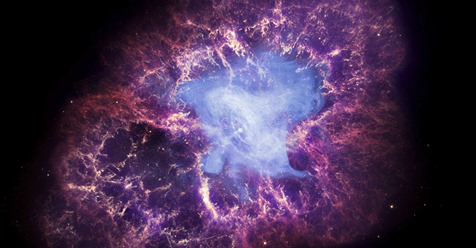
This composite image made available by NASA shows a neutron star, center, left behind by the explosion from the original star’s death in the constellation Taurus, observed on Earth as the supernova of A.D. 1054. This image uses data from three of NASA’s observatories: the Chandra X-ray image is shown in blue, the Hubble Space Telescope optical image is in red and yellow, and the Spitzer Space Telescope’s infrared image is in purple. After nearly two decades in Earth orbit, scanning the universe with infrared eyes, ground controllers plan to put the faltering Spitzer Space Telescope into permanent hibernation on Thursday, Jan. 29, 2020. (X-Ray: NASA/CXC/J.Hester (ASU); Optical: NASA/ESA/J.Hester & A.Loll (ASU); Infrared: NASA/JPL-Caltech/R.Gehrz (Univ. Minn.) via AP)
NASA is pulling the plug on one of its great observatories—the Spitzer Space Telescope—after 16 years of scanning the universe with infrared eyes.
The end comes Thursday when ground controllers put the aging spacecraft into permanent hibernation.
For years, Spitzer peered through dusty clouds at untold stars and galaxies, uncovered a huge, nearly invisible ring around Saturn, and helped discover seven Earth-size planets around a nearby star.
Spitzer’s last observation was expected Wednesday. Altogether, Spitzer observed 800,000 celestial targets and churned out more than 36 million raw images as part of the $1.4 billion mission.
An estimated 4,000 scientists around the world took part in the observations and published nearly 9,000 studies, according to NASA.
„You have to be proud … when you look back and say, ‘Look at the team that’s operating Spitzer, look at the team that’s contributing to having all of this great science,’ ” said project manager Joseph Hunt.
Designed to last just 2.5 years to five years, the telescope got increasingly difficult to operate as it drifted farther behind Earth, NASA said. It currently trails Earth by 165 million miles (265 million kilometers), while orbiting the sun.
NASA shutting down space telescope, infrared eyes to cosmos
This image made available by NASA shows an active stellar nursery containing thousands of young stars and developing protostars, near the sword of the constellation Orion, captured by the Spitzer Space Telescope. (NASA/JPL-Caltech/T. Megeath (University of Toledo, Ohio) via AP)
Spitzer will continue to fall even farther behind Earth, posing no threat to another spacecraft or anything else, officials said.
„Although it would be great to be able to operate all of our telescopes forever, this is not possible,” NASA’s astrophysics director Paul Hertz said in an email.
NASA originally planned to decommission Spitzer a few years ago, but put off its demise as the James Webb Space Telescope, a vastly more elaborate infrared observatory, kept getting delayed.
Webb’s launch is now off until at least early next year. This week, the Government Accountability Office warned of further delays because of technical challenges.
It had been costing NASA about $12 million a year lately to keep Spitzer going. Hertz said with „no guarantee” Spitzer would last until Webb’s launch, the decision was made to shut it down now.
NASA shutting down space telescope, infrared eyes to cosmos
This image made available by NASA shows fledgling stars hidden in the gas and clouds of the Orion nebula, captured by infrared observations from the Spitzer Space Telescope and the European Space Agency’s Herschel mission. In several hundred thousand years, some of the forming stars will accrete enough material to trigger nuclear fusion at their cores. (ESA/NASA/JPL-Caltech/N. Billot (IRAM) via AP)
NASA shutting down space telescope, infrared eyes to cosmos
Launched in 2003, Spitzer was the last of NASA’s four so-called great observatories. With its infrared instruments, it was able to sense heat coming off celestial objects like night vision goggles, said Suzanne Dodd, a former project manager who now oversees NASA’s Deep Space Network at the Jet Propulsion Laboratory in Pasadena, California.
By seeing through dust, „we’re lifting the cosmic veil on the universe,” Dodd said.
Still sending back breathtaking pictures, the Hubble Space Telescope rocketed into orbit in 1990 to observe the cosmos in visible and ultraviolet light; it will celebrate its 30th anniversary in April.
The Compton Gamma Ray Observatory was launched in 1991, but because of equipment failure was destroyed in a fiery re-entry in 2000. The Chandra X-Ray Observatory is still working since its 1999 launch.
Foto: Această imagine compozită pusă la dispoziție de NASA ne arată o stea de neutroni, în centru, rămasă în urma exploziei stelei originale din constelația Taur, observată pe Pământ ca supernova în anul 1054 d.H. Această imagine folosește date de la trei dintre observatoarele NASA: Imaginea cu raze X Chandra este prezentată în albastru, imaginea optică a telescopului spațial Hubble este în roșu și galben, iar imaginea infraroșie a telescopului spațial Spitzer este în violet.
După aproape două decenii pe orbita Pământului, scanând universul cu ochii săi în infraroșu, controlorii de la sol au tras cortina peste telescopul spațial Spitzer trimițându-l în hibernare permanentă joi, 29 ianuarie 2020.
Timp de ani, Spitzer a privit prin norii prăfuiți ai cosmosului la stele și galaxii nevăzute, a descoperit un inel imens, aproape invizibil, în jurul lui Saturn și a ajutat la descoperirea a șapte planete de dimensiunea Pământului în jurul unei stele din apropiere.
Ultima observație a lui Spitzer era așteptată miercuri. În total, Spitzer a observat 800.000 de ținte cerești și a dat peste 36 de milioane de imagini brute ca parte a misiunii de 1,4 miliarde de dolari.
Se estimează că 4.000 de oameni de știință din întreaga lume au luat parte la observații și au publicat aproape 9.000 de studii, potrivit NASA.
„Trebuie să fii mândru … când te uiți înapoi și spui:„ Uită-te la echipa care operează Spitzer, uită-te la echipa care contribuie la a avea toată această știință grozavă ”, a spus managerul de proiect, Joseph Hunt.
Proiectat să dureze doar 2,5 ani până la 5 ani, telescopul a devenit din ce în ce mai dificil de exploatat, deoarece s-a îndepărtat tot mai mult de Pământ, a spus NASA. În prezent, acesta urmărește Pământul cu 165 milioane de mile (265 milioane de kilometri), în timp ce orbitează Soarele.
„Deși ar fi grozav să putem opera toate telescoapele noastre pentru totdeauna, acest lucru nu este posibil”, a declarat directorul de astrofizică al NASA, Paul Hertz, într-un e-mail.
NASA plănuia inițial să dezafecteze Spitzer cu câțiva ani în urmă, dar a renunțat la întrucât Telescopul spațial James Webb, un observator cu infraroșu mult mai elaborat, încă nu este funcțional.
Lansarea Webb este oprită până cel puțin la începutul anului viitor. Săptămâna aceasta, Oficiul de Responsabilitate al Guvernului a avertizat asupra întârzierilor din cauza provocărilor tehnice.
În ultima perioadă costase NASA aproximativ 12 milioane de dolari pe an pentru a-l continua pe Spitzer. Hertz a spus că „fără nicio garanție” Spitzer va dura până la lansarea lui Webb, decizia a fost luată să o închidă acum.
Lansat în 2003, Spitzer a fost ultimul dintre cele patru așa-numite mari observatorii ale NASA. Cu instrumentele sale în infraroșu, a fost capabil să simtă căldura care iese din obiecte cerești precum ochelari de vedere nocturnă, a spus Suzanne Dodd, fost manager de proiect care supraveghează acum rețeaua spațială profundă a NASA la Jet Propulsion Laboratory din Pasadena, California.
Văzând prin praf, „ridicăm vălul cosmic de pe univers”, a spus Dodd.
Încă trimitând înapoi imagini uluitoare, Telescopul spațial Hubble a intrat în orbită în 1990 pentru a observa cosmosul în lumină vizibilă și ultravioletă; își va sărbători cea de-a 30-a aniversare în aprilie.
Observatorul Compton Gamma Ray a fost lansat în 1991, dar din cauza defectării echipamentului a fost distrus într-o reintrare aprinsă în 2000. Observatorul Chandra X-Ray încă funcționează de la lansarea sa din 1999.
***
Publicat de Mihail
Fiind geamăn cu ascendant în săgetător sunt un extrovertit spre coleric de o curiozitate excesivă, perfecționist păgubos, împrăștiat, superficial, agnostic... și nimic din ce-i omenesc nu mi-e străin.
Being a Twin with ascendant in Sagittarius I am an extrovert up the choleric, of an excessive curiosity, a to the bitter end perfectionist, scattered, superficial, agnostic... and nothing that is human is foreign to me.
Vezi toate articolele lui Mihail

 Mihail stories