Three enormous asteroids, up to 100 feet wide, are set to skim past Earth this weekend, NASA has warned.
According to scientists, the largest of the three asteroids, 2018VR1 is up to 100 feet wide, as long as a blue whale.
NASA explains that the three asteroids are set to make close approaches with Earth by Sunday.
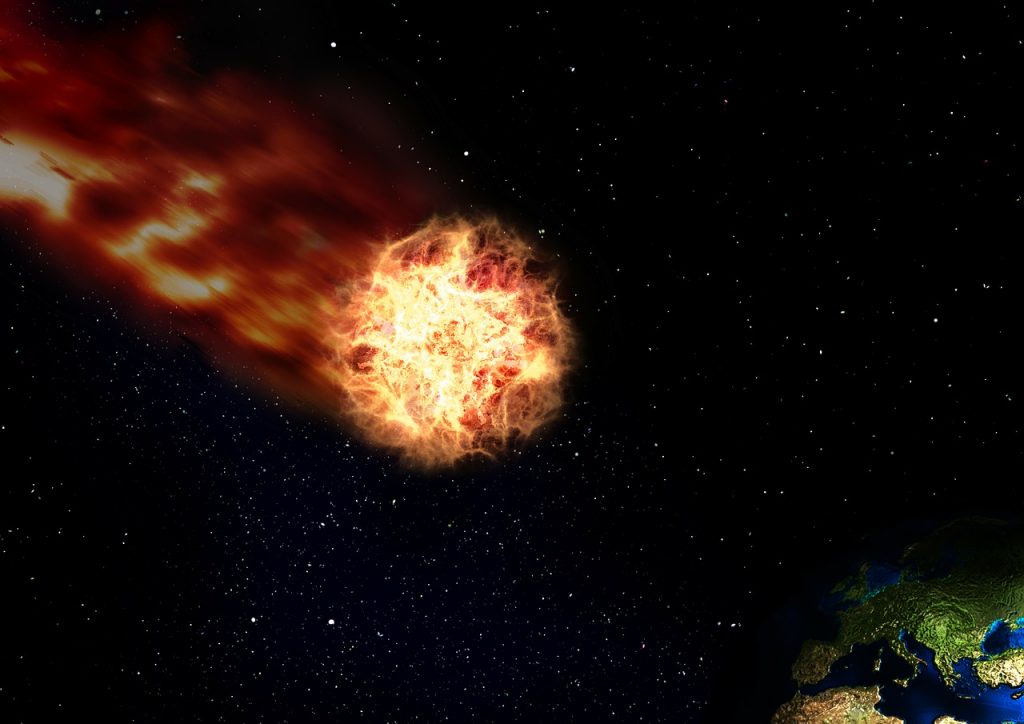
Three enormous asteroids will skim past Earth warns NASA. Image Credit: geralt / Pixabay
Despite the fact they will pass relatively close to Earth, they won’t be visible to the naked eye, and you will need a satellite to see them.
Of the three, the asteroid dubbed as 2018VS1 is expected to pass Earth first, according to calculations from Nasa’s Jet Propulsion Laboratory in California.
2018VS1 will miss Earth by 1,386,771 km, successfully passing us at 2:03pm GMT (9:03am ET) on Saturday, November 10.
The Asteroid is believed to measure between 40 to 90 feet across. According to NASA it won’t collide against Earth.
Sixteen minutes after, at 2:19pm GMT, (9:19am ET), the largest of the three space rocks, 2018 VR1, will fly past Earth.
The calculated trajectory suggests the space rock will pass withing 5 million km from Earth, a reassuring distance given the size of the asteroid.
The third and final flyby this weekend will see asteroid VX1 pass by Earth at a distance of 381,474 km, which is closer to us than the moon. VX1 will skim past Earth at around 6:21pm GMT (13:21 ET) on Saturday.
And despite the fact that some of these asteroids are going to come really close to Earth, NASA has classified their trajectories as close approaches.
NASA’s center for Near Earth Object Studies explains that “As they orbit the Sun, Near-Earth Objects can occasionally approach close to Earth.”
“Note that a ‘close’ passage astronomically can be very far away in human terms: millions or even tens of millions of kilometers.”
În ciuda faptului că vor trece relativ aproape de Pământ, aceştia nu vor fi vizibili cu ochiul liber și veți avea nevoie de o lunetă pentru a îi vedea.
Dintre cei trei, asteroidul numit 2018VS1 va trece mai întâi pe Pământ, potrivit calculelor de la Laboratorul de Propulsie Jet din Nasa, din California.
2018VS1 va rata Pământul cu 1.386.771 km, la 2:03 pm GMT (9:03 am ET) sâmbătă, 10 noiembrie.
Se crede că Asteroidul măsoară între 40 și 90 de metri. Conform NASA, acesta nu se va ciocni cu Pământul.
Șaisprezece minute după, la ora 14:19 GMT, (9:19 am ET), cea mai mare dintre cele trei roci spațiale, VR1 2018, va zbura pe lângă Pământ.
Traiectoria calculată sugerează că roca spațială va trece cu 5 milioane de km față de Pământ, o distanță liniștitoare având în vedere dimensiunea asteroidului.
Al treilea din acest weekend va fi asteroidul VX1 trecând pe Pământ la o distanță de 381.474 km, care este mai aproape de noi decât luna. VX1 va trece pe lângă Pământ în jurul orei 18:21 GMT (13:21 ET) sâmbătă.
Și în ciuda faptului că unii dintre acești asteroizi se vor apropia cu adevărat de Pământ, NASA și-a clasificat traiectoriile ca fiind abordări apropiate.
Centrul NASA pentru Studiile Obiectelor Aproape de Pământ explică faptul că „Pe măsură ce orbitează Soarele, Obiectele se pot apropia ocazional de aproape de Pământ”.
„Rețineți că un pasaj„ aproape ”din punct de vedere astronomic poate fi foarte departe în termeni umani: milioane sau chiar zeci de milioane de kilometri.”
Publicat de Mihail
Fiind geamăn cu ascendant în săgetător sunt un extrovertit spre coleric de o curiozitate excesivă, perfecționist păgubos, împrăștiat, superficial, agnostic... și nimic din ce-i omenesc nu mi-e străin.
Being a Twin with ascendant in Sagittarius I am an extrovert up the choleric, of an excessive curiosity, a to the bitter end perfectionist, scattered, superficial, agnostic... and nothing that is human is foreign to me.
Vezi toate articolele lui Mihail

 Mihail stories