
Even though we are led to believe that during the Cretaceous the Earth used to be an exclusive home for fearsome giants, including carnivorous velociraptors and arthropods larger than a modern adult human, it turns out that there was still room for harmless minute invertebrates measuring only several millimetres.
Such is the case of a tiny millipede of only 8.2 mm in length, recently found in 99-million-year-old amber in Myanmar. Using the latest research technologies, the scientists concluded that not only were they handling the first fossil millipede of the order (Callipodida) and also the smallest amongst its contemporary relatives, but that its morphology was so unusual that it drastically deviated from its contemporary relatives.
As a result, Prof. Pavel Stoev of the National Museum of Natural History (Bulgaria) together with his colleagues Dr. Thomas Wesener and Leif Moritz of the Zoological Research Museum Alexander Koenig (Germany) had to revise the current millipede classification and introduce a new suborder. To put it in perspective, there have only been a handful of millipede suborders erected in the last 50 years. The findings are published in the open-access journal ZooKeys
To analyse the species and confirm its novelty, the scientists used 3D X-ray microscopy to ‘slice’ through the Cretaceous specimen and look into tiny details of its anatomy, which would normally not be preserved in fossils. The identification of the millipede also presents the first clue about the age of the order Callipodida, suggesting that this millipede group evolved at least some 100 million years ago. A 3D model of the animal is also available in the research article.
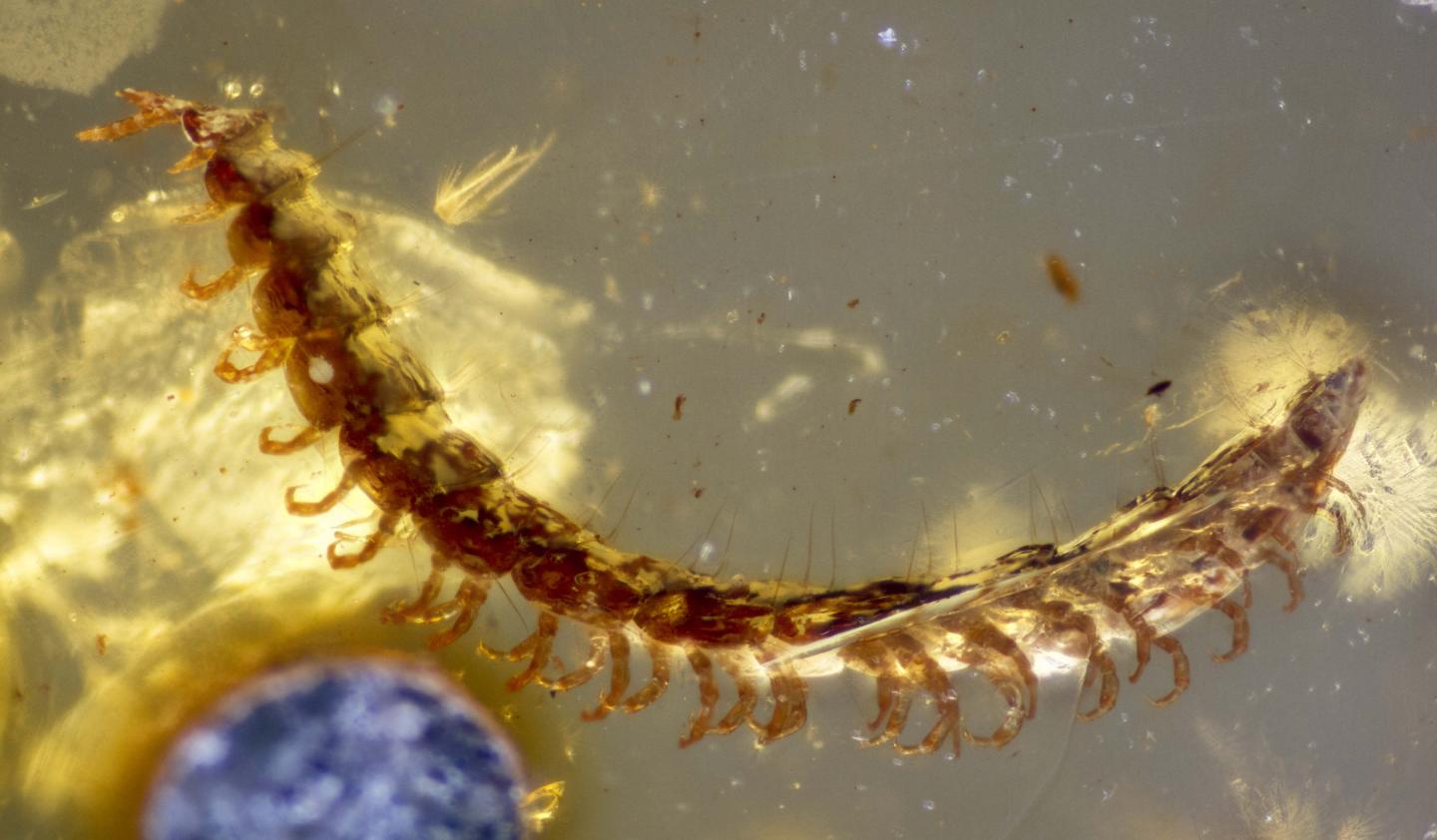
Curiously, the studied arthropod was far from the only one discovered in this particular amber deposit. On the contrary, it was found amongst as many as 529 millipede specimens, yet it was the sole representative of its order. This is why the scientists named it Burmanopetalum inexpectatum, where “inexpectatum” means “unexpected” in Latin, while the generic epithet (Burmanopetalum) refers to the country of discovery (Myanmar, formerly Burma).
Lead author Prof. Pavel Stoev says:
We were so lucky to find this specimen so well preserved in amber! With the next-generation micro-computer tomography (micro-CT) and the associated image rendering and processing software, we are now able to reconstruct the whole animal and observe the tiniest morphological traits which are rarely preserved in fossils. This makes us confident that we have successfully compared its morphology with those of the extant millipedes. It came as a great surprise to us that this animal cannot be placed in the current millipede classification. Even though their general appearance have remained unchanged in the last 100 million years, as our planet underwent dramatic changes several times in this period, some morphological traits in Callipodida lineage have evolved significantly.
Co-author Dr. Thomas Wesener adds:
“We are grateful to Patrick Müller, who let us study his private collection of animals found in Burmese amber and dated from the Age of Dinosaurs. His is the largest European and the third largest in the world collection of the kind. We had the opportunity to examine over 400 amber stones that contain millipedes. Many of them are now deposited at the Museum Koenig in Bonn, so that scientists from all over the world can study them. Additionally, in our paper, we provide a high-resolution computer-tomography images of the newly described millipede. They are made public through MorphBank, which means anyone can now freely access and re-use our data without even leaving the desk.”

Leading expert in the study of fossil arthropods Dr. Greg Edgecombe (Natural History Museum, London) comments:
“The entire Mesozoic Era — a span of 185 million years — has until now only been sampled for a dozen species of millipedes, but new findings from Burmese amber are rapidly changing the picture. In the past few years, nearly all of the 16 living orders of millipedes have been identified in this 99-million-year-old amber. The beautiful anatomical data presented by Stoev et al. show that Callipodida now join the club.”
Chiar dacă suntem învățați că, în timpul Cretaceului, Pământul era locul exclusiv pentru uriași înfricoșători, incluzând velocirapioanele carnivore și artropodele mai mari decât un om adult adult, se dovedește că mai exista loc și pentru nevertebrate minute inofensive care măsoară doar câteva milimetri.
Acesta este cazul unui mic miliped de numai 8,2 mm lungime, găsit recent în chihlimbarul vechi de 99 de milioane de ani din Myanmar. Folosind cele mai noi tehnologii de cercetare, oamenii de știință au ajuns la concluzia că, nu numai că se ocupau de prima milipedă fosilă a ordinului (Callipodida) ci, de asemenea, de cea mai mică dintre rudele sale contemporane, dar că morfologia sa a fost atât de neobișnuită încât s-a abătut drastic de rudele sale contemporane.
Drept urmare, prof. Pavel Stoev de la Muzeul Național de Istorie Naturală (Bulgaria) împreună cu colegii săi Dr. Thomas Wesener și Leif Moritz de la Muzeul de Cercetare Zoologică Alexander Koenig (Germania) au fost nevoiți să revizuiască clasificarea milipedă actuală și să introducă un nou subordin. Pentru a înțelege, au existat doar o mână de subordine milipede descoperite în ultimii 50 de ani. Rezultatele sunt publicate în jurnalul ZooKeys
Pentru a analiza specia și a confirma noutatea ei, oamenii de știință au folosit microscopia cu raze X 3D pentru a „tăia” prin exemplarul cretacic și a analiza detalii minuscule ale anatomiei sale, care în mod normal nu ar fi păstrate în fosile. Identificarea milipedeului prezintă, de asemenea, primul indiciu despre vârsta speciei Callipodida, sugerând că acest grup de milipede a evoluat în urmă cu cel puțin aproximativ 100 de milioane de ani. Un model 3D al animalului este de asemenea disponibil în articolul de cercetare.
Curios, artropodul studiat nu a fost singurul descoperit în acest depozit de chihlimbar. Dimpotrivă, a fost găsit printre 529 de exemplare milipede, dar a fost singurul reprezentant al ordinului său. Acesta este motivul pentru care oamenii de știință au numit-o Burmanopetalum inexpectatum, unde „inexpectatum” înseamnă „neașteptat” în latină, în timp ce epitetul generic (Burmanopetalum) se referă la țara descoperirii (Myanmar, fostul Birman).
Autorul principal al studiului, prof. Pavel Stoev, spune:
Am fost atât de norocoși să găsim acest exemplar atât de bine păstrat în chihlimbar! Cu ajutorul tomografiei (micro-CT) de ultimă generație și a software-ului de redare și procesare a imaginilor asociate, suntem acum capabili să reconstruim întregul animal și să observăm cele mai mici trăsături morfologice care sunt rareori păstrate în fosile. Acest lucru ne face să fim siguri că am comparat cu succes morfologia acesteia cu cele ale milipedelor existente. A fost o mare surpriză pentru noi că acest animal nu poate fi plasat în clasamentul actual al milipedeului. Chiar dacă aspectul general al acestora a rămas neschimbat în ultimii 100 de milioane de ani, întrucât planeta noastră a suferit modificări dramatice de mai multe ori în această perioadă, unele trăsături morfologice ale liniei Callipodida au evoluat semnificativ.
Coautorul Dr. Thomas Wesener adaugă:
„Suntem recunoscători lui Patrick Müller, care ne-a lăsat să studiem colecția sa privată de animale găsite în chihlimbarul birman și datate din epoca dinozaurilor. Acesta este cea mai mare colecție europeană și a treia ca mărime din colecțiile mondiale de acest fel. Am avut ocazia să examinăm peste 400 de pietre chihlimbar care conțin milipede. Multe dintre ele sunt acum depuse la Muzeul Koenig din Bonn, pentru ca oamenii de știință din întreaga lume să le poată studia. În plus, în lucrarea noastră, oferim imagini de tomografie de înaltă rezoluție computerizate ale milipede-ului recent descris. Acestea sunt făcute publice prin MorphBank, ceea ce înseamnă că oricine poate acum accesa și reutiliza în mod liber datele noastre fără să părăsească măcar biroul. ”
Acesta este cazul unui mic miliped de numai 8,2 mm lungime, găsit recent în chihlimbarul vechi de 99 de milioane de ani din Myanmar. Folosind cele mai noi tehnologii de cercetare, oamenii de știință au ajuns la concluzia că, nu numai că se ocupau de prima milipedă fosilă a ordinului (Callipodida) ci, de asemenea, de cea mai mică dintre rudele sale contemporane, dar că morfologia sa a fost atât de neobișnuită încât s-a abătut drastic de rudele sale contemporane.
Drept urmare, prof. Pavel Stoev de la Muzeul Național de Istorie Naturală (Bulgaria) împreună cu colegii săi Dr. Thomas Wesener și Leif Moritz de la Muzeul de Cercetare Zoologică Alexander Koenig (Germania) au fost nevoiți să revizuiască clasificarea milipedă actuală și să introducă un nou subordin. Pentru a înțelege, au existat doar o mână de subordine milipede descoperite în ultimii 50 de ani. Rezultatele sunt publicate în jurnalul ZooKeys
Pentru a analiza specia și a confirma noutatea ei, oamenii de știință au folosit microscopia cu raze X 3D pentru a „tăia” prin exemplarul cretacic și a analiza detalii minuscule ale anatomiei sale, care în mod normal nu ar fi păstrate în fosile. Identificarea milipedeului prezintă, de asemenea, primul indiciu despre vârsta speciei Callipodida, sugerând că acest grup de milipede a evoluat în urmă cu cel puțin aproximativ 100 de milioane de ani. Un model 3D al animalului este de asemenea disponibil în articolul de cercetare.
Curios, artropodul studiat nu a fost singurul descoperit în acest depozit de chihlimbar. Dimpotrivă, a fost găsit printre 529 de exemplare milipede, dar a fost singurul reprezentant al ordinului său. Acesta este motivul pentru care oamenii de știință au numit-o Burmanopetalum inexpectatum, unde „inexpectatum” înseamnă „neașteptat” în latină, în timp ce epitetul generic (Burmanopetalum) se referă la țara descoperirii (Myanmar, fostul Birman).
Autorul principal al studiului, prof. Pavel Stoev, spune:
Am fost atât de norocoși să găsim acest exemplar atât de bine păstrat în chihlimbar! Cu ajutorul tomografiei (micro-CT) de ultimă generație și a software-ului de redare și procesare a imaginilor asociate, suntem acum capabili să reconstruim întregul animal și să observăm cele mai mici trăsături morfologice care sunt rareori păstrate în fosile. Acest lucru ne face să fim siguri că am comparat cu succes morfologia acesteia cu cele ale milipedelor existente. A fost o mare surpriză pentru noi că acest animal nu poate fi plasat în clasamentul actual al milipedeului. Chiar dacă aspectul general al acestora a rămas neschimbat în ultimii 100 de milioane de ani, întrucât planeta noastră a suferit modificări dramatice de mai multe ori în această perioadă, unele trăsături morfologice ale liniei Callipodida au evoluat semnificativ.
Coautorul Dr. Thomas Wesener adaugă:
„Suntem recunoscători lui Patrick Müller, care ne-a lăsat să studiem colecția sa privată de animale găsite în chihlimbarul birman și datate din epoca dinozaurilor. Acesta este cea mai mare colecție europeană și a treia ca mărime din colecțiile mondiale de acest fel. Am avut ocazia să examinăm peste 400 de pietre chihlimbar care conțin milipede. Multe dintre ele sunt acum depuse la Muzeul Koenig din Bonn, pentru ca oamenii de știință din întreaga lume să le poată studia. În plus, în lucrarea noastră, oferim imagini de tomografie de înaltă rezoluție computerizate ale milipede-ului recent descris. Acestea sunt făcute publice prin MorphBank, ceea ce înseamnă că oricine poate acum accesa și reutiliza în mod liber datele noastre fără să părăsească măcar biroul. ”

Expertul principal în studiul artropodelor fosile Dr. Greg Edgecombe (Natural History Museum, Londra) comentează:
„Întreaga epocă mezozoică – o perioadă de 185 de milioane de ani – a fost prelevată până în prezent doar pentru o duzină de specii de milipede, dar noile descoperiri din chihlimbarul birman schimbă rapid situația. În ultimii ani, aproape toate cele 16 ordine vii de milipede au fost identificate în acest chihlimbar vechi de 99 de milioane de ani. Frumosele date anatomice prezentate de Stoev și colab. arată că Callipodida se alătură acum clubului milipedelor. ”

 Mihail stories