Astronomers Just Watched a Star Turn Directly into a Black Hole
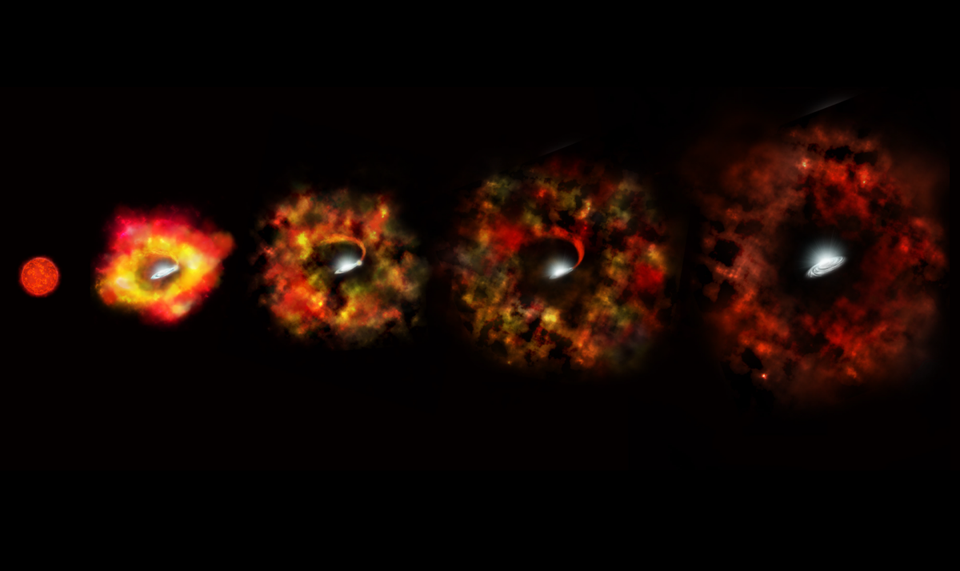
Most dying stars go out with a bang — a supernova, more specifically. But scientists recently observed a star that went out with a whisper, skipping the supernova phase and going straight into a black hole.
The discovery not only teaches us more about stars, but it could also uncover the mysteries behind some of the universe’s most massive black holes.
Scientists at The Ohio State University have, for some time, been watching a galaxy 22 million light-years away. That galaxy, called NGC 6946 and nicknamed the „Fireworks Galaxy,” sees a large number of supernovae that scientists observe via the help of the Large Binocular Telescope (LBT).
In 2009, scientists noticed that one star, N6946-BH1, was beginning to weaken. In 2015, it disappeared — no big flash, no epic supernova. The scientists concluded that it had instead become a black hole, something that scientists usually believe can only happen after a supernova. Scientists aptly called this unusual trajectory a „massive fail,” and published their results in the Monthly Notices of the Royal Astronomical Society.
Star N6946-BH1 before and after it vanished out of sight by imploding to form a black hole.
„The typical view is that a star can form a black hole only after it goes supernova,” said Ohio State astronomy professor and study researcher Christopher Kochanek in the press release. „If a star can fall short of a supernova and still make a black hole, that would help explain why we don’t see supernovae from the most massive stars.”
The doomed star, named N6946-BH1, was 25 times as massive as our sun. It began to brighten weakly in 2009. But, by 2015, it appeared to have winked out of existence. By a careful process of elimination, based on observations researchers eventually concluded that the star must have become a black hole.
This may be the fate for extremely massive stars in the universe.
The doomed star, named N6946-BH1, was 25 times as massive as our sun. It began to brighten weakly in 2009. But, by 2015, it appeared to have winked out of existence. By a careful process of elimination, based on observations researchers eventually concluded that the star must have become a black hole. This may be the fate for extremely massive stars in the universe.
Scientists still don’t know how often stars go through massive fails, but researcher Scott Adams predicts that it occurs in about 10 to 30 percent of massive stars.
The findings could help explain the origins of very massive black holes, since they may be easier to form if no supernova is necessary. That’s because the explosion of the supernova ends up blasting out the star’s outer layers, leaving behind less mass to create a black hole. If no supernova was involved, more of the star’s mass would be available to transform into a more massive black hole.
Majoritatea stelelor muribunde sfârșesc cu un bang – o supernova, mai precis. Însă, oamenii de știință au observat recent o stea care ne părăsea doar cu o șoaptă, sărind de faza supernovei și implodând într-o gaură neagră.
Descoperirea nu numai că ne învață mai multe despre stele, dar ar putea de asemenea să descopere misterele din spatele unora dintre cele mai masive găuri negre ale universului.
Oamenii de știință de la Universitatea de Stat din Ohio urmăreau, de ceva timp, o galaxie aflată la 22 de milioane de ani lumină. Acestă galaxie, numită NGC 6946 și supranumită Fireworks Galaxy, include un număr mare de supernovee pe care oamenii de știință le observă cu ajutorul Marelui Telescop Binocular (LBT).
În 2009, oamenii de știință au observat că o stea, N6946-BH1, începea să piardă din luminozitate. În 2015, aceasta a dispărut – fără flash-uri mari, fără supernove epice. Oamenii de știință au ajuns la concluzia că, în schimb, a devenit o gaură neagră, fapt care de obicei nu se poate întâmpla decât după transformarea în supernovă. Oamenii de știință au numit în mod adecvat aceast eveniment neobișnuit un „eșec masiv” și și-au publicat rezultatele în paginile Monthly Notices of the Royal Astronomical Society..
„Părerea tipică este că o stea poate forma o gaură neagră numai după ce trece de faza supernovă”, a declarat Christopher Kochanek, profesor de astronomie și documentarist din Ohio, în comunicatul de presă. „Faptul că o stea poate trece de faza supernovă și să să se transforme direct într-o gaură neagră ne-ar ajuta să explicăm de ce nu le vedem pe cele mai masive stele transformându-se în supernove.”
Steaua condamnată, numită N6946-BH1, a fost de 25 de ori mai masivă decât soarele nostru. A început să-și piardă din luminozitate începând din 2009. Dar, în 2015, părea să-și fi pus definitiv capăt zilelor. Printr-un proces atent de eliminare, bazat pe observații, cercetătorii au ajuns până la urmă la concluzia că steaua trebuie să fi devenit o gaură neagră.
Aceasta pare a fi soarta pentru stelele extrem de masive din univers.
Oamenii de știință încă nu știu cât de des trec stelele prin astfel de stări, dar cercetătorul Scott Adams presupune că acestea apar la aproximativ 10-30% din stelele masive.
Descoperirea ar putea ajuta la explicarea originii găurilor negre foarte masive, deoarece acestea pot fi mai ușor de format dacă nu este necesară o supernova. Asta pentru că explozia supernovei sfârșește prin a exploda straturile exterioare ale stelei, lăsând în urmă mai puțină masă pentru a crea o gaură neagră. Dacă nu ar fi implicată nici o supernovă, mai multă masă stelară ar fi disponibilă pentru a se transforma într-o gaură neagră mai masivă.
Fiind geamăn cu ascendant în săgetător sunt un extrovertit spre coleric de o curiozitate excesivă, perfecționist păgubos, împrăștiat, superficial, agnostic... și nimic din ce-i omenesc nu mi-e străin.
Being a Twin with ascendant in Sagittarius I am an extrovert up the choleric, of an excessive curiosity, a to the bitter end perfectionist, scattered, superficial, agnostic... and nothing that is human is foreign to me.
Vezi toate articolele lui Mihail

 Mihail stories