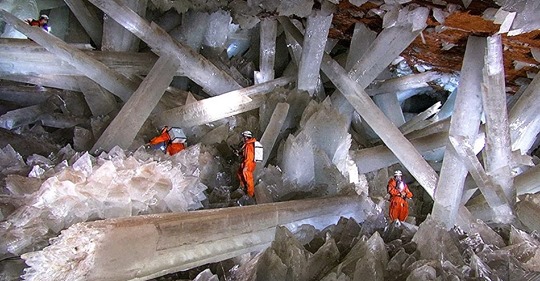
Discovered by chance, the secret Mexican crystal caves big enough to drive a car through
Formation of the crystals
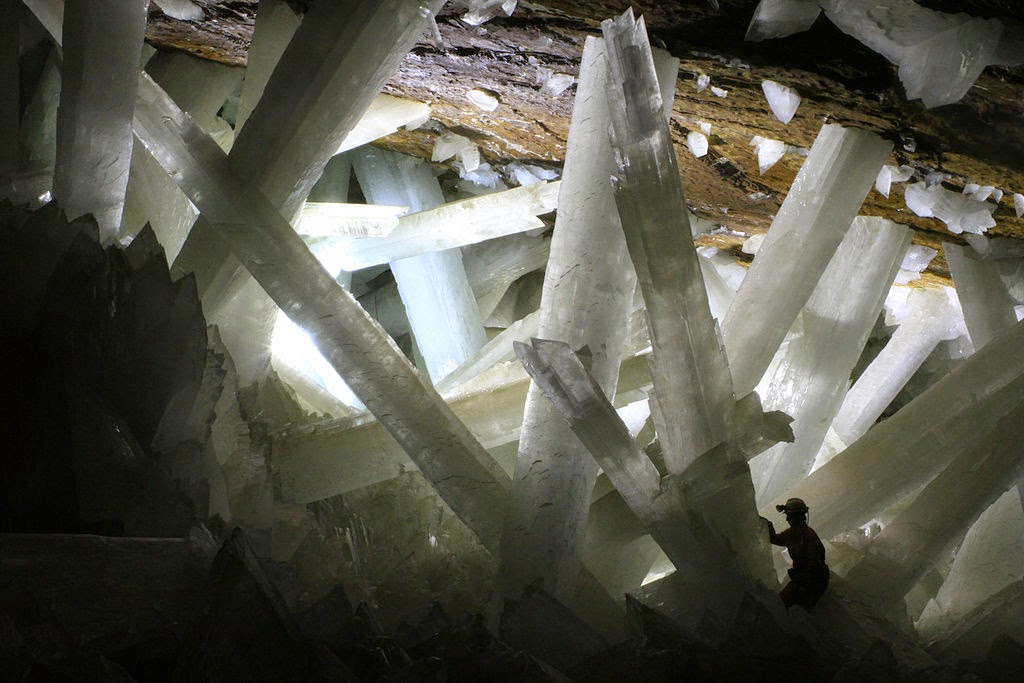 |
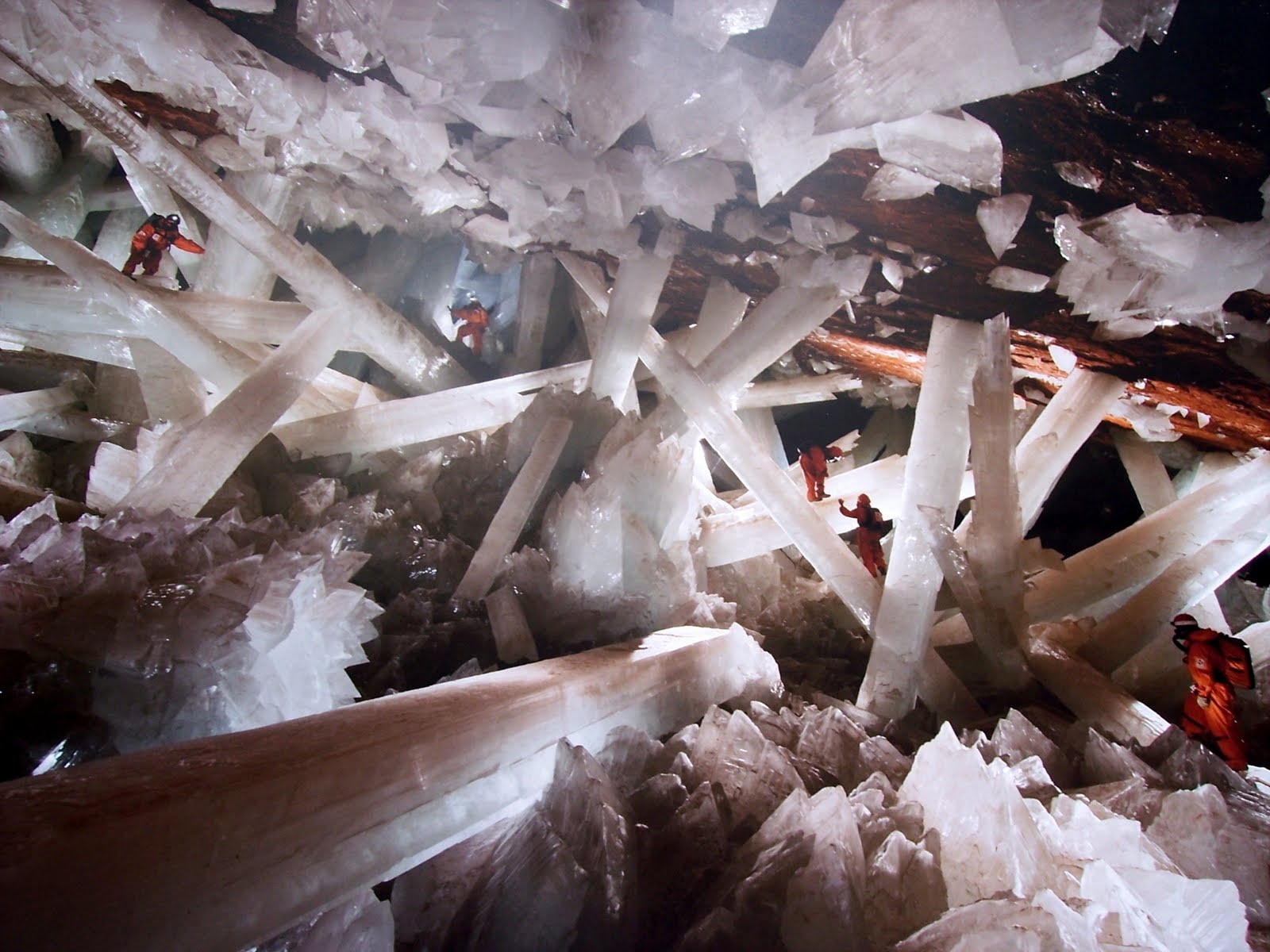
| Enormous gypsum crystals in a Naica cavern, found during mining. Note person for scale. |
How did the crystals reach such superheroic proportions?
Modern-day mining operations exposed the natural wonder by pumping water out of the 30-by-90-foot (10-by-30-meter) cave, which was found in 2000 near the town of Delicias (Chihuahua state map). Now García-Ruiz is advising the mining company to preserve the caves.
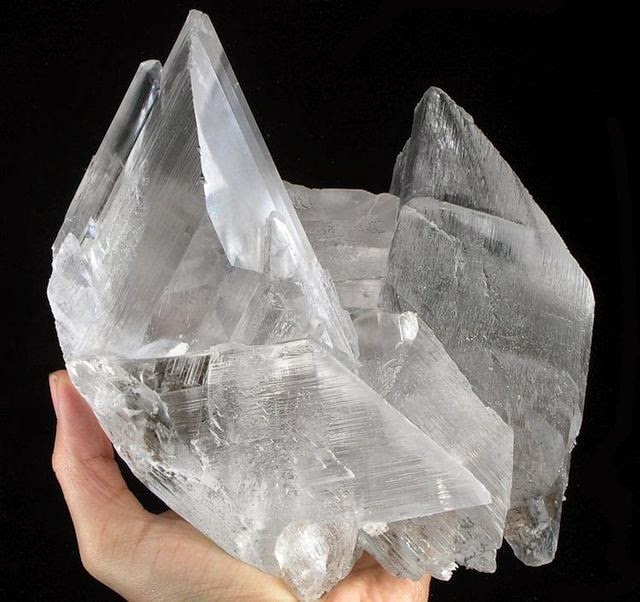 |
| Water-clear selenite crystal „floater” from the Naica Mine. weight 2.6 kg. |
Exploration and scientific studies
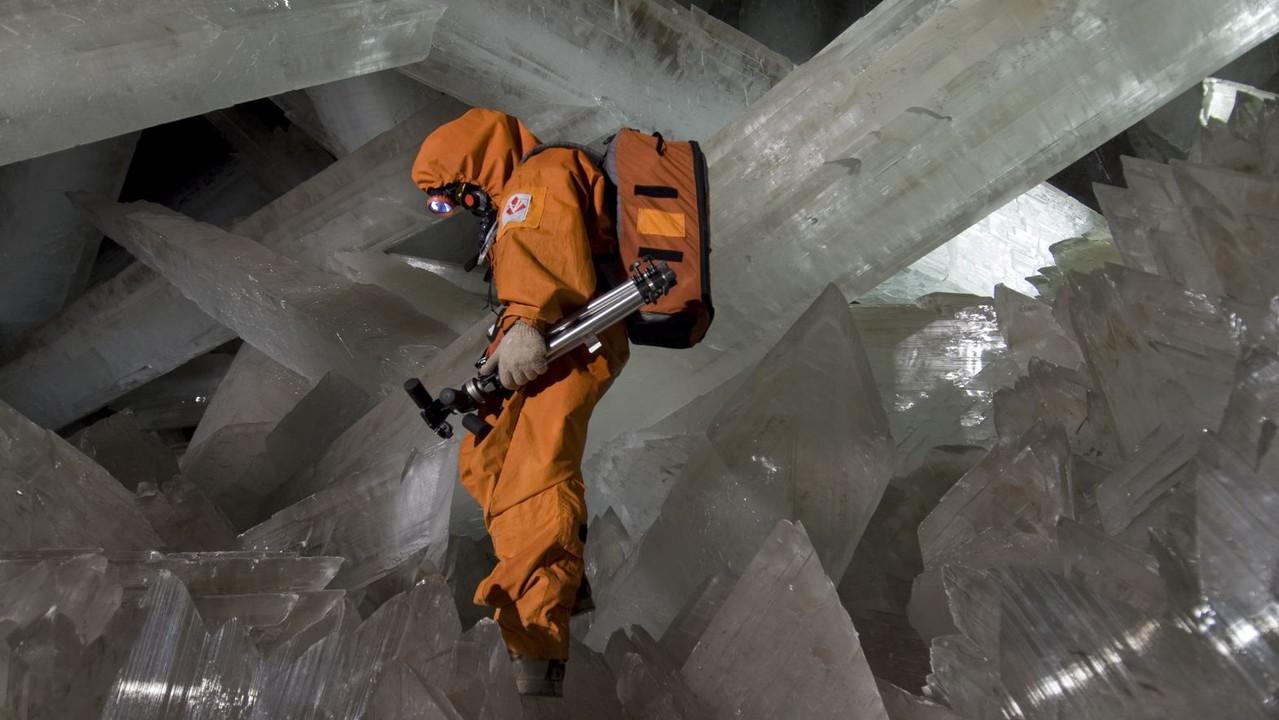
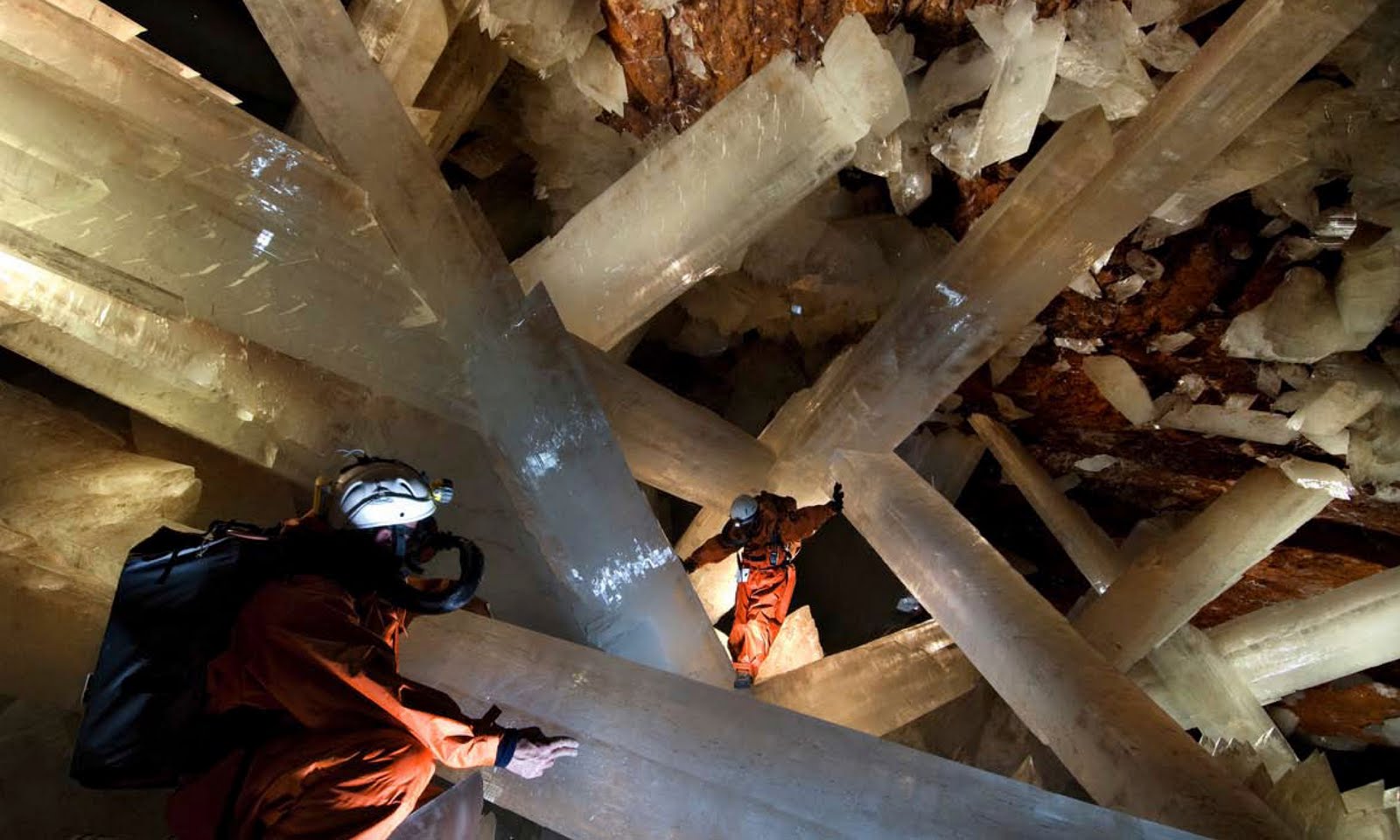
A scientific team coordinated by Paolo Forti, specialist of cave minerals and crystallographer at the University of Bologna (Italy) explored the cave in detail in 2006. To survive and to be able to work in the extreme temperature and humid conditions which prevent prolonged incursion in the crystal chamber, they developed their own refrigerated suits and cold breathing systems (respectively dubbed Tolomea suit and Sinusit respirator).
Special caving overalls were fitted with a mattress of refrigerating tubes placed all over the body and connected to a backpack weighing about 20 kg (44 lbs) containing a reservoir filled with cold water and ice. The cooling provided by melting ice was sufficient to provide about half an hour of autonomy.
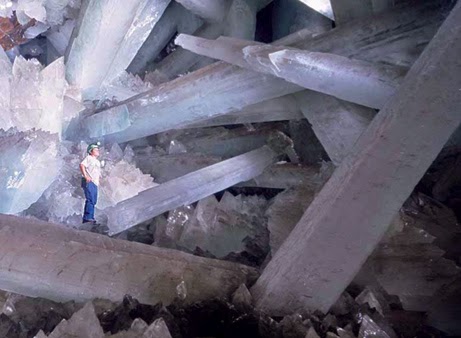
Penelope Boston (New Mexico Institute of Mining and Technology), speleologist and geomicrobiologist specialist of extremophile organisms realized sterile sampling of gypsum drillcores by making small boreholes inside large crystals under aseptic conditions. The aim was to detect the possible presence of ancient bacteria encapsulated inside fluid and solid inclusions present the calcium sulfate matrix from its formation.
 |
|
|
Solid inclusions mainly consist of magnesium and iron oxy-hydroxide but no organic matter could be found associated with the solid hydroxides. No DNA from ancient bacteria could be extracted from the solid inclusions and amplified by PCR.
Microbial studies on fluid inclusions are foreseen to attempt to evidence the presence of ancient micro-organisms in the original fluid solution in which the crystals developed.
Other researches also cover the fields of palynology (pollen study), geochemistry, hydrogeology and the physical conditions prevailing in the Cave of Crystals.
Photos:

Science And Nature
Descoperite din întâmplare, peșterile secrete de cristal mexicane sunt suficient de mari pentru a te plimba cu mașina.
Mina Naica din statul chihuahua mexican, este o mină de lucru care este cunoscută mai ales pentru extraordinarele sale cristale de selenit. Situată în Naica, în municipalitatea Saucillo, Mina Naica este o mină de plumb, zinc și argint, operată de Industrias Peñoles, cel mai mare producător principal din Mexic. Peșterile descoperite în timpul operațiunilor miniere conțin cristale de selenit (gips) de până la 1,2 m diametru și 15 m lungime.
Formarea cristalelor
Naica se află pe o falie veche și a existat o vână de magmă subterană sub peșteră. Magma a încălzit apa subterană care s-a saturat de minerale, inclusiv cantități mari de gips. Spațiul gol al peșterii a fost umplut cu această apă caldă bogată în minerale și a rămas umplut timp de aproximativ 500.000 de ani. În acest timp, temperatura apei a rămas foarte stabilă la peste 50 ° C (122 ° F). Acest lucru a permis cristalinelor să se formeze și să crească până la dimensiuni imense.
Cum au ajuns cristalele la aceste proporții gigantice?
În noul număr al revistei Geology, García-Ruiz relatează că, timp de milenii, cristalele au prosperat în mediul natural extrem de rar și stabil al peșterii. Temperaturile au crescut constant în jurul unui abur de 136 de grade Fahrenheit (58 de grade Celsius), iar peștera a fost umplută cu apă bogată în minerale care a condus la creșterea cristalelor.
Operațiunile miniere moderne au expus minunea naturală golind apa prin pompare din peștera de 10 pe 30 de metri (30 de metri), care a fost găsită în anul 2000 în apropierea orașului Delicias (harta de stat Chihuahua). Acum, García-Ruiz recomandă companiei miniere să păstreze peșterile.
Explorare și studii științifice
O echipă științifică coordonată de Paolo Forti, specialist în minerale de peșteră și cristalograf la Universitatea din Bologna (Italia) a explorat în 2006 peștera în detaliu. Pentru a supraviețui și a putea lucra în temperaturi extreme și în condiții umede care împiedică incursiunea prelungită în camera de cristal, și-au dezvoltat propriile costume frigorifice și sisteme de respirație la rece (respectiv costum Tolomea denumit și respirator Sinusit).
Salopetele speciale au fost prevăzute cu o saltea de tuburi frigorifice așezate pe tot corpul și conectate la un rucsac cu o greutate de aproximativ 20 kg (44 lbs) care conține un rezervor umplut cu apă rece și gheață. Răcirea furnizată prin topirea gheții a fost suficientă pentru a asigura aproximativ jumătate de oră de autonomie.
Pe lângă studiile mineralogice și cristalografice, s-a efectuat, de asemenea, caracterizarea biogeochimică și microbiană a cristalelor gigantice de gips. Stein-Erik Lauritzen (Universitatea din Bergen, Norvegia) a efectuat datări de uraniu-toriu pentru a determina vârsta maximă a cristalelor uriașe, aproximativ 500.000 de ani.
Penelope Boston (Institutul Minier și Tehnologie din New Mexico), speleolog și geomicrobiolog specialist în organisme extremofile, a realizat prelevarea sterilă a structurilor de ghips, făcând mici găuri în cristalele mari în condiții aseptice. Scopul a fost să detecteze prezența posibilă a bacteriilor străvechi încapsulate în fluid și incluziunile solide prezintă matricea sulfatului de calciu de la formarea sa.
Incluziunile solide constau în principal din magneziu și oxid-hidroxid de fier, dar nu s-a putut găsi materie organică asociată cu hidroxizii solizi. Nici ADN-ul din bacteriile antice nu a putut fi extras din incluziunile solide și amplificat prin PCR.
Studiile microbiene asupra incluziunilor fluide sunt prevăzute pentru a încerca să dovedească prezența microorganismelor antice în soluția de fluid originală în care s-au dezvoltat cristalele.
Alte cercetări acoperă, de asemenea, domeniile palinologiei (studiul polenului), geochimie, hidrogeologie și condițiile fizice care predomină în Peștera Cristalelor.

 Mihail stories