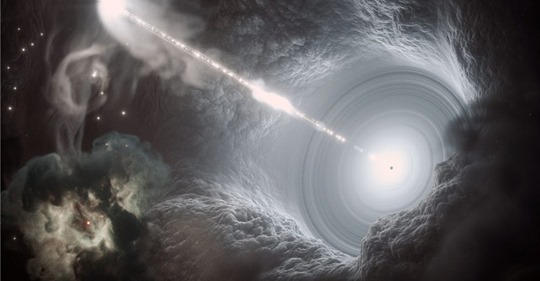
Scientists have recently reported discovering what they believe is the most massive black hole ever discovered in the early Universe.
It’s 34 billion times the mass of our Sun, and it eats the equivalent of one Sun every day.
The research led by the National University of Australia (ANU) has revealed how massive the fastest-growing black hole in the Universe really is, as well as how much matter it is able to suck in.
The black hole, known as ‘J2157‘, was discovered by the same research team in 2018.
The study detailing the characteristics of the humongous black hole has been published in Monthly Notices of the Royal Astronomical Society.
According to Dr. Christopher Onken and his colleagues, this object is 34 billion times the mass of the Sun and gobbles up the equivalent of one Sun every day. That’s billion with a b.For other comparisons, the monstrous black hole has a mass of approximately 8,000 times the mass of Sagittarius A*, the black hole located at the center of the Milky Way galaxy.
“If the Milky Way’s black hole wanted to get fat, it would have to swallow two-thirds of all the stars in our galaxy,” explains Onken.
Scientists studied the object at a time when the Universe was only 1.2 billion years old, less than 10% of its current age, which makes the black hole the largest known in terms of mass in the early Universe.“It is the largest black hole ever measured in this early period of the Universe,” says Onken.
How black holes get so big so early in the life of the Universe remains a mystery, but the team is now looking for more black holes in the hope that they can provide some clues.
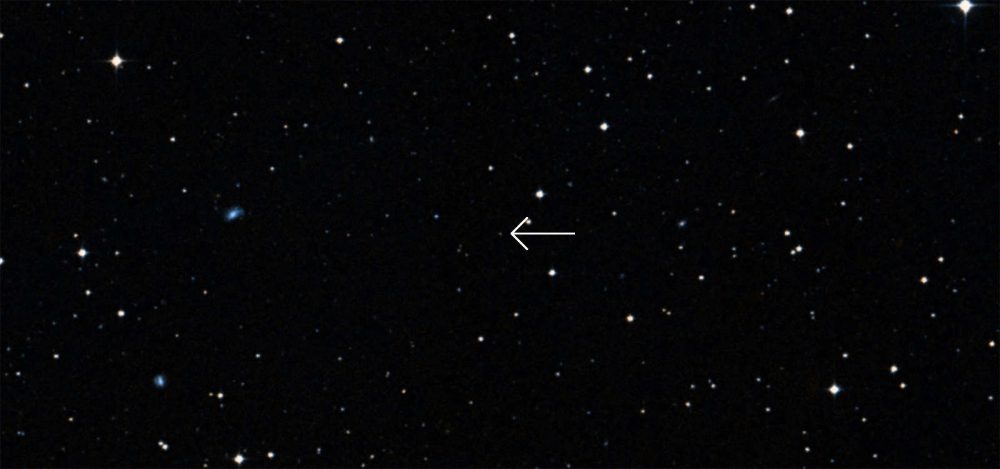
“We knew we were with a very massive black hole when we realized its rapid growth rate,” says team member Dr. Fuyan Bian, an astronomer at the European Southern Observatory (ESO).
“How much black holes can devour depends on how much mass they already have. So for this object to be devouring matter at such a high rate, we thought it could become a new record holder. And now we know,” he says.The team, which includes researchers from the University of Arizona, used ESO’s Very Large Telescope (VLT) in Chile to accurately measure the mass of the black hole.
“With such an enormous black hole, we’re also excited to see what we can learn about the galaxy in which it’s growing,” Onken said.
“Is this galaxy one of the behemoths of the early Universe, or did the black hole just swallow up an extraordinary amount of its surroundings? We’ll have to keep digging to figure that out.”
The gigantic black hole—J2157— is located at the center of a quasar galaxy. The observations made with the—equally massive—10-meter Keck telescope in Hawaii and the 8-meter Very Large Telescope in Chile allowed astronomers to find out important details about the cosmic monster.
Astronomers were able to get an idea of how far the quasar is and understand its overall brightness. This, in turn, allowed them to see how big the black hole was and how much of the matter from the disk the black hole can actually devour.
In terms of size, the black hole is really big; It is approximately 200 billion kilometers across which is pretty massive.Humongous, in fact, if you were to replace it with our Sun, such is its size that it would encompass the entire solar system.
Este de 34 de miliarde de ori masa Soarelui nostru și mănâncă echivalentul unui Soare în fiecare zi.
Cercetarea condusă de Universitatea Națională din Australia (ANU) a dezvăluit cât de masivă este cu adevărat cea mai rapidă gaură neagră din Univers, precum și cât de multă materie este în stare să sugă.
Gaura neagră, cunoscută sub numele de „J2157”, a fost descoperită de aceeași echipă de cercetare în 2018.
Studiul care detaliază caracteristicile găurii negre uriașe a fost publicat în Notificările lunare ale Royal Astronomical Society.
Potrivit Dr. Christopher Onken și colegii săi, acest obiect este de 34 de miliarde de ori mai mult decât masa Soarelui și înghite echivalentul unui Soare în fiecare zi. Adică un miliard cu un b. Pentru alte comparații, monstruoasa gaură neagră are o masă de aproximativ 8.000 de ori mai mare decât Sagetatorul A *, gaura neagră situată în centrul galaxiei Calea Lactee.
„Dacă gaura neagră a Calea Lactee ar vrea să se îngrașe, ar trebui să înghită două treimi din toate stelele din galaxia noastră”, explică Onken.
Oamenii de știință au studiat obiectul într-o perioadă în care Universul avea doar 1,2 miliarde de ani, mai puțin de 10% din vârsta sa actuală, ceea ce face ca gaura neagră să fie cea mai cunoscută din punct de vedere al masei din Universul timpuriu. măsurat vreodată în această perioadă timpurie a Universului ”, spune Onken.
Cum găurile negre devin atât de mari atât de devreme în viața Universului rămâne un mister, dar echipa caută acum mai multe găuri negre, în speranța că pot oferi câteva indicii.
Cercetarea condusă de Universitatea Națională din Australia (ANU) a dezvăluit cât de masivă este cu adevărat cea mai rapidă gaură neagră din Univers, precum și cât de multă materie este în stare să sugă.
Gaura neagră, cunoscută sub numele de „J2157”, a fost descoperită de aceeași echipă de cercetare în 2018.
Studiul care detaliază caracteristicile găurii negre uriașe a fost publicat în Notificările lunare ale Royal Astronomical Society.
Potrivit Dr. Christopher Onken și colegii săi, acest obiect este de 34 de miliarde de ori mai mult decât masa Soarelui și înghite echivalentul unui Soare în fiecare zi. Adică un miliard cu un b. Pentru alte comparații, monstruoasa gaură neagră are o masă de aproximativ 8.000 de ori mai mare decât Sagetatorul A *, gaura neagră situată în centrul galaxiei Calea Lactee.
„Dacă gaura neagră a Calea Lactee ar vrea să se îngrașe, ar trebui să înghită două treimi din toate stelele din galaxia noastră”, explică Onken.
Oamenii de știință au studiat obiectul într-o perioadă în care Universul avea doar 1,2 miliarde de ani, mai puțin de 10% din vârsta sa actuală, ceea ce face ca gaura neagră să fie cea mai cunoscută din punct de vedere al masei din Universul timpuriu. măsurat vreodată în această perioadă timpurie a Universului ”, spune Onken.
Cum găurile negre devin atât de mari atât de devreme în viața Universului rămâne un mister, dar echipa caută acum mai multe găuri negre, în speranța că pot oferi câteva indicii.
„Știam că avem o gaură neagră foarte masivă când ne-am dat seama de ritmul său de creștere rapidă”, spune membrul echipei, Dr. Fuyan Bian, astronom la Observatorul European Sud (ESO).
„Cât de multe găuri negre pot devora depinde de câtă masă au deja. Așadar, pentru ca acest obiect să devoreze materia la un ritm atât de mare, am considerat că ar putea deveni un nou deținător de înregistrări. Și acum știm „, spune el. Echipa, care include cercetători de la Universitatea din Arizona, a folosit Telescopul foarte mare al ESO (VLT) din Chile pentru a măsura cu exactitate masa găurii negre.
„Cu o gaură neagră atât de mare, suntem de asemenea încântați să vedem ce putem învăța despre galaxia în care crește”, a spus Onken.
„Această galaxie este una dintre prăpastiile Universului timpuriu, sau gaura neagră a înghițit doar o cantitate extraordinară din împrejurimile sale? Va trebui să continuăm să săpăm pentru a ne da seama. ”
Giganta gaură neagră – J2157 – este situată în centrul unei galaxii quasar. Observațiile făcute cu telescopul Keck, la fel de masiv, de 10 metri din Hawaii și cu telescopul foarte mare de 8 metri din Chile, au permis astronomilor să afle detalii importante despre monstrul cosmic.
Astronomii au fost capabili să-și facă o idee despre cât este de cvasar și să înțeleagă luminozitatea generală. Acest lucru, la rândul lor, le-a permis să vadă cât de mare a fost gaura neagră și cât de mult din materie de pe disc gaura neagră poate devora de fapt.
În ceea ce privește dimensiunea, gaura neagră este într-adevăr mare; Este de aproximativ 200 de miliarde de kilometri, care este destul de masiv. De fapt, dacă ar fi să-l înlocuiți cu Soarele nostru, aceasta este dimensiunea ei încât ar cuprinde întregul sistem solar.
„Cât de multe găuri negre pot devora depinde de câtă masă au deja. Așadar, pentru ca acest obiect să devoreze materia la un ritm atât de mare, am considerat că ar putea deveni un nou deținător de înregistrări. Și acum știm „, spune el. Echipa, care include cercetători de la Universitatea din Arizona, a folosit Telescopul foarte mare al ESO (VLT) din Chile pentru a măsura cu exactitate masa găurii negre.
„Cu o gaură neagră atât de mare, suntem de asemenea încântați să vedem ce putem învăța despre galaxia în care crește”, a spus Onken.
„Această galaxie este una dintre prăpastiile Universului timpuriu, sau gaura neagră a înghițit doar o cantitate extraordinară din împrejurimile sale? Va trebui să continuăm să săpăm pentru a ne da seama. ”
Giganta gaură neagră – J2157 – este situată în centrul unei galaxii quasar. Observațiile făcute cu telescopul Keck, la fel de masiv, de 10 metri din Hawaii și cu telescopul foarte mare de 8 metri din Chile, au permis astronomilor să afle detalii importante despre monstrul cosmic.
Astronomii au fost capabili să-și facă o idee despre cât este de cvasar și să înțeleagă luminozitatea generală. Acest lucru, la rândul lor, le-a permis să vadă cât de mare a fost gaura neagră și cât de mult din materie de pe disc gaura neagră poate devora de fapt.
În ceea ce privește dimensiunea, gaura neagră este într-adevăr mare; Este de aproximativ 200 de miliarde de kilometri, care este destul de masiv. De fapt, dacă ar fi să-l înlocuiți cu Soarele nostru, aceasta este dimensiunea ei încât ar cuprinde întregul sistem solar.

 Mihail stories