Where do comet tails come from? There are no obvious places on the nuclei of comets from which the jets that create comet tails emanate. One of the best images of emerging jets is shown in the featured picture, taken in 2015 by ESA’s robotic Rosetta spacecraft that orbited Comet 67P/Churyumov-Gerasimenko (Comet CG) from 2014 to 2016. The picture shows plumes of gas and dust escaping numerous places from Comet CG‘s nucleus as it neared the Sun and heated up. The comet has two prominent lobes, the larger one spanning about 4 kilometers, and a smaller 2.5-kilometer lobe connected by a narrow neck. Analyses indicate that evaporation must be taking place well inside the comet’s surface to create the jets of dust and ice that we see emitted through the surface. Comet CG (also known as Comet 67P) loses in jets about a meter of radius during each of its 6.44-year orbits around the Sun, a rate at which will completely destroy the comet in only thousands of years. In 2016, Rosetta‘s mission ended with a controlled impact onto Comet CG’s surface.
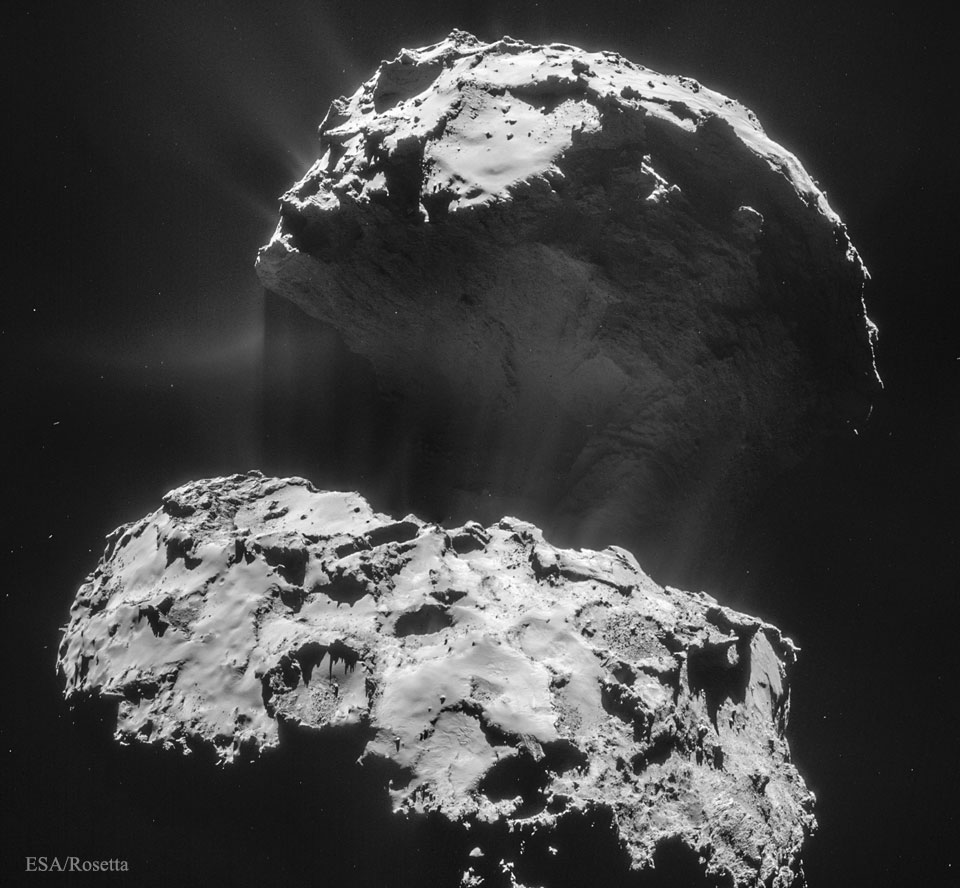
De unde provin cozile de cometă? Nu există locuri evidente în nucleele cometelor din care emană jeturile care creează cozi de cometă. Una dintre cele mai bune imagini cu jeturi emergente este prezentată în poza prezentată, realizată în 2015 de robotul ESA Nava spațială Rosetta care a orbit pe Comet 67P / Churyumov-Gerasimenko (Comet CG) din 2014 până în 2016. Imaginea arată fulgi de gaze și praf care scapă prin numeroase fisuri din nucleul Cometei CG în timp ce se apropia de Soare și se încălzește. Cometa are doi lobi proeminenți, cel mai mare se întinde pe aproximativ 4 kilometri și un lob mai mic de 2,5 km conectate de un gât îngust. Analizele indică faptul că evaporarea trebuie să se desfășoare puternic în interiorul suprafeței cometei pentru a crea jeturile de praf și gheață pe care le vedem emise prin suprafață. Cometul CG (cunoscut și sub numele de Comet 67P) pierde în jeturi aproximativ un metru de rază în fiecare dintre orbitele sale de 6,44 de ani în jurul Soarelui, o rată la care va distruge complet cometa în câteva mii de ani. În 2016, misiunea Rosetta s-a încheiat cu un impact controlat pe suprafața Cometei CG.

 Mihail stories