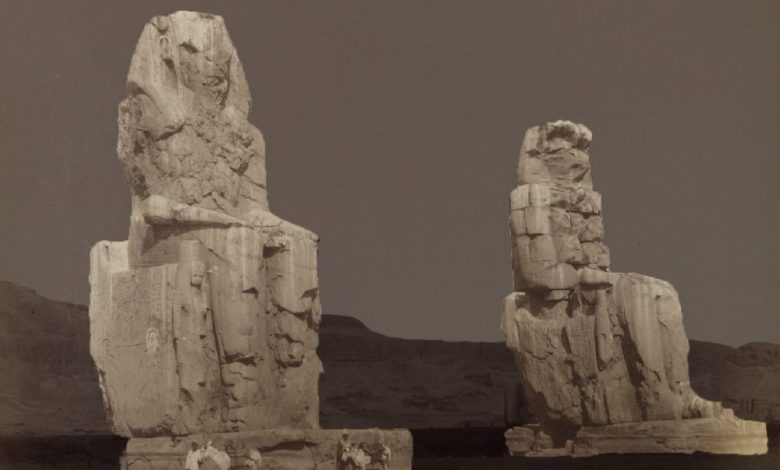
EACH OF THE STATUES WEIGHS AROUND 720 TONS. THE COLOSSI ARE MADE OF QUARTZITE SANDSTONE WHICH WAS QUARRIED AT EL-GABAL EL-AHMAR (NEAR THE PYRAMIDS OF GIZA) AND TRANSPORTED 675 KM (420 MI) OVERLAND TO THEIR CURRENT POSITION. ALL OF THIS, MORE THAN 3,300 YEARS AGO.
IN THE MIDDLE OF WHAT IS NOW EGYPT STAND TWO TOWERING ANCIENT STATUTES DUBBED THE COLOSSI OF MEMNON. EACH OF THEM REACHING A HEIGHT OF 19 METERS (60FT), IT HAS BEEN CALCULATED THAT EACH OF THE STATES WEIGHS 720 TONS. LOCATED NO MORE THAN 15 METERS (50FT) APART, THE MASSIVE QUARTZITE SANDSTONE ARE BELIEVED TO DEPICT PHARAOH AMENHOTEP III. THE STATUES WERE TRANSPORTED MORE THAN 675 KILOMETERS AWAY. BUT HOW?
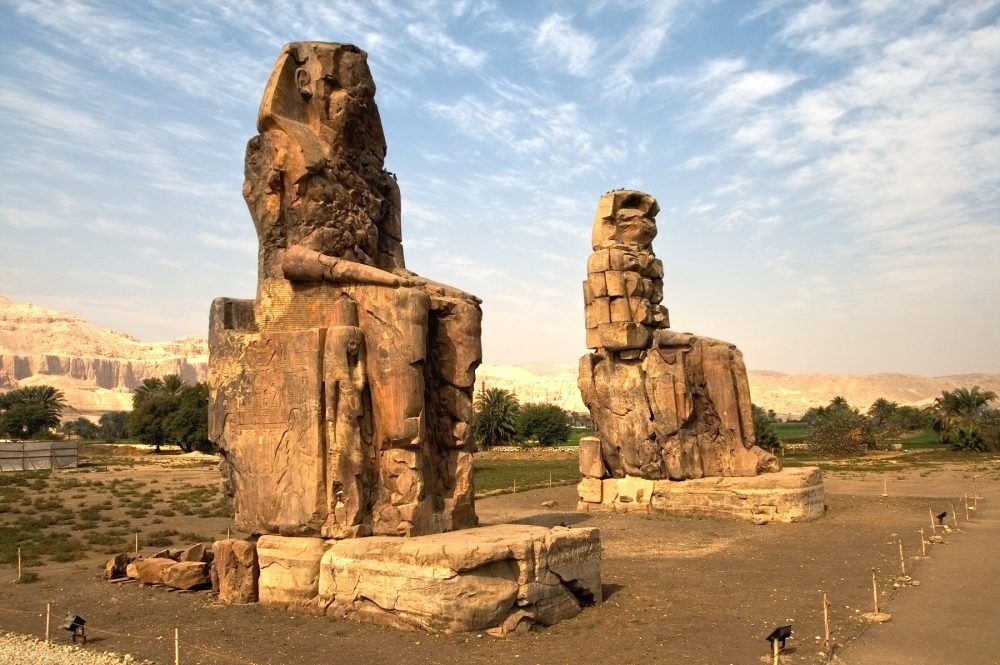
West of Luxor stand two massive ancient statues representing Pharaoh Amenhotep III, an ancient Egyptian King who ruled over the land of the Pharaohs during the Since 1350 BCE, they have stood in the Theban Necropolis, located west of the River Nile from the modern city of Luxor.Their heavily eroded shape speaks of their antiquity. The features of the statues located just above the waist are nearly unrecognizable. The statue to the south is made of a single piece of stone while the northern figure has a massive crack in the lower half and above the waist, consisting of a total of five tiers of stone.The statues have been reconstructed and repaired throughout history. Analysis of the statues has revealed that the upper levels are made of a different type of sandstone.Although they are heavily damaged, it is believed that once completed, the statues were most likely identical to each other, only featuring minor inscriptions and art that may have varied.The Colossi of Memnon were beautifully decorated and served as guardians to the entrance of Amenhotep’s memorial temple (or mortuary temple): an extensive construct erected during the pharaoh’s lifetime, where he was venerated as a god-on-earth both before and after his departure from this world.Amenhotep’s temple was a wonder of its own. In its day, the massive structure was the largest and most luxuriant anywhere in Egypt, covering a total area of more than 35 hectares rivaling that of Ramesses II’s Ramesseum or Ramesses III’s Medinet Habu and even the Temple of Karnak, which were much smaller in terms of area.The statues depict the king in a seated position with the hands placed on the knees, facing eastwards towards the River Nile. The stones used in the construction of the statues are one of the biggest mysteries of the statues; they were quarried at el-Gabel el-Ahmar, not far from the Giza Pyramids and transported towards upper Egypt (south) more than 675 kilometers.We are talking about 720-ton statues, not rocks weigh a few tons.All of this was done around 1350 BC, more than 3,300 years ago. Since the stones were too heavy to have been transported upstream using boats, it is believed the quartzite sandstone was transported via land by means wer are still unable to understand.Transporting statues weighing a few tens of tons may have been challenging, but it is completely mindboggling to find out that somehow, thousands of years ago, the ancients managed to move stones that weigh several hundreds of tons.Although a wonder of engineering, both the statues and the temple, this miniature ancient wonder did not stand the test of time like other ancient Egyptian monuments. Soon after the completion of the temple, the area was struck by a massive earthquake that destroyed everything but the massive colossi at its entrance standing.
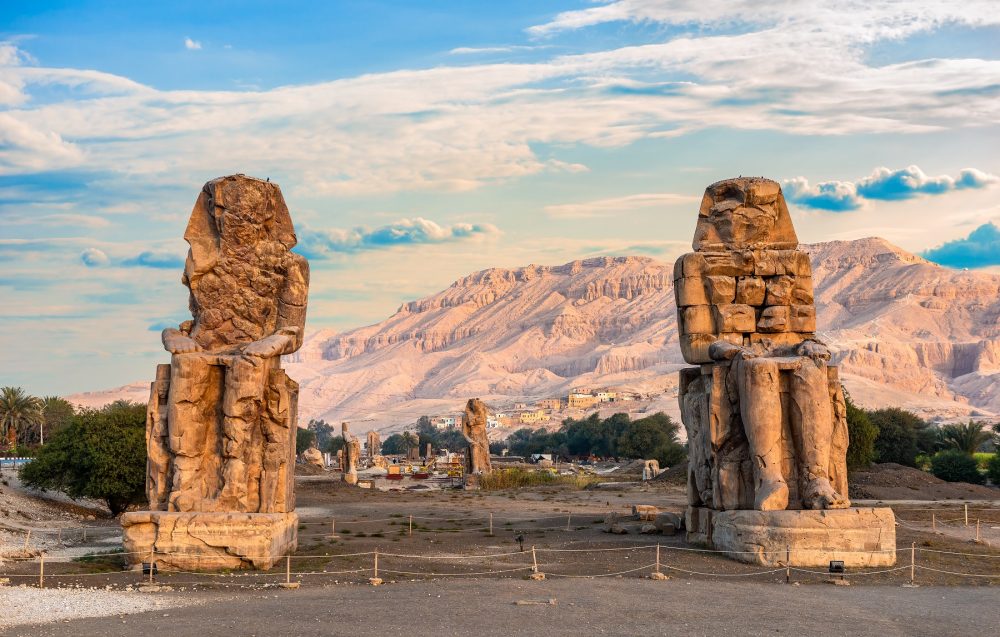
The statues did not go undamaged. The earthquake of 1200 BC which destroyed the mortuary temple struck a great deal of damage to the statues. Eventually, another earthquake around 27BC further destroyed the colossi which were then partially reconstructed by Roman authorities.The earthquakes opened numerous holes in the ground around the temple most likely burying a great number of statues, some of which may have been in pristine condition. An extensive archeological survey of the area has revealed important clues about the temple and its surrounding area.Archeologist Hourig Sourouzian has shown that the ancient temple complex–guarded by the colossi–was made of three massive pylons which were fronted by colossal statues.Around 200 statues and fragments of statues are currently held at the Luxor Museum. Some of these are on display, while many others await restoration and conservation.
THE SINGING COLOSSI
The earthquake that struck the region in 27 BC reportedly caused a great deal of damage to the northern colossus shattering it and causing it to collapse from the waist up while cracking its lower half.Although tragic due to the history that was lost, the collapse of the statue gave rise to a myth that the colossi would sing, on numerous occasions. It was said that within an hour or two of sunrise, right at dawn, the rupture in the statue would cause it to produce a curious sound.The sound was often reported as occurring more frequently in February or March, but experts argue there wasn’t an actual pattern that the sound followed.The earliest report of the singing Colossi of Memnon is that of Greek Historian Strabo who wrote that the colossi would produce a sound “like a bow”. Others reported the sound as being similar to the striking of brass or even whistling.This odd noise eventually gave rise to the legend of the Vocal Memnon. Reportedly, hearing the sound reportedly brought luck to the person. The colossi reportedly also had oracular powers. This mixture eventually made the colossi famous outside of Egypt which led to a massive flow of tourists, including Roman emperors, who traveled to Egypt to marvel at the ancient statues.During the Roman Era, the upper tiers of sandstone were added (the material may have come from Edfu, north of Aswan), reconstructing the statue. The original upper half was never found.Although it remains unclear when exactly the statute was repaired, local tradition gives us a timeline that coincides with the reign of Roman Emperor Septimius Severus, around 199 AD.The exact cause of the singing sound remains a mystery although two explanations have been offered: one of a natural origin, and another one manmade.Luckily for us, Strabo documented the phenomenon better than anyone else. He wrote that he was unable to determine the exact nature of the phenomenon. As he stood too far from the statues, he could not conclude whether the sound came from the pedestal, the damaged upper part, or whether the sound was produced by the people at the base.If the phenomenon was of natural origin then it most likely was caused by the rising temperatures and the evaporation of dew, located within the porous rock.Curiously, similar sounds have been reported coming from other ancient Egyptian monuments, with the temple of Karnak being one of the locations.
COLOSSI OF MEMNON: TRANSPORTING 720-TON STONES
One of the greatest mysteries in ancient Egyptian architecture and engineering is how massive stones were transported. In other words, how did they transport 720-ton statues?We know of ancient papyri that document the transport of stones weighing several tons via boat down the river.But for larger stones–some of which may have been used in the construction of the pyramids–the methods of transportation must have been different.It has been proposed by experts that some of the stones used in the construction of the pyramids were moved across the desert sand. The builders would place the massive rocks on a sledge, and workers would then pull it over the sand. Experts argue that the ancients may have made the desert in front of the sand wet in order to make it tougher and easier to transport.One research argues that “sliding friction on sand is greatly reduced by the addition of some — but not that much — water.”The study argues that the amount of pulling force required to move a massive rock was reduced–apparently by as much as fifty percent–if the ancients poured water onto the sand in front of the sledge since it glides far more easily over firm and wet sand because the sand does not tend to pile up in front of the sledge, compared to dry and hot sand.However, we must bear in mind that this is with stones that weigh less than ten tons.When it comes to much heavier stones–like the Colossi of Memnon, the issues become clear. Is it possible the ancient Egyptian used techniques and devices that are now lost to history? More importantly, why did the ancient Egyptians not find a need to document how such a massive undertaking was achieved? After all, moving 720-ton statues was no easy task.
FIECARE STATUIE CÂNTĂREȘTE APROXIMATIV 720 DE TONE. COLOȘII SUNT REALIZAȚI DIN GRESIE CUARȚITĂ, CARE A FOST EXTRASĂ LA EL-GABAL EL-AHMAR (ÎN APROPIERE DE PIRAMIDELE DIN GIZA) ȘI TRANSPORTAȚI 675 KM (420 MI) PE USCAT ÎN POZIȚIA LOR ACTUALĂ. TOATE ASTEA, ACUM MAI MULT DE 3.300 DE ANI.
ÎN MIJLOCUL A CEEA CE ESTE ACUM EGIPT STAU DOUĂ STATUI ANTICE FALNICE NUMITE COLOȘII LUI MEMNON. FIECARE DINTRE ELE AJUNGÂND LA O ÎNĂLȚIME DE 19 METRI (60FT), S-A CALCULAT CĂ FIECARE DINTRE ELE CÂNTĂREȘTE 720 DE TONE. LA O DEPĂRTARE DE NU MAI MULT DE 15 METRI (50FT) , ÎN GRESIE MASIVĂ DE QUARȚIT, SE AFLĂ ALTE STATUI CARE SUNT CONSIDERATE A-L ÎNFĂȚIȘA PE FARAONUL AMENHOTEP III. STATUILE AU FOST TRANSPORTATE DE LA PESTE 675 DE KILOMETRI DEPĂRTARE. DAR?
La vest de Luxor se află două statui antice masive care îl reprezintă pe faraonul Amenhotep al III-lea, un vechi rege egiptean care a condus țara faraonilor în timpul anului 1350 î.Hr., în necropola tebană, situată la vest de râul Nil, din orașul modern Luxor.
Forma lor puternic erodată vorbește despre antichitatea lor. Trăsăturile statuilor situate chiar deasupra taliei sunt aproape de nerecunoscut. Statuia din sud este realizată dintr-o singură bucată de piatră, în timp ce figura nordică are o fisură masivă în jumătatea inferioară și deasupra taliei, formată dintr-un total de cinci niveluri de piatră.
Statuile au fost reconstituite și reparate de-a lungul istoriei. Analiza statuilor a arătat că nivelurile superioare sunt realizate dintr-un alt tip de gresie.
Deși sunt puternic deteriorate, se crede că odată finalizate, statuile au fost cel mai probabil identice una cu cealaltă, având doar detalii minore de artă care ar fi putut varia.
Coloșii din Memnon au fost frumos decorați și au servit ca gardieni la intrarea templului memorial al lui Amenhotep (sau templul mortuar): o construcție extinsă ridicată în timpul vieții faraonului, unde a fost venerat ca zeu pe pământ, înainte și după plecarea sa din această lume.
Templul lui Amenhotep a fost o minune însăși. La vremea sa, structura masivă era cea mai mare și mai luxuriantă din Egipt, acoperind o suprafață totală de peste 35 de hectare rivalizând cu cea a Ramesseum-ului lui Ramesses II sau Medinet Habu al lui Ramesses III și chiar Templului din Karnak, care erau mult mai mici.
Statuile îl înfățișează pe rege în poziție așezată cu mâinile așezate în genunchi, orientate spre est spre râul Nil. Pietrele folosite la construcția statuilor sunt unul dintre cele mai mari mistere ale statuilor; au fost extrase la el-Gabel el-Ahmar, nu departe de piramidele de la Giza și transportate spre Egiptul de sus (sud) mai mult de 675 de kilometri.
Vorbim despre statui de 720 de tone, rocile cântăresc câteva tone.
Toate acestea au fost făcute în jurul anului 1350 î.Hr., cu mai mult de 3.300 de ani în urmă. Deoarece pietrele erau prea grele pentru a fi transportate în amonte folosind bărci, se crede că gresia de cuarțit a fost transportată pe uscat cu mijloace încă necunoscute.
Transportul statuilor care cântăresc câteva zeci de tone ar fi putut fi o provocare, dar este complet năucitor să aflăm că cumva, cu mii de ani în urmă, anticii au reușit să mute pietre care cântăresc câteva sute de tone.
Deși o minune a ingineriei, atât a statuilor, cât și a templului, această minunăție antică în miniatură nu a fost testul timpului ca și alte monumente egiptene antice. La scurt timp după finalizarea templului, zona a fost lovită de un cutremur masiv care a distrus totul, cu excepția colosilor masivi de la intrarea sa care au rezistat.
Statuile nu au rămas nedeteriorate. Cutremurul din 1200 î.Hr. care a distrus templul mortuar a afectat foarte mult statuile. În cele din urmă, un alt cutremur din jurul anului 27BC a distrus în continuare colosii care au fost apoi reconstruiți parțial de autoritățile romane.
Cutremurele au deschis numeroase găuri în pământ în jurul templului, cel mai probabil îngropând un număr mare de statui, dintre care unele ar fi putut fi în stare bună. O cercetare arheologică extinsă a zonei a relevat indicii importante despre templu și zona înconjurătoare.
Arheologul Hourig Sourouzian a arătat că vechiul complex de temple – străjuit de coloși – era format din trei stâlpi masivi care erau în fața unor statui colosale.
În prezent, la Muzeul Luxor se află aproximativ 200 de statui și fragmente de statui. Unele dintre acestea sunt expuse, în timp ce multe altele așteaptă restaurarea și conservarea.
Cântecul coloșilor
Cutremurul care a lovit regiunea în 27 î.Hr. ar fi cauzat o mare pagubă colosului nordic, dărâmându-l din talie în sus, și crăpînd jumătatea inferioară.
Deși tragic datorită istoriei pierdute, prăbușirea statuii a dat naștere unui mit cum că, în numeroase ocazii, coloșii ar cânta. S-a spus că în decurs de o oră sau două la răsăritul soarelui, chiar în zori, statuia ar produce un sunet curios.
Sunetul a fost adesea raportat că apare mai frecvent în februarie sau martie.
Primul care a amintit despre cântecul Coloșilor din Memnon este cel al istoricului grec Strabon care a scris că colosii ar produce un sunet „ca un arc”. Alții au raportat că sunetul este similar cu izbirea aramei sau chiar cu fluieratul.
Acest zgomot ciudat a dat naștere în cele din urmă legendei Memnonului vocal. Se pare că auzirea sunetului ar fi adus noroc persoanei respective. Se presupune că colosii aveau și puteri oraculare. Acest amestec a făcut în cele din urmă faimoși coloși în afara Egiptului, ceea ce a dus la un flux masiv de turiști, inclusiv împărați romani, care au călătorit în Egipt pentru a se minuna de statuile antice.
În timpul epocii romane, au fost adăugate nivelurile superioare de gresie (materialul ar fi putut proveni din Edfu, la nord de Aswan), reconstituind statuia. Jumătatea superioară originală nu a fost găsită niciodată.
Deși rămâne neclar când a fost reparată, tradiția locală ne oferă o cronologie care coincide cu domnia împăratului roman Septimius Severus, în jurul anului 199 d.Hr.
Cauza exactă a sunetului de cântec rămâne un mister, deși au fost oferite două explicații: una de origine naturală și alta artificială.
Din fericire pentru noi, Strabon a documentat fenomenul mai bine decât oricine altcineva. El a scris că nu este în stare să determine natura exactă a fenomenului. Întrucât stătea prea departe de statui, nu a putut concluziona dacă sunetul provine de la piedestal, partea superioară deteriorată sau dacă sunetul era produs de oamenii de la bază.
Dacă fenomenul a fost de origine naturală, cel mai probabil a fost cauzat de creșterea temperaturilor și evaporarea rouei, situată în roca poroasă.
Curios, s-au raportat sunete similare provenite din alte monumente egiptene antice, templul Karnak fiind una dintre locații.
COLOȘII LUI MEMNON: TRANSPORTAREA PIETRELOR DE 720 TONE
Unul dintre cele mai mari mistere din arhitectura și ingineria egipteană antică este modul în care au fost transportate pietrele masive. Cu alte cuvinte, cum au transportat statui de 720 de tone?
Știm despre papirusuri antice care documentează transportul de pietre în greutate de câteva tone pe barcă în josul râului.
Dar pentru pietrele mai mari – dintre care unele ar fi putut fi utilizate în construcția piramidelor – metodele de transport trebuie să fi fost diferite.
Experții au propus ca unele dintre pietrele utilizate la construcția piramidelor să fie mutate pe nisipul deșertului. Constructorii ar așeza stâncile masive pe sanie, iar muncitorii ar fi tras-o peste nisip. Experții susțin că anticii ar fi putut face deșertul din fața nisipului ud pentru a-l face mai dur și mai ușor de transportat.
O cercetare susține că „fricțiunea de alunecare pe nisip este mult redusă prin adăugarea de apă – dar nu cu mult”.
Studiul susține că cantitatea de forță necesară pentru a muta o rocă atât de masivă ar fi fost redusă – aparent cu până la cincizeci la sută – dacă anticii ar fi aruncat apă pe nisipul din fața saniei, întrucât alunecă mult mai ușor peste nisipul ferm și umed. deoarece nisipul nu tinde să se îngrămădească în fața saniei, în comparație cu nisipul uscat și fierbinte.
Cu toate acestea, trebuie să avem în vedere că este vorba despre pietre care cântăresc zece tone.
Când vine vorba de pietre mult mai grele – cum ar fi Colosul de Memnon, problemele devin clare. Este posibil ca tehnicile și dispozitivele străvechi folosite în Egipt să fie acum pierdute în istorie? Mai important, de ce nu au găsit vechii egipteni nevoia de a documenta cum s-a realizat o astfel de întreprindere masivă? La urma urmei, mutarea statuilor de 720 de tone nu a fost o sarcină ușoară.

 Mihail stories