It’s official. There’s water on the Moon.
We’ve thought that there was for over a decade, based on detections described back in 2009, but there was room for interpretation in the wavelengths used. Now, using a different wavelength unique to water, scientists report the first unambiguous detection.
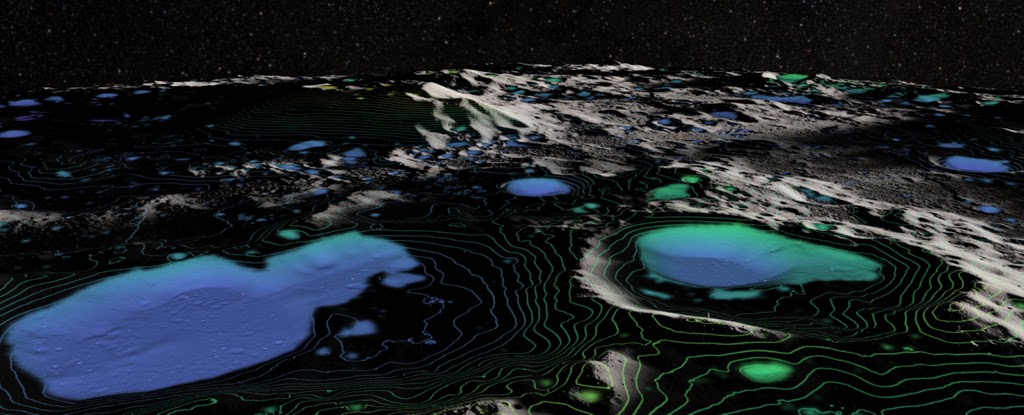
Permanently shadowed regions where lunar water may exist. (NASA’s Goddard Space Flight Centre
Those 2009 conclusions were apparently on the money.
The ambiguity arose because the 2009 detections were made in the 3-micrometre infrared band. At this wavelength, there were two possibilities – water, or another hydroxyl compound comprising hydrogen and oxygen.
Led by astronomer Casey Honniball of the NASA Goddard Space Flight Centre, a team of scientists decided to look into the wavelength that could confirm or overturn those findings. The 6-micrometre infrared band should show a line that can only be created by two hydrogen atoms and one oxygen atom – what is called the H-O-H bend vibration.
But actually making an unambiguous detection in that band is tricky. It requires the use of the Stratospheric Observatory for Infrared Astronomy (SOFIA), a special, one-of-a-kind telescope that is flown in a plane above the bulk of Earth’s atmosphere.
„SOFIA is the only current and planned observatory capable of these observations,” Honniball told ScienceAlert.
„Current lunar spacecraft do not have instruments that can measure at 6 micrometres, and from the ground, Earth’s atmosphere blocks 6-micron light, and so it cannot be done from ground-based observatories. SOFIA flies above 99.9 percent of the Earth’s water vapour, which allows 6-micrometre light to pass through and be observed. And luckily SOFIA’s FORCAST instrument can make 6-micrometre measurements and look at the Moon.”
Using FORCAST, the team carefully studied a region in which the 3-micrometre detections had been made – high southern latitudes, around the south pole. There, they found the emission line they had been hoping for – that unique signature that could only be created by the H-O-H bend vibration.
Based on their detections, the team estimates water abundances of around 100 to 400 parts per million – consistent with 3-micrometre detections made by the Moon Mineralogy Mapper.
Of course, there are no liquid lakes sloshing around on the lunar surface, and any frozen water would sublimate as soon as the sunlight hit it. But there are multiple ways the Moon could still be harbouring surface water.
„We mainly think the water is in glass,” Honniball said.
„When a micrometeorite impacts the Moon, it melts some lunar material, which quickly cools and forms a glass. If there is water already present, formed during or delivered during the impact, some of the water can be captured in the structure of the glass while it cooled.”
In a separate paper led by astronomer Paul Hayne of the University of Colorado Boulder, scientists explored another possibility – regions of permanent shadow in polar craters. At high latitudes, high crater rims create regions that sunlight never touches.
In these spots, temperatures never reach above approximately -163 degrees Celsius (-260 degrees Fahrenheit), creating cold traps that could harbour hidden patches of water ice.
Using data from NASA’s Lunar Reconnaissance Orbiter, Hayne and his colleagues calculated that there could be as much as 40,000 square kilometres (15,000 square miles) of such permanently shadowed surface. And 60 percent of that is at the south pole.
„The temperatures are so low in cold traps that ice would behave like a rock,” Hayne said. „If water gets in there, it’s not going anywhere for a billion years.”
Both papers have very important implications for future lunar missions. NASA is planning to establish a lunar base as part of the Artemis mission; if an abundant source of water can be found nearby, lunar residents could make use of it for drinking, for growing crops, even splitting it using electrolysis to obtain hydrogen for rocket fuel.
But we need to get a better picture of where the water might be, and how much is there. The work of Haynes’ team will help work out where to look; the work of Honniball’s team gives us the how. All we need now is the telescope time.
„We have been granted two more hours on SOFIA and are requesting an additional 72 hours,” Honniball said. „With more observations we will be able to characterise the behaviour of water across the lunar surface and understand its source, where it resides, and if it moves around the lunar surface.”
Se presepunea existența apei, pe baza detecțiilor descrise în 2009, dar au existat interpretari diferite funcție de lungimile de undă utilizate. Acum, folosind o lungime de undă diferită unică pentru apă, oamenii de știință raportează prima detectare fără de echivoc.
Ambiguitatea a apărut deoarece detecțiile din 2009 au fost făcute în banda infraroșu de 3 micrometri. La această lungime de undă, existau două posibilități – apă sau un alt compus hidroxil care conține hidrogen și oxigen.
Condusă de astronomul Casey Honniball de la NASA Goddard Space Flight Center, o echipă de oameni de știință a decis să analizeze lungimea de undă care ar putea confirma sau răsturna aceste descoperiri. Banda cu infraroșu de 6 micrometri ar trebui să prezinte o linie care poate fi creată doar de doi atomi de hidrogen și un atom de oxigen – ceea ce se numește vibrația H-O-H.
Dar, de fapt, a face o detectare fără echivoc în acea bandă este dificil. Necesită utilizarea Observatorului stratosferic pentru astronomie în infraroșu (SOFIA), un telescop special unic, care zboară deasupra atmosferei Pământului.
„SOFIA este singurul observator actual și planificat capabil de aceste observații”, a declarat Honniball pentru ScienceAlert.
„Nava spațială lunară actuală nu are instrumente care să poată măsura la 6 micrometri, iar de la sol, atmosfera Pământului blochează lumina de 6 microni și, prin urmare, nu se poate face din observatoarele de la sol. SOFIA zboară peste 99,9 la sută din vaporii de apă ai Pământului. , care permite luminii de 6 micrometri să treacă și să fie observate. Și din fericire, instrumentul FORCAST al SOFIA poate face măsurători de 6 micrometri și poate privi Luna. „
Folosind FORCAST, echipa a studiat cu atenție o regiune în care au fost făcute detecții de 3 micrometri – latitudini sudice ridicate, în jurul polului sudic. Acolo, au găsit linia de emisie la care sperau – acea semnătură unică care nu putea fi creată decât prin vibrația curbei H-O-H.
Pe baza detecțiilor lor, echipa estimează abundențe de apă de aproximativ 100 până la 400 de părți pe milion – în concordanță cu detecțiile de 3 micrometri efectuate de Moon Mineralogy Mapper.
Desigur, nu există lacuri lichide care să se strecoare pe suprafața lunară și orice apă înghețată s-ar sublima imediat ce lumina soarelui a lovit-o. Dar există mai multe moduri în care Luna ar putea încă adăposti apele de suprafață.
„Credem în principal că apa este prinsă în sticlă”, a spus Honniball.
„Când un micrometeorit are impact asupra Lunii, acesta topește un material lunar, care se răcește rapid și formează un pahar. Dacă există deja apă, formată în timpul sau livrată în timpul impactului, o parte din apă poate fi capturată în structura paharului. în timp ce s-a răcit. „
Într-o lucrare separată condusă de astronomul Paul Hayne de la Universitatea din Colorado Boulder, oamenii de știință au explorat o altă posibilitate – regiunile de umbră permanentă din craterele polare. La latitudini mari, jantele înalte ale craterelor creează regiuni pe care soarele nu le atinge niciodată.
În aceste locuri, temperaturile nu depășesc niciodată peste aproximativ -163 grade Celsius (-260 grade Fahrenheit), creând capcane reci care ar putea adăposti pete ascunse de gheață de apă.
Folosind date de la Lunar Reconnaissance Orbiter al NASA, Hayne și colegii săi au calculat că ar putea exista până la 40.000 de kilometri pătrați (15.000 de mile pătrate) de o astfel de suprafață umbrită permanent. Și 60% din acestea se află la polul sud.
„Temperaturile sunt atât de scăzute în capcanele reci încât gheața s-ar comporta ca o piatră”, a spus Hayne. „Dacă apa ajunge acolo, nu va mai pleca nicăieri timp de un miliard de ani”.
Ambele lucrări au implicații foarte importante pentru viitoarele misiuni lunare. NASA intenționează să stabilească o bază lunară ca parte a misiunii Artemis; dacă în apropiere se găsește o sursă abundentă de apă, locuitorii lunari ar putea să o folosească pentru băut, pentru cultivarea culturilor, chiar folosind electroliza pentru a obține hidrogen pentru combustibilul rachetelor.
Dar trebuie să avem o imagine mai bună despre locul în care ar putea fi apa și cât de multă este acolo.
„Ni s-au acordat încă două ore pe SOFIA și solicităm încă 72 de ore”, a spus Honniball. „Cu mai multe observații vom putea caracteriza comportamentul apei pe suprafața lunară și să înțelegem sursa acesteia, unde se află și dacă se mișcă în jurul suprafeței lunare.”

 Mihail stories