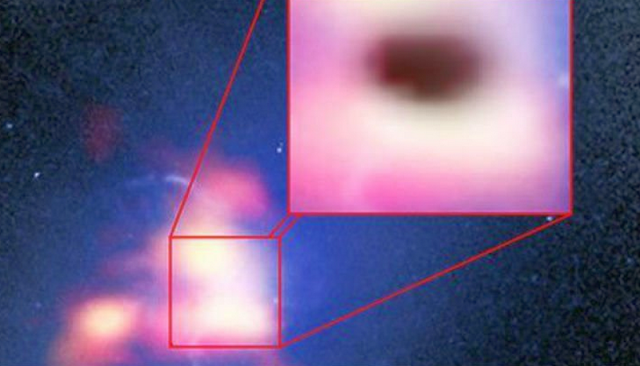
The weather may be crappy where you are right now, but count your lucky stars you live in the comfort of planet Earth, because out there in space, sh*t just got real.For the first time, Scientists have identified cold, dense clouds condensing around a super-massive black hole in the centre of a huge cluster of galaxies called Abell 2597. Not only are these monstrous intergalactic gas clouds pouring down on the black hole, they’re also feeding it, which could explain how very big black holes keep getting more massive.”Although it has been a major theoretical prediction in recent years, this is one of the first unambiguous pieces of observational evidence for a chaotic, cold rain feeding a super-massive black hole,” said one of the team, astronomer Grant Tremblay from Yale University.”It’s exciting to think we might actually be observing this galaxy-spanning rainstorm feeding a black hole whose mass is about 300 million times that of the Sun.”Tremblay and his team used data from the Atacama Large Millimetre/submillimetre Array (ALMA) telescope in Chile to locate the activities of cold molecular gas in the centre of the Abell 2597 Brightest Cluster Galaxy – a huge spiral of 50 galaxies located about 1.23 billion light years from Earth.The Scientists discovered three huge cold gas clouds travelling about 1 million km per hour (around 300 km per second) towards the black hole.They estimate that both cloud contained as much material as 1 million Suns, and spans at least 10 light-years across. To put that in perspective, 1 light-year is around 9.5 trillion kilometres (5.88 trillion miles), so, umm, you’re gonna need a bigger umbrella.And if you believe we’re oversimplifying by calling this phenomenon crazy black hole rain, Michael Byrne from Motherboard explains:„Astrophysics and astronomy are overloaded with metaphors, but, in this case, black hole rain is almost a literal description. The precipitation we experience here on Earth happens as moisture-laden air cools and condenses.It turns out that something similar happens among clusters of galaxies characteristically found commingling with clouds of hot, ionised plasma – some regions of gas cool and fall inward as they condense.”Not only is it incredibly cool that scientists have witnessed a brand new – and completely badass – form of space weather, but the discovery is helping us make sense of how black holes continue to grow so enormous before they eventually collapse under the mass of their own gravity and die.Astronomer have long suggested that supermassive black holes – the biggest black holes we know about in terms of mass – in the largest galaxy clusters grow by feeding on a slow, steady diet of hot, ionised gas pulled in from the galaxy’s outer halo – a process known as accretion. (Aldrich, get out of here, you’ve had enough.)
What the presence of three gas clouds shooting towards Abell 2597’s black hole suggests is that this ‘eating and growing fat’ process is far more sporadic – basically, it binges, rather than grazes, Tremblay and his team suggest.
As Byrne explains over at Motherboard, these clouds are about 300 light-years from reaching the event horizon, which is beautiful much equivalent to Earth rain being milliseconds away from landing in a puddle. This means the Astronomer got about as close as you can get to catching them in the act of feeding the black hole, and there’s even a chance that they could witness it falling in.
Pentru prima dată, oamenii de știință au identificat nori reci și densi condensând în jurul unei găuri negre super-masive în centrul unui imens grup de galaxii numite Abell 2597. Nu numai că acești monstruoși nori de gaz intergalactic se revarsă pe gaura neagră, ci o alimentează și ei, ceea ce ar putea explica dece găurile continuă să devină mai masive. „Deși a fost o predicție teoretică majoră în ultimii ani, aceasta este una dintre primele dovezi neechivoce de observație pentru o ploaie haotică și rece care alimentează o gaură neagră super-masivă”, a spus unul dintre membrii echipei. , astronomul Grant Tremblay de la Universitatea Yale. „Este incitant să credem că am putea observa de fapt această furtună care se întinde peste o galaxie hrănind o gaură neagră a cărei masă este de aproximativ 300 de milioane de ori mai mare decât a Soarelui.” Tremblay și echipa sa au folosit date de la telescopul ATA (Chile) pentru a localiza activitățile gazului molecular rece în centrul galaxiei Abell 2597 Brightest Cluster – o imensă spirală de 50 de galaxii situate la aproximativ 1,23 miliarde de ani lumină de Pământ. Oamenii de știință au descoperit trei nori uriași de gaze reci care călătoresc cu aproximativ 1 milion de km pe oră (aproximativ 300 km pe secundă) spre gaura neagră. Estimează că ambii nori conțineau atât material cât 1 milion de Sori și se întind pe o rază de cel puțin 10 ani-lumină. Pentru a pune asta în perspectivă, un an lumină este de aproximativ 9,5 trilioane de kilometri (5,88 trilioane de mile), așa că vei avea nevoie de o umbrelă mai mare. Și dacă crezi că simplificăm prea mult numind acest fenomen, ploaie în găurii negre , Michael Byrne de la Motherboard explică: „Astrofizica și astronomia sunt supraîncărcate cu metafore, dar, în acest caz, ploaia în găuri negre este aproape o descriere literală. Precipitațiile pe care le experimentăm aici pe Pământ se întâmplă pe măsură ce aerul încărcat de umiditate se răcește și se condensează. Ceva similar se întâmplă printre grupurile de galaxii care, în mod caracteristic, se amestecă cu nori de plasmă fierbinte și ionizată – unele regiuni de gaz se răcesc și cad în interior, pe măsură ce se condensează. – forma vremii spațiale, dar descoperirea ne ajută să înțelegem modul în care găurile negre continuă să crească atât de enorm înainte de a se prăbuși în cele din urmă sub masa propriei lor gravitații și de a muri. R au sugerat de mult că găurile negre supermasive – cele mai mari găuri negre despre care cunoaștem în termeni de masă – în cele mai mari grupuri de galaxii cresc prin hrănirea cu o dietă lentă și constantă de gaz fierbinte, ionizat, extras din haloul exterior al galaxiei – un proces cunoscută sub numele de acumulare.
Ceea ce sugerează prezența a trei nori de gaz care se îndreaptă spre gaura neagră a lui Abell 2597.
După cum explică Byrne la Motherboard, acești nori sunt la aproximativ 300 de ani lumină de atingerea orizontului evenimentelor, ceea ce este echivalent cu ploaia de pe Pământ care se află la milisecunde distanță de aterizarea într-o baltă. Acest lucru înseamnă că astronomii s-au apropiat atât de mult încât există chiar șansa ca aceștia să poată asista la căderea acesteia.

 Mihail stories