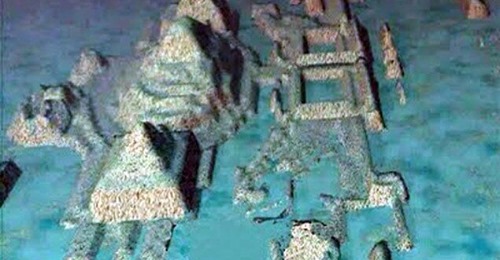
The remains of what may be a 6000-year-old city immersed in deep waters off the west coast of Cuba was discovered by a team of Canadian and Cuban researchers.

Offshore engineer Paulina Zelitsky and her husband, Paul Weinzweig and her son Ernesto Tapanes used sophisticated sonar and video videotape devices to find “some kind of megaliths you ‘d find on Stonehenge or Easter Island,” Weinzweig said in an interview.
“Some structures within the complex may be as long as 400 meters wide and as high as 40 meters,” he said. “Some are sitting on top of each other. They show very distinct shapes and symmetrical designs of a non-natural kind. We’ve shown them to scientists in Cuba, the U.S., and elsewhere, and nobody has suggested they are natural.”

Moreover, an anthropologist affiliated with the Cuban Academy of Sciences has said that still photos were taken from the videotape clearly show “symbols and inscriptions,” Mr. Weinzweig said. It is not yet known in what language the inscriptions are written.The sonar images, he added, bear a remarkable resemblance to the pyramidal design of Mayan and Aztec temples in Mexico.
Mr. Weinzweig said it is too early to draw firm conclusions from the evidence collected so far. The research team plans another foray to the site — off the Guanahacabibes Peninsula on Cuba’s western tip. It hopes to return again, this time with the first deep-water mobile excavator, equipped with functions needed for on-site archeological evaluation, including the ability to blow the sand off the stone.
Geologists have recently hypothesized that a land bridge once connected Cuba to Mexico’s Yucatan peninsula. And portions of the Cuban island are believed to have been submerged in the sea on three separate occasions in the distant past.
The structures are on a plateau that forms the bottom of what is thought to be a mud volcano, 650 to 700 meters beneath the surface of the ocean, and along what is clearly a geological fault line. “It’s well known that ancient civilizations liked to build at the base of volcanoes because the land is fertile. So that’s suggestive,” Mr. Weinzweig said.One tantalizing possibility, entirely speculative for now, is that if the legendary sunken continent of Atlantis is ever proven to have existed, these structures may have been submerged during the same cataclysm.
Mr. Weinzweig simply says that more information is needed. “We’d prefer to stay away from that subject. This is something of great potential scientific interest, but it must involve serious authorities on ancient civilizations.”
The precise age of the underwater site is also unknown, although Cuban archeologists in 1966 excavated a land-based megalithic structure on the western coast, close to the new underwater discovery, said to date from 4000 BC. “Based on that and other geological information, we’re speculating that these are 6,000 years old,” he explained.If that dating estimate proves accurate, it would mean that an ancient civilization had designed and erected these vast stone structures in the Americas only 500 years after human settlements first became organized in cities and states.
They would also have been built long before the wheel was invented in Sumeria (3500 BC), or the sundial in Egypt (3000 BC). The three pyramids on Egypt’s Giza plateau are thought to have been constructed between 2900 and 2200 BC.
The couple’s Havana-based company, Advanced Digital Communications, discovered the site, using side-scan sonar equipment to view what resembled an underwater city, complete with roads, buildings, and pyramids.https://www.youtube.com/embed/g9ivUMErK-I?feature=oembed
The team returned this past summer with a 1.3-tonne, unmanned Remotely Operated Vehicle, controlled from the mother ship via fiber-optic cable. Its cameras confirmed the earlier findings, showing vast granite-like blocks, between two and five meters in length, that were cut in perpendicular and circular designs.But because of technical problems, Mr. Weinzweig said, “we were only able to survey the perimeter of the site. Based on initial explorations, we think it’s much larger than even our sonar projections show. It may extend for several kilometers.”
In addition to the archeological site, ADC has been exploring what Mr. Weinzweig calls “the richest underwater cemetery in the world” for sunken Spanish galleons. Hundreds of treasure-bearing ships are said to lie around the island, several hundred to several thousand meters deep.
Last year, off Havana Bay, it found the remains of USS Maine, the battleship that blew up in 1898. That incident, never entirely explained, killed 260 sailors and precipitated the Spanish-American War.
Rămășițele a ceea ce ar putea fi un oraș vechi de 6000 de ani, cufundat în apele adânci de pe coasta de vest a Cubei, au fost descoperite de o echipă de cercetători canadieni și cubanezi.
Inginerul offshore Paulina Zelitsky și soțul ei, Paul Weinzweig și fiul ei Ernesto Tapanes au folosit dispozitive sofisticate pentru a găsi „un fel de megalit pe care l-ați găsi pe Stonehenge sau Insula Paștelui”, a spus Weinzweig într-un interviu.
„Unele structuri din cadrul complexului pot avea o lățime de până la 400 de metri și o înălțime de până la 40 de metri”, a spus el. „Unii stau unul peste altul. Ele prezintă forme foarte distincte și modele simetrice de natură non-naturală. Le-am arătat oamenilor de știință din Cuba, SUA și din alte părți și nimeni nu a sugerat că sunt naturale „.
Mai mult, un antropolog afiliat la Academia Cubană de Științe a spus că fotografiile statice arată în mod clar „simboluri și inscripții”, a spus domnul Weinzweig. Nu se știe încă în ce limbă sunt scrise inscripțiile. Imaginile sonarului, a adăugat el, au o asemănare remarcabilă cu designul piramidal al templelor mayașe și aztece din Mexic.
Domnul Weinzweig a spus că este prea devreme pentru a trage concluzii ferme din dovezile colectate până acum. Echipa de cercetare planifică o altă incursiune către sit – în largul Peninsulei Guanahacabibes, în vârful vestic al Cubei. Speră să revină din nou, de data aceasta cu primul excavator mobil de apă adâncă, echipat cu funcțiile necesare pentru evaluarea arheologică la fața locului, inclusiv capacitatea de a arunca nisipul de pe pietre.
Geologii au emis recent ipoteza că un pod terestru lega odată Cuba de peninsula Mexicului Yucatan. Iar porțiuni din insula cubaneză se crede că au fost scufundate în mare în trei ocazii separate în trecutul îndepărtat.
Structurile se află pe un platou care formează fundul a ceea ce se crede a fi un vulcan de noroi, la 650 până la 700 de metri sub suprafața oceanului și de-a lungul a ceea ce este în mod clar o linie de falie geologică. „Se știe că civilizațiilor antice le plăcea să construiască la baza vulcanilor, deoarece terenul este fertil. Așa că este sugestiv „, a spus domnul Weinzweig. O posibilitate tentantă, cu totul speculativă deocamdată, este că, dacă se dovedește că a existat vreodată legendarul continent scufundat al Atlantidei, aceste structuri ar fi putut fi scufundate în același cataclism.
Domnul Weinzweig spune pur și simplu că sunt necesare mai multe informații. „Am prefera să stăm departe de acest subiect. Acesta este ceva de mare interes științific potențial, dar trebuie să implice autorități serioase în civilizațiile antice. ”
Vârsta precisă a sitului subacvatic este, de asemenea, necunoscută, deși arheologii cubanezi au săpat în 1966 o structură megalitică terestră pe coasta de vest, aproape de noua descoperire subacvatică, despre care se spune că datează din 4000 î.Hr. „Pe baza acestor informații și a altor informații geologice, speculăm că acestea au o vechime de 6.000 de ani”, a explicat el. Dacă această estimare a datării se dovedește corectă, ar însemna că o civilizație antică a proiectat și a ridicat aceste structuri de piatră vaste la 500 de ani după ce așezările umane s-au organizat pentru prima dată în orașe și state.
De asemenea, ar fi fost construite cu mult înainte ca roata să fie inventată în Sumeria (3500 î.Hr.) sau cadranul solar în Egipt (3000 î.Hr.). Se crede că cele trei piramide de pe platoul Gizei din Egipt au fost construite între 2900 și 2200 î.Hr.
Compania cuplată la Havana, Advanced Digital Communications, a descoperit site-ul, folosind echipamente sonare cu scanare laterală pentru a vedea ce seamănă cu un oraș subacvatic, complet cu drumuri, clădiri și piramide.
Echipa s-a întors în vara trecută cu un vehicul de 1,3 tone, fără pilot, de la distanță, controlat de pe nava-mamă prin cablu cu fibră optică. Camerele sale au confirmat descoperirile anterioare, care arătau blocuri vaste de granit, între două și cinci metri lungime, care au fost tăiate în mod perpendicular și circular. perimetrul sitului. Pe baza explorărilor inițiale, credem că este mult mai mare decât arată chiar proiecțiile noastre sonare. Se poate extinde pe câțiva kilometri. ”
În plus față de situl arheologic, ADC a explorat ceea ce domnul Weinzweig numește „cel mai bogat cimitir subacvatic din lume” pentru galionii spanioli scufundați. Se spune că sute de nave purtătoare de comori zac în jurul insulei, cu câteva sute până la câteva mii de metri adâncime.
Anul trecut, lângă Golful Havanei, a găsit rămășițele USS Maine, cuirasatul care a explodat în 1898. Acest incident, niciodată explicat în totalitate, a ucis 260 de marinari și a precipitat războiul spano-american.

 Mihail stories