Astrophysicists have found an out-of-place supermassive black hole – 12 billion times more enormous than the sun – that mysteriously formed when the cosmos was less than 900 million years old.
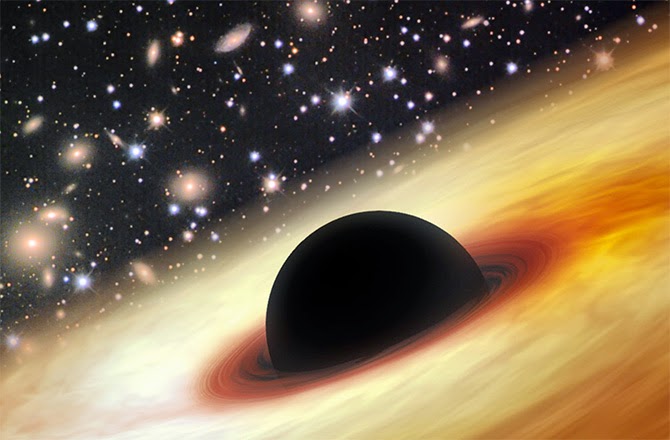
Such behemoths are usually found in the more modern cosmos, which seemingly offers more feeding material. Black holes are areas of space so condensed with matter that not even photons of light can discharge their gravitational fists. They are sensed as they pull and eat neighbouring stars and dust, making a cosmic zoo of noticeable phenomenon, such gas jets and rapidly spinning accretion disks.
“Before this finding the most enormous black hole identified within 1 billion years after the Big Bang was about 5 billion solar mass, less than half the mass of the new discovery,” Bram Venemans, research staff researcher with Max Planck Institute for Astronomy in Germany, wrote in an email to Discovery News.
The finding, reported in this week’s Nature, offers a serious challenge to theories about how black holes grew in the early cosmos.
Researchers previously expected young black holes started off with between 100 and 100,000 times the mass of the sun and matured from there by consuming in intergalactic matter and/or merging with other black holes.
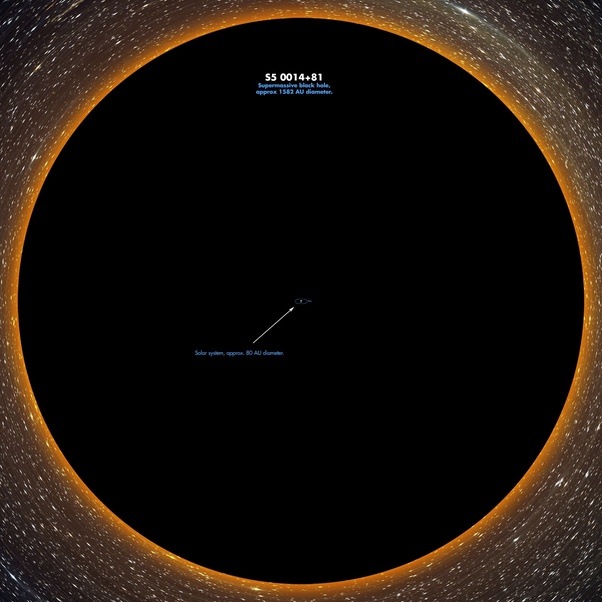
It may need either very extraordinary ways to grow the black hole within a very short time, or the presence of a huge seed black hole when the first generation of stars and galaxies formed,” lead scientist Xue-Bing Wu, with China’s Peking University in Beijing, said in an email to Discovery News.
Neither clarification fits with present theories.
“A very stimulating feature of this work is that the outcomes hint that in the early cosmos the supermassive black holes and their host galaxies did not co-evolve,” said astrophysicist Akos Bogdan, with the Harvard-Smithsonian Center for Astrophysics in Cambridge, Mass., who was not involved in the study.
It is improbable the black hole’s parent galaxy would be as big as what calculations based on existing theories would conclude. “This would propose that – at least in this case – the black hole is developing faster than the galaxy, questioning the often expected co-evolution of galaxies and their central black holes through cosmic time,” added Venemans. The newly discovered black hole exists in in an enormously bright quasar that existed when the cosmos was about 857 million years old – about 6% of the cosmos’s current 13.8-billion-year age.
“We can comparatively easily sense this object because it is brighter than others at the same distance,” Wu said.
Observations with numerous ground- and space-based telescopes carry on, as well as a search for any comparable giant siblings.
“These objects are so far away from us so most of them look (very) faint even if their inherent brightness is large,” Wu said.
Astrofizicienii au găsit o gaură neagră supermasivă de 12 miliarde de ori mai mare decât soarele care s-a format în mod misterios pe când cosmosul avea mai puțin de 900 de milioane de ani.
Astfel de monștri se găsesc de obicei în cosmosul mai modern, care pare să ofere mai mult material hrănitor. Găurile negre sunt zone ale spațiului atât de condensate cu materie încât nici măcar fotonii de lumină nu se pot elibera. Sunt simțite în timp ce atrag și mănâncă stele și praful învecinate, făcând o grădină zoologică cosmică cu fenomene vizibile, jeturi de gaz și discuri de acumulare care se rotesc rapid.
„Înainte de această descoperire, cea mai enormă gaură neagră identificată în decurs de 1 miliard de ani de la Big Bang era de aproximativ 5 miliarde de mase solare, mai puțin de jumătate din masa noii descoperiri”, a scris într-un e-mail către Discovery News Bram Venemans, cercetător al Institutului de Astronomie Max Planck din Germania.
Descoperirea, raportată în Nature de săptămâna aceasta, oferă o provocare serioasă teoriilor despre cum au crescut găurile negre în cosmosul timpuriu.
Cercetătorii se așteptau anterior la găurile negre tinere care au început cu 100 până la 100.000 de ori mai mult decât masa soarelui și s-au maturizat consumând materie intergalactică și / sau fuzionând cu alte găuri negre.
Poate a găsit modalități extraordinare de a crește gaura neagră într-un timp foarte scurt, sau de prezența unei uriașe găuri negre ca sămânță atunci când s-a format prima generație de stele și galaxii „, a declarat într-un e-mail către Discovery News savantul principal Xue-Bing Wu, împreună cu Universitatea din Beijing din China Beijing.
Nici o clarificare nu se potrivește cu teoriile actuale.
„O caracteristică foarte stimulatoare a acestei lucrări este că rezultatele sugerează că în cosmosul timpuriu găurile negre supermasive și galaxiile gazdă ale acestora nu au evoluat în comun”, a spus astrofizicianul Akos Bogdan, alături de Centrul Harvard-Smithsonian pentru Astrofizică din Cambridge, Massachusetts.
Este improbabil că galaxia mamă a găurii negre să fie la fel de mare precum ar concluziona calculele bazate pe teoriile existente. „Acest lucru ar propune ca – cel puțin în acest caz – gaura neagră să se dezvolte mai repede decât galaxia, punând sub semnul întrebării co-evoluția deseori așteptată a galaxiilor și a găurilor negre centrale ale acestora prin timpul cosmic”, a adăugat Venemans. Noua gaură neagră descoperită se află într-un quasar extrem de luminos, care exista când cosmosul avea o vechime de aproximativ 857 milioane de ani – aproximativ 6% din vârsta actuală a cosmosului de 13,8 miliarde de ani.
„Putem simți relativ ușor acest obiect, deoarece este mai luminos decât altele la aceeași distanță”, a spus Wu.
Se continuă observații cu numeroase telescoape terestre și spațiale, precum și o căutare a oricărui frate gigant comparabil.
„Aceste obiecte sunt atât de departe de noi, încât majoritatea par (foarte) slabe chiar dacă strălucirea lor inerentă este mare”, a spus Wu.

 Mihail stories