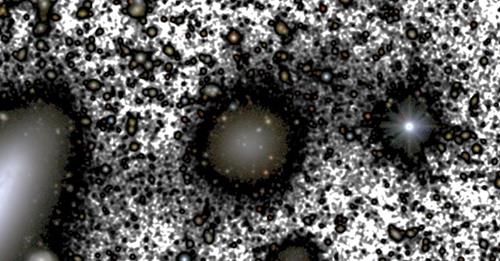
A small, mysterious galaxy 44 million light-years away is finally yielding up its secrets. Revealed last year to have a shockingly low amount of dark matter, the galaxy NGC 1052-DF4 posed a significant challenge to our models of galaxy formation.
Those models yet live another day. According to new research, NGC 1052-DF4 is indeed lacking in dark matter – but only because another nearby galaxy nicked it.
„The dark matter isn’t there because it’s already been removed,” said astrophysicist Mireia Montes of the University of New South Wales in Australia and the Space Telescope Science Institute.
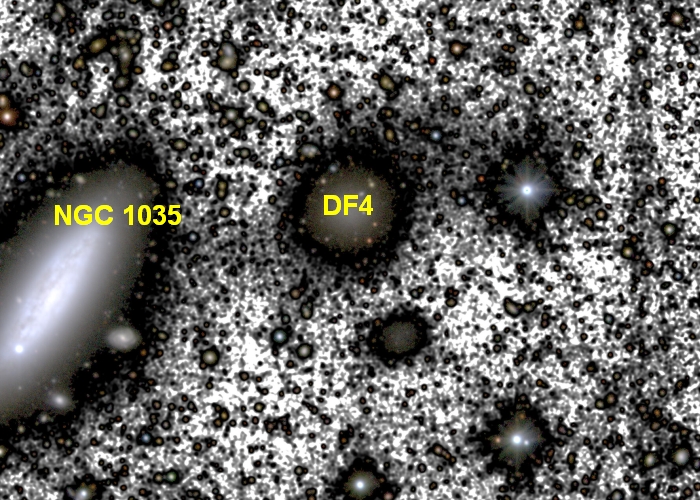
„We found that the gravitational pull from the nearby massive galaxy NGC1035 is removing its stars – and dark matter.”
(Montes et al., ApJ, 2020)
The discovery of NGC 1052-DF4 (or DF4 for short) was announced last year, and it was immediately a dilly of an astronomical pickle. It was the second galaxy of its type – a faint, ultra-diffuse galaxy, or UDF – to be found seriously dark-matter depleted. The first was NGC 1052-DF2 (DF2), and DF4 represented a confirmation that galaxies with insufficient dark matter could exist.
The problem was that, according to our current models, dark matter is necessary for galaxies to form in the first place.
We don’t know what dark matter is, and we can’t detect it directly, but we do know that most galaxies have way more gravity than their normal, detectable matter could create. There’s some hidden mass in the Universe creating that extra pull, and without it, according to our understanding of galaxy formation, there wouldn’t be enough gravity for matter to collapse down to form baby galaxies.The matter seemed to draw close to a resolution when a team of astrophysicists found that DF2 was actually a lot closer to us than first thought. That meant it has much less mass than initial calculations suggested, and the proportion of normal matter was much lower. Once calculations based on the revised distance were completed, DF2 had a pretty normal amount of dark matter.
Then they focused their attention on DF4. It, too, seemed to be much closer… but something was still not quite right. The velocities of clusters of stars inside the galaxy were still suggesting that there was much less dark matter than there should have been.
The faint galaxy is very hard to see, so Montes and her colleagues booked time on some of the world’s most powerful telescopes to see if they could figure out why.
Using the IAC80 Telescope, the Gran Telescopio Canarias, and the Hubble Space Telescope, they detected stars being pulled out of DF4, consistent with an interaction with the much larger spiral galaxy NGC 1035. This process, whereby a larger body gravitationally „disrupts” a smaller one, is known as tidal disruption.
„Initial papers showed that the galaxy has a very ‘relaxed’ symmetrical shape, suggesting that no outside forces were perturbing it,” Montes said.
„But our deep images show that this galaxy is in fact being affected by its neighbour galaxy – it’s just caught in the beginning of the interaction. The inner part of the galaxy keeps its shape, but the outer, fainter parts are where you see these ‘tidal tails’: stars that have been already separated from the galaxy.”
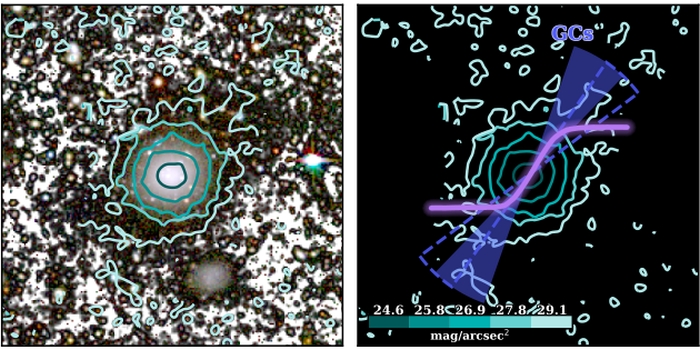
The tidal tails found streaming out of DF4. (Montes et al., ApJ, 2020)
Since dark matter surrounds galaxies in a large halo, this tidal stripping would remove most of the smaller galaxy’s dark matter before affecting the stars, Montes noted. Stars only start to be stripped once the dark matter content falls below 10 to 15 percent of the galaxy’s total mass.
That’s consistent with the team’s observations. UDFs tend to have a high proportion of dark matter – around 99 percent of the total mass of the galaxy. In the case of DF4, the team estimated that dark matter makes up just one percent of the total mass.
Because dark matter is basically the gravitational glue that holds galaxies together, this also means that DF4’s time in this Universe is limited.
„With time,” said astrophysicist Ignacio Trujillo of the Instituto de Astrofísica de Canarias, „NGC1052-DF4 will be cannibalised by the large system around NGC1035, with at least some of their stars floating free in deep space.”
But at least we don’t have to go back to the drawing board on galaxy formation.
The research has been published in The Astrophysical Journal.
O mică, misterioasă galaxie aflată la 44 de milioane de ani lumină distanță își dezvăluie în sfârșit secretele. Luată în colimator anul trecut pentru a avea o cantitate șocant de mică de materie întunecată, galaxia NGC 1052-DF4 a reprezentat o provocare semnificativă pentru modelele noastre de formare a galaxiei.
Aceste modele încă supraviețuiesc. Conform noilor cercetări, NGC 1052-DF4 este într-adevăr lipsit de materie întunecată – dar numai pentru că o altă galaxie din apropiere a tăiat-o.
„Materia întunecată nu există, deoarece a fost deja eliminată”, a spus astrofizicianul Mireia Montes de la Universitatea din New South Wales din Australia și Institutul de Științe pentru Telescopul Spațial.
„Am constatat că atracția gravitațională din galaxia masivă din apropiere NGC1035 îi îndepărtează stelele – și materia întunecată.”
Descoperirea NGC 1052-DF4 (sau pe scurt DF4) a fost anunțată anul trecut și a devenit imediat o provocare astronomică. A fost a doua galaxie de acest tip – o galaxie slabă, ultra-difuză sau UDF – care a fost găsită grav epuizată de materie întunecată. Primul a fost NGC 1052-DF2 (DF2), iar DF4 a reprezentat o confirmare că galaxiile cu materie întunecată insuficientă ar putea exista.
Problema a fost că, conform modelelor noastre actuale, materia întunecată este necesară pentru ca galaxiile să se formeze în primul rând.
Nu știm ce este materia întunecată și nu o putem detecta direct, dar știm că majoritatea galaxiilor au mult mai multă gravitație decât ar putea crea materia lor normală, detectabilă. Există o masă ascunsă în Univers care creează această atracție suplimentară și, fără aceasta, conform înțelegerii noastre despre formarea galaxiilor, nu ar exista suficientă gravitație pentru ca materia să se prăbușească pentru a forma galaxii. Materia părea să se apropie de o rezoluție când o echipă de astrofizicieni a constatat că DF2 era de fapt mult mai aproape de noi decât se credea inițial. Asta a însemnat că are o masă mult mai mică decât calculele inițiale sugerate, iar proporția materiei normale era mult mai mică. Odată ce calculele bazate pe distanța revizuită au fost finalizate, DF2 avea o cantitate destul de normală de materie întunecată.
Apoi și-au concentrat atenția asupra DF4. Și el părea să fie mult mai aproape … dar ceva însă nu era chiar în regulă. Viteza grupurilor de stele din interiorul galaxiei sugerează încă că există mult mai puțină materie întunecată decât ar fi trebuit.
Galaxia slabă este foarte greu de văzut, așa că Montes și colegii ei au rezervat timp pe unele dintre cele mai puternice telescoape ale lumii pentru a vedea dacă își dau seama de ce.
Folosind telescopul IAC80, Gran Telescopio Canarias și telescopul spațial Hubble, au detectat stele scoase din DF4, în concordanță cu o interacțiune cu galaxia spirală mult mai mare NGC 1035. Acest proces, prin care un corp mai mare „întrerupe” gravitațional unul mai mic, este cunoscut sub numele de perturbare a mareelor.
„datele inițiale au arătat că galaxia are o formă simetrică foarte „relaxată” , sugerând că nici o forță exterioară nu o perturba”, a spus Montes.
„Dar imaginile noastre profunde arată că această galaxie este de fapt afectată de galaxia vecină – este prinsă doar la începutul interacțiunii. Partea interioară a galaxiei își păstrează forma, dar părțile exterioare, mai slabe, sunt locul în care le vedeți. „cozi de maree”: stele care au fost deja separate de galaxie. „
Deoarece materia întunecată înconjoară galaxiile într-un halou mare, această decapare de maree ar elimina majoritatea materiei întunecate a galaxiei mai mici înainte de a afecta stelele, a remarcat Montes. Stelele încep să fie dezbrăcate doar după ce conținutul de materie întunecată scade sub 10-15 la sută din masa totală a galaxiei.
Acest lucru este în concordanță cu observațiile echipei. UDF-urile tind să aibă o proporție mare de materie întunecată – în jur de 99% din masa totală a galaxiei. În cazul DF4, echipa a estimat că materia întunecată reprezintă doar un procent din masa totală.
Deoarece materia întunecată este practic lipiciul gravitațional care ține galaxiile unite, aceasta înseamnă, de asemenea, că timpul DF4 în acest Univers este limitat.
„Cu timpul”, a spus astrofizicianul Ignacio Trujillo de la Instituto de Astrofísica de Canarias, „NGC1052-DF4 va fi canibalizat de marele sistem din jurul NGC1035, cel puțin unele dintre stelele lor plutind libere în spațiul profund”.
Cercetarea a fost publicată în The Astrophysical Journal.

 Mihail stories