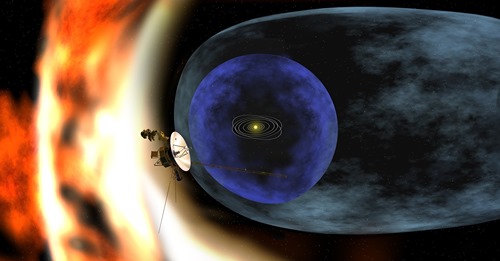
NASA’s Voyager 2 space probe, launched in 1977, has sent us some fascinating and unexpected data. In 2018 it began passing through the heliopause, a region surrounding our solar system. Here, the probe discovered a wall of interstellar plasma, something like a shield of fire-like gas made of solar-wind.
This sphere of piping hot plasma is low density, so Voyager 2 can pass right through it. However, as far as cosmic radiation is concerned, the wall of interstellar plasma is like a physical barrier, blocking 70% of the radiation from getting into our solar system. As soon as the wall is breached, we step into interstellar space where the level of cosmic radiation spikes. If it weren’t for the heliosphere’s solar-wind shield, all that radiation would strike us here on Earth.

According to the measurement of temperature taken by the probe, the wall of hot plasma is between 30,000 to 50,000 kelvins, which is roughly 53,000 to 89,000 degrees Fahrenheit. A paper published on the matter in the journal Nature Astronomy explained:
The [very local interstellar medium, a.k.a. the wall of hot plasma] is variable near the [heliopause] and hotter than expected. Voyager 2 observations show that the temperature [in that region] is 30,000–50,000 K, whereas models and observations predicted a [very local interstellar medium] temperature of 15,000–30,000 K.

NASA is not sure if, and how, this wall of hot plasma will make interstellar travel. They do plan to venture out beyond our solar system someday, after all. Although, the fact that both Voyager 1 and 2 are seemingly making it through ok (and they are over 40-year-old pieces of equipment, let’s not forget) is a good sign, at least for the spaceshipsFor now, there’s no way of knowing how the radiation would affect biological beings. Nevertheless, the discovery is impressive! A human-made device has reached the environment created by our sun, where our solar system ends, and the boundless ocean of interstellar space begins.
Below is a very informative and easy to understand video by science teacher Anton Petrov. He explains everything about the “wall of fire,” the heliosphere, interstellar space, and the two Voyager space probes.
Sonda spațială Voyager 2 a NASA, lansată în 1977, ne-a trimis niște date fascinante și neașteptate. În 2018 a început să treacă prin heliopauză, o regiune care înconjoară sistemul nostru solar. Aici, sonda a descoperit un perete de plasă interstelară, ceva asemănător unui scut de gaz asemănător focului din vânt solar. Această sferă de plasmă fierbinte are densitate mică, astfel încât Voyager 2 poate trece chiar prin ea. Cu toate acestea, în ceea ce privește radiația cosmică, peretele plasmei interstelare este ca o barieră fizică, blocând 70% din radiații să pătrundă în sistemul nostru solar. De îndată ce peretele este trecut, pășim în spațiul interstelar unde nivelul radiației cosmice crește. Dacă nu ar fi scutul solar-vânt al heliosferei, toată acea radiație ne-ar fi lovit aici pe Pământ. Conform măsurării temperaturii luată de sondă, peretele plasmei fierbinți este cuprins între 30.000 și 50.000 kelvini, ceea ce înseamnă aproximativ 53.000 până la 89.000 grade Fahrenheit. O lucrare publicată pe această temă în revista Nature Astronomy explica: [Mediul interstelar foarte local, adică peretele plasmei fierbinți] este variabil în apropierea [heliopauzei] și mai fierbinte decât era de așteptat. Observațiile Voyager 2 arată că temperatura [în acea regiune] este de 30.000-50.000 K, în timp ce modelele și observațiile au prezis o temperatură [mediu interstelar foarte local] de 15.000-30.000 K. NASA nu este sigur dacă și cum, acest perete de plasmă fierbinte va face călătorii interstelare. La urma urmei, ei intenționează să se aventureze dincolo de sistemul nostru solar. Deși, faptul că atât Voyager 1, cât și 2 par să facă acest lucru ok (și sunt piese de echipament vechi de peste 40 de ani, să nu uităm) este un semn bun, cel puțin pentru navele spațiale. Deocamdată, nu există nicio cale de știind cum ar afecta radiațiile ființele biologice. Cu toate acestea, descoperirea este impresionantă! Un dispozitiv creat de om a ajuns în mediul creat de soarele nostru, unde se termină sistemul nostru solar, și începe oceanul nemărginit al spațiului interstelar. Mai jos este un videoclip informativ și ușor de înțeles de către profesorul de știință Anton Petrov. El explică totul despre „peretele de foc”, heliosfera, spațiul interstelar și cele două sonde spațiale Voyager.

 Mihail stories