
I see you!

A 3,200 Megapixel Space Camera is About to Go Online
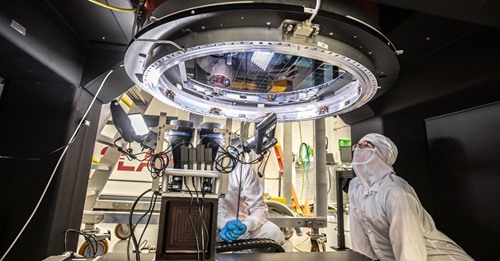
Construction is nearly complete for a camera that will take 3,200-megapixel panoramas of the southern night sky.The Vera C. Rubin Observatory in Chile is about to get the world’s biggest camera for astronomy.The images the camera takes contain billions of pixels.It can capture objects 100 million times fainter than the human eye can see.
This camera takes colossal digital pictures. It would take 378 4K ultra-high-definition televisions to display just one of them at full size. So what kind of test picture might one take with such a beast? Well, a head of broccoli, of course.
The world’s largest digital camera for astronomy captures 3,200-megapixel images. It’s destined to photograph panoramic views of the night sky in unprecedented detail for the Legacy Survey of Space and Time (LSST) database at the Vera C. Rubin Observatory in Chile, 8,700 feet above sea level atop Cerro Pachón. Right now, people at the Department of Energy’s SLAC National Accelerator Laboratory are finishing up its construction. The exquisitely detailed broccoli portrait was taken in January 2020 as a test of the camera’s focal plane.
Everyday produce notwithstanding, project manager Vincent Riot says that, „this is a huge milestone for us. The focal plane will produce the images for the LSST, so it’s the capable and sensitive eye of the Rubin Observatory.”
The tech involved in the focal plane is incredibly sophisticated and its assembly is downright harrowing.
The sensors that capture 16-megapixel images in high-end digital cameras are called charge-coupled devices, or CCDs. (Our phones and tablets instead use CMOS sensors.) The LSST camera contains 189 CCD sensors. The sensors are arranged into 21 squares of nine CCDs each — each square is called a „science raft.” The 2-foot-tall, 20-pound rafts are mounted in a grid inside the camera. This all adds up to 3.2 billion pixels, each of which is tiny at 10 microns in size, about a tenth of the width of a human hair.
As you might expect, assembling such sophisticated hardware is not for the faint of heart. The rafts must be precisely positioned in the grid so that they’re separated by a width equivalent to just five human hairs. If they touch they crack, and down the drain goes $3 million per raft. The SLAC team practiced the assembly operation for a year before the six-month assembly process commenced.

One CCD raft in place, plus a smaller non-imaging raft to its left.Credit: SLAC National Accelerator LaboratoryAmazingly detailed imagesThe camera will be worth the effort.The flatness of its giant focal plane — over 2 feet wide, as opposed to 1.4 inches in a consumer camera — will allow it to capture images of the heavens about 40 moons across. Zoomed in, the team says an image it produces will be so clear it will be like seeing a golf ball from 15 miles away. The camera will also be highly sensitive to dim objects, so it will be able to take pictures of things that are more than 100 million times dimmer than what we can see with our eyes — it’s comparable to being able to see a candle from 1,000 miles away. Project scientists Steven Ritz sums it up: „These specifications are just astounding.”Once assembled, the focal plane was put inside a custom-built cryostat for cooling — the required operating temperatureis -150° F.Broccoli, say „cheese.”Broccoli’s surface is packed with tiny details, making it a sensible candidate for testing out the focal plane. The camera housing hasn’t yet been completed, so the scientists created a pinhole device that projected the broccoli’s image onto the focal plane.The man in charge of assembling and testing the LSST focal plane is Aaron Roodman, who says that „taking these images is a major accomplishment. With the tight specifications we really pushed the limits of what’s possible to take advantage of every square millimeter of the focal plane and maximize the science we can do with it.”(Click image to explore the image at full resolution.)Credit: SLAC National Accelerator Laboratory
Next up for the SLAC team is moving the cryostat/focal plane structure into the actual camera body along with the camera’s lens assembly, which is also remarkable — it’s the world’s largest optical lens. The three-lens array was built by Ball Aerospace and Arizona Optical Systems and (carefully) driven 17 hours from Boulder, Colorado to SLAC ‘s Menlo Park, New Jersey facility.”Nearing completion of the camera is very exciting,” says JoAnne Hewett, SLAC’s chief research officer. „And we’re proud of playing such a central role in building this key component of Rubin Observatory.”The LSST camera’s mission is to take one complete, incredibly detailed panoramic image of the Southern sky per day for 10 years. Adds Hewett, „It’s a milestone that brings us a big step closer to exploring fundamental questions about the universe in ways we haven’t been able to before.”

Construcția este aproape completă pentru o cameră care va face panorame de 3.200 megapixeli ale cerului de noapte din sud.
Observatorul Vera C. Rubin din Chile este pe cale să obțină cea mai mare cameră din lume pentru astronomie.
Imaginile pe care le face camera conțin miliarde de pixeli.
Poate captura obiecte de 100 de milioane de ori mai slabe decât poate vedea ochiul uman.
Această cameră face fotografii digitale colosale. Ar fi nevoie de 378 de televizoare de înaltă definiție 4K pentru a afișa doar unul dintre ele la dimensiune completă. Deci, ce fel de imagine de testare s-ar putea face cu o astfel de fiară? Ei bine, un cap de broccoli, desigur.
Cea mai mare cameră digitală din lume pentru astronomie captează imagini de 3.200 megapixeli. Este destinat să fotografieze vederi panoramice ale cerului nopții cu detalii fără precedent pentru baza de date Legacy Survey of Space and Time (LSST) de la Observatorul Vera C. Rubin din Chile, la 8 700 de metri deasupra nivelului mării, deasupra Cerro Pachón. În acest moment, oamenii de la Laboratorul Național de Accelerare SLAC al Departamentului Energiei își încheie construcția. Portretul de broccoli deosebit de detaliat a fost realizat în ianuarie 2020 ca o testare a planului focal al camerei.
În ciuda produselor cotidiene, managerul de proiect Vincent Riot spune că „aceasta este o etapă imensă pentru noi. Planul focal va produce imaginile pentru LSST, deci este ochiul capabil și sensibil al Observatorului Rubin”.
Tehnologia implicată în planul focal este incredibil de sofisticată, iar ansamblul său este de-a dreptul îngrozitor.
Senzorii care captează imagini de 16 megapixeli în camerele digitale de ultimă generație se numesc dispozitive cuplate la încărcare sau CCD. (Telefoanele și tabletele noastre folosesc în schimb senzori CMOS.) Camera LSST conține 189 de senzori CCD. Senzorii sunt dispuși în 21 de pătrate de câte nouă CCD – fiecare pătrat este numit „plută științifică”. Plutele înalte de 20 de kilograme sunt montate într-o rețea în interiorul camerei. Toate acestea adună până la 3,2 miliarde de pixeli, fiecare dintre acestea fiind mic, la dimensiunea de 10 microni, aproximativ o zecime din lățimea unui păr uman.
Așa cum v-ați putea aștepta, asamblarea hardware-ului atât de sofisticat nu este pentru cei slabi de inimă. Plutile trebuie să fie poziționate cu precizie în grilă, astfel încât să fie separate de o lățime echivalentă cu doar cinci fire de păr umane. Dacă ating, se crăpă, iar pe canalul de scurgere se ridică 3 milioane dolari pe plută. Echipa SLAC a practicat operațiunea de asamblare timp de un an înainte de începerea procesului de asamblare de șase luni.
Planul său focal gigant – de peste 2 metri lățime, spre deosebire de 1,4 inci într-o cameră de consum – îi va permite să capteze imagini ale cerului la aproximativ 40 de luni. Mărită, echipa spune că o imagine pe care o produce va fi atât de clară încât va fi ca și cum ai vedea o minge de golf de la 25 de mile distanță. Camera va fi, de asemenea, extrem de sensibilă la obiectele slabe, deci va putea face fotografii cu lucruri care sunt de peste 100 de milioane de ori mai slabe decât ceea ce putem vedea cu ochii noștri – este comparabil cu a putea vedea o lumânare de la 1.000 de mile departe. Oamenii de știință ai proiectului, Steven Ritz, o rezumă: „Aceste specificații sunt uluitoare”.
Odată asamblat, planul focal a fost introdus într-un criostat special pentru răcire – temperatura de funcționare necesară este -150 ° F.
Broccoli, spune „brânză”.
Suprafața Broccoli este plină de detalii minuscule, făcându-l un candidat sensibil pentru testarea planului focal. Carcasa camerei nu a fost încă finalizată, așa că oamenii de știință au creat un dispozitiv de gaură care a proiectat imaginea broccoli pe planul focal.
Omul însărcinat cu asamblarea și testarea planului focal LSST este Aaron Roodman, care spune că „realizarea acestor imagini este o realizare majoră. Cu specificațiile strânse am împins cu adevărat limitele a ceea ce este posibil pentru a profita de fiecare milimetru pătrat al focalei. planificați și maximizați știința pe care o putem face cu el „.
În continuare, pentru echipa SLAC se mută structura criostatului / planului focal în corpul real al camerei, împreună cu ansamblul obiectivului camerei, ceea ce este de asemenea remarcabil – este cel mai mare obiectiv optic din lume. Gama cu trei lentile a fost construită de Ball Aerospace și Arizona Optical Systems și condusă (cu grijă) 17 ore de la Boulder, Colorado până la SLAC Menlo Park, New Jersey.
„Aproape finalizarea camerei este foarte interesantă”, spune JoAnne Hewett, ofițer șef al cercetării SLAC. „Și suntem mândri că jucăm un rol atât de important în construirea acestei componente cheie a Observatorului Rubin”.
Misiunea camerei LSST este de a realiza o imagine panoramică completă, incredibil de detaliată a cerului sudic pe zi, timp de 10 ani. Hewett adaugă: „Este o etapă importantă care ne aduce un pas mare mai aproape de explorarea întrebărilor fundamentale despre univers în moduri pe care nu le-am putut până acum”.

Just dust…

Chiribim chiribom
😉
Pisica neagră


Vasile Roaită

 Mihail stories