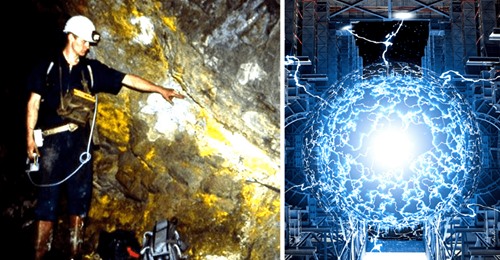
There are many secrets hidden in the African continent, and one of them is located in Oklo, Gabon. There was one of the richest uranium deposits on Earth. It was mainly used for nuclear power plants in Europe. France has operated several mines in this region for several decades. However, the uranium reserves were depleted. But back in 1972, something unsual was discovered in several uranium ore samples.

This oddity was first discovered by French physicist Francis Perrin. While examining a dark piece of radioactive natural uranium ore extracted from the Oklo mine, he noticed that the high-grade ore had a lower proportion of uranium-235 (U-235).
This discovery stunned the researchers and a team of scientists around the world.

Uranium ore, like any other ore, is found in different places around the world, and each ore has its own characteristics that can be used to track its origin. Typically, Oklo ore contained 0.7202% uranium-235. However, some samples were found to have a concentration of only 0.600%. And that’s a pretty significant difference. It looked like this uranium had already been inside the reactor, because it was depleted just as if it had already been used.
During further research, it was found that the uranium deposits in Oklo underwent spontaneous fission inside a natural reactor. This happened about 1.8 billion years ago, and this required special conditions.

It turned out that the ratio of U-235 to U-238 happened to be almost the same as used by a modern nuclear reactor, and all that was needed was the introduction of groundwater into the reaction zone as a neutron moderator.
An investigation began, and a commission of nuclear scientists was sent to Africa. After three months, scientists came up with shocking statements.
Firstly, initially, everything was fine with uranium, but it was used, and, accordingly, became depleted.

Secondly, in the area where uranium was mined, several nuclear reactors were discovered at once, with a reasonable structure, which are at least 2 billion years old.
These reactors worked for around 500,000 years, and the spent material was not utilized or removed from the area.
The findings prove that at that time, ancient civilizations were more advanced than we are now. No human-made reactor can be compared to what the French scientists found at the Oklo mining site.
Gradually, the excitement at the end of the 20th century subsided, uranium mining continued, and the reactors were somehow destroyed.
It is no longer possible to study the site, scientists are unlikely to find there something that would help modern technologies reach a higher level in this area.
Există multe secrete ascunse pe continentul african, iar unul dintre ele se află în Oklo, Gabon. A existat unul dintre cele mai bogate zăcăminte de uraniu de pe Pământ. A fost utilizat în principal pentru centralele nucleare din Europa. Franța operează mai multe mine în această regiune de câteva decenii. Cu toate acestea, rezervele de uraniu au fost epuizate. Dar în 1972, ceva neobișnuit a fost descoperit în mai multe probe de minereu de uraniu.
Această ciudățenie a fost descoperită pentru prima dată de fizicianul francez Francis Perrin. În timp ce examina o bucată întunecată de minereu de uraniu natural radioactiv extras din mina Oklo, a observat că minereul de înaltă calitate avea o proporție mai mică de uraniu-235 (U-235).
Această descoperire a uimit cercetătorii și o echipă de oameni de știință din întreaga lume.
Minereul de uraniu, ca orice alt minereu, se găsește în diferite locuri din lume și fiecare minereu are propriile sale caracteristici care pot fi utilizate pentru a-și urmări originea. De obicei, minereul Oklo conținea 0,7202% uraniu-235. Cu toate acestea, s-a constatat că unele eșantioane au o concentrație de doar 0,600%. Și aceasta este o diferență destul de semnificativă. Se părea că acest uraniu fusese deja în interiorul reactorului, deoarece era epuizat la fel ca și când ar fi fost deja folosit.
În timpul cercetărilor suplimentare, s-a constatat că depozitele de uraniu din Oklo au suferit fisiuni spontane în interiorul unui reactor natural. Acest lucru s-a întâmplat în urmă cu aproximativ 1,8 miliarde de ani, iar acest lucru necesita condiții speciale.
S-a dovedit că raportul dintre U-235 și U-238 s-a întâmplat să fie aproape același cu cel utilizat de un reactor nuclear modern și tot ce era necesar era introducerea apei subterane în zona de reacție ca moderator de neutroni.
A început o anchetă și o comisie de oameni de știință din domeniul nuclear a fost trimisă în Africa. După trei luni, oamenii de știință au venit cu declarații șocante.
În primul rând, inițial, totul era în regulă cu uraniul, dar a fost folosit și, în consecință, a devenit epuizat.
În al doilea rând, în zona în care a fost extras uraniul, au fost descoperite simultan mai multe reactoare nucleare, cu o structură rezonabilă, care au o vechime de cel puțin 2 miliarde de ani.
Aceste reactoare au funcționat timp de aproximativ 500.000 de ani, iar materialul uzat nu a fost utilizat sau îndepărtat din zonă.
Descoperirile demonstrează că la acea vreme, civilizațiile antice erau mai avansate decât suntem noi acum. Niciun reactor creat de om nu poate fi comparat cu ceea ce oamenii de știință francezi au descoperit la situl minier Oklo.
Treptat, entuziasmul de la sfârșitul secolului al XX-lea a scăzut, exploatarea uraniului a continuat, iar reactoarele au fost cumva distruse.
Nu mai este posibil să se studieze situl, este puțin probabil ca oamenii de știință să găsească acolo ceva care să ajute tehnologiile moderne să atingă un nivel mai înalt în acest domeniu.



 Mihail stories