
Fericiți cei săraci cu duhul!
Tot ceea ce ne putem imagina este real


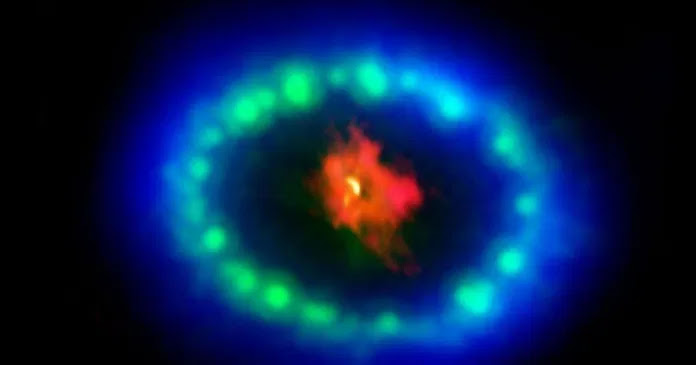
A team of astronomers have observed what they believe to be a neutron star being born following a supernova first detected in 1987, in a satellite galaxy of the Milky Way 170,000 light-years from Earth, dubbed SN 1987A.Until now, astronomers weren’t sure if the neutron star survived the powerful event and didn’t just collapse in on itself to form a black hole — but a new paper published last week in The Astrophysical Journal suggests that it may have survived after all.
That means the neutron star would be a millennial, no older than 33.
If confirmed, it would be the youngest neutron star known to mankind, as Astronomy reports. To date, the youngest supernova remnant is the 330 years old Cassiopeia A, about 11,000 light-years away from Earth inside the Milky Way.
Analyzing high-resolution imagery from the Atacama Large Millimeter/submillimeter Array (ALMA) in Chile, a team of astronomers was able to get a closer look at what was left behind following SN 1987A.
They found a hot “blob” inside the core of the supernova, likely a gas cloud shrouding the neutron star. The star itself would be far too small to be detected directly, as it’s extremely small and dense — the mass of 1.4 times the Sun inside a sphere that’s only 15 miles across.“We were very surprised to see this warm blob made by a thick cloud of dust in the supernova remnant,” Mikako Matsuura from Cardiff University who made the discovery with ALMA, said in a statement.
The discovery by the ALMA team supports the new theoretical study published last week.
“There has to be something in the cloud that has heated up the dust and which makes it shine. That’s why we suggested that there is a neutron star hiding inside the dust cloud,” Matsuura added.
“In spite of the supreme complexity of a supernova explosion and the extreme conditions reigning in the interior of a neutron star, the detection of a warm blob of dust is a confirmation of several predictions,” lead author Dany Page, astrophysicist at the National Autonomous University of Mexico, explained in the statement.
According to computer models, the neutron star would have been sent screaming through space at hundreds of kilometers per second. The location where the ALMA team found it is exactly where it would be today, according to the models.
The theoretical star was also found to be extremely bright, in large part thanks to its hypothesized temperature of around five million degrees Celsius.
It will take time until the existence of the star can be confirmed. The dust and gas around the supernova need to subside further for astronomers to say with any certainty that the extremely young star really exists.
O echipă de astronomi a observat ceea ce cred că este o stea neutronică care se naște în urma unei supernove detectate pentru prima dată în 1987, într-o galaxie satelit a Căii Lactee la 170.000 de ani lumină de Pământ, supranumită SN 1987. Până acum, astronomii nu erau siguri dacă steaua neutronică a supraviețuit puternicului eveniment și nu s-a prăbușit doar în sine pentru a forma o gaură neagră – dar o nouă lucrare publicată săptămâna trecută în The Astrophysical Journal sugerează că s-ar putea să fi supraviețuit până la urmă.
Asta înseamnă că steaua neutronică ar fi un milenar, nu mai veche de 33 de ani.
Dacă ar fi confirmată, ar fi cea mai tânără stea de neutroni cunoscută de omenire, după cum relatează Astronomy. Până în prezent, cea mai tânără rămășiță de supernova este Cassiopeia A, veche de 330 de ani, la aproximativ 11.000 de ani lumină distanță de Pământ în interiorul Căii Lactee.
Analizând imagini de înaltă rezoluție din matricea Atacama Large Millimeter / submillimeter Array (ALMA) din Chile, o echipă de astronomi a reușit să analizeze mai atent ceea ce a rămas în urma SN 1987A.
Au găsit un „blob” fierbinte, probabil un nor de gaz care învelea steaua de neutroni. Steaua în sine ar fi mult prea mică pentru a fi detectată direct, deoarece este extrem de mică și densă – masa de 1,4 ori a Soarelui într-o sferă care are o rază de numai 15 mile. „Am fost foarte surprinși să vedem acest blob cald făcut de o gros nor de praf în rămășița de supernovă ”, a declarat Mikako Matsuura de la Universitatea Cardiff, care a făcut descoperirea împreună cu ALMA, într-un comunicat.
Descoperirea de către echipa ALMA susține noul studiu teoretic publicat săptămâna trecută.
„Trebuie să existe ceva în nor care să încălzească praful și să-l facă să strălucească. De aceea, am sugerat că există o stea de neutroni care se ascunde în interiorul norului de praf „, a adăugat Matsuura.
„În ciuda complexității supreme a unei explozii de supernova și a condițiilor extreme care domnesc în interiorul unei stele de neutroni, detectarea unei pete calde de praf este o confirmare a mai multor previziuni”, a declarat autorul principal Dany Page, astrofizician la National University din Mexic, explică în declarație.
Potrivit modelelor computerizate, steaua neutronică ar fi fost expulzată în spațiu cu sute de kilometri pe secundă. Locația în care a găsit-o echipa ALMA este exact unde ar trebui să fie astăzi, conform modelelor.
Steaua teoretică s-a dovedit a fi, de asemenea, extrem de strălucitoare, în mare parte datorită temperaturii sale ipotetice de aproximativ cinci milioane de grade Celsius.
Va dura ceva până când va fi confirmată existența stelei. Praful și gazele din jurul supernovei trebuie să se disipeze și mai mult pentru ca astronomii să spună cu siguranță că steaua extrem de tânără există cu adevărat.


 Mihail stories