Hubble Hubble: Telescope Provides Stunning New Images of Two Planetary Nebulas

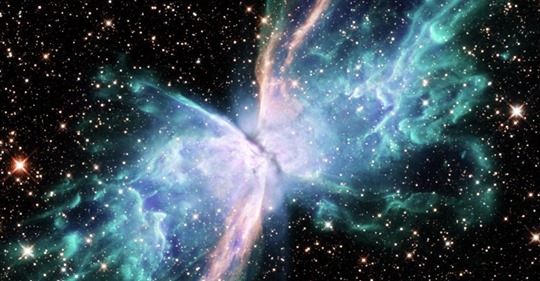
Hubble was recently retrained on NGC 6302, known as the Butterfly Nebula, to observe it across a more complete spectrum of light, helping researchers better understand the mechanics at work in its technicolor wings of gas. The star at its center is responsible for the nebula’s appearance. In its death throes, it has cast off layers of gas periodically over the past couple thousand years. SPACE TELESCOPE SCIENCE INSTITUTE/NASA, ESA, AND J. KASTNER (RIT)
The Hubble Space Telescope just celebrated its 30th year of revealing stunning scenes and mind-blowing photography from space. And NASA just released more images from Hubble of two young planetary nebulas, which are expanding shells of gas created by dying stars shedding their outer layers. The images provide new insight into the chaos stars can undergo at the end of their lives.
The multi-wavelength images, which were captured by Hubble’s Wide Field Camera 3, have astronomers hypothesizing that the Butterfly Nebula (NGC 6302) and one resembling a colorful jewel bug (NGC 7027) are binary-star systems. And the images have allowed astronomers to see how both systerms are splitting themselves apart at a fast space — at least in space time.Joel Kastner of Rochester Institute of Technology, Rochester, New York, led the study, in which researchers traced the nebulae’s histories of shock waves. The findings have led them to suspect that two stars are — or were — circling each other at the center of each nebula, which accounts for the cinched appearance in the center. The recent changes in output could even be evidence of a star merging with its companion star.
„When I looked in the Hubble archive and realized no one had observed these nebulas with Hubble’s Wide Field Camera 3 across its full wavelength range, I was floored,” Kastner said in a press statement. „These new multi-wavelength Hubble observations provide the most comprehensive view to date of both of these spectacular nebulas. As I was downloading the resulting images, I felt like a kid in a candy store.”
Astronomers theorize that a two-star nebula can form when a mass-losing star is one of two in a binary system, according to NASA. As they interact, they form a gas disk, which becomes the source of the outflowing material. In this case that would be the wings of the butterfly or the shape of the jewel bug.
NGC 7027
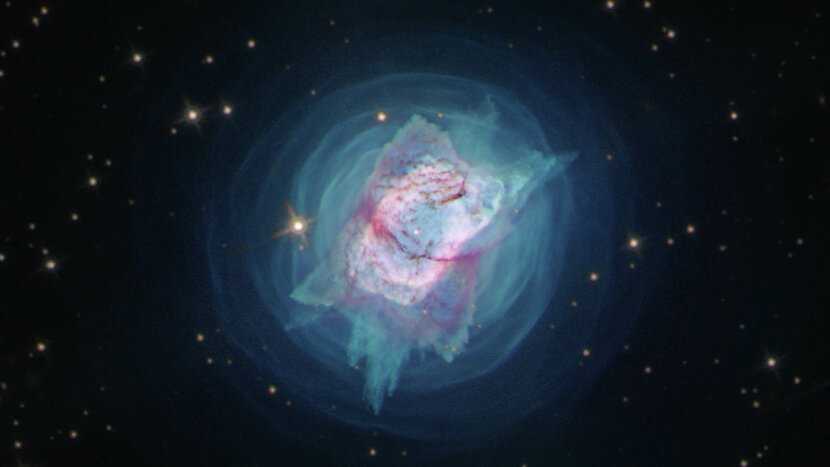
NGC 7027s, aka the ‘Jewel Bug’ Nebula, was identified for the first time by Hubble in 1998. These new near-ultraviolet observations will help reveal how much dust obscures the star and how hot the star really is.
SPACE TELESCOPE SCIENCE INSTITUTE/NASA, ESA, AND J. KASTNER (RIT)
When the smaller star merges with the other, „jets of material” can flow out and wobble, which is what researchers think is happening with the Butterfly Nebula. The way iron emissions — gas blown out at high speed by a star and captured by the Hubble camera filter — show up along opposing, off-center directions, implies that the source is wobbling over time, „like a spinning top that’s about to fall,” Kastner explains. „That’s another telltale sign of the presence of a disk, which directs the flow, and also a binary companion.”
As for the „jewel bug,” it had been „slowly puffing away its mass” for centuries in a regular spherical pattern until it recently produced a new cloverleaf pattern. Kastner said that something „went haywire” at the center. Based on its iron emission pattern, researchers think its red giant star swallowed its companion.
„The suspected companion stars in NGC 6302 and NGC 7027 haven’t been directly detected because they are next to, or perhaps have already been swallowed by, larger red giant stars, a type of star that is hundreds to thousands of times brighter than the sun,” said team member Bruce Balick of the University of Washington in Seattle in the press statement. „The hypothesis of merging stars seems the best and simplest explanation for the features seen in the most active and symmetric planetary nebulas. It’s a powerful unifying concept, so far without rival.”
Hubble a fost orientat recent spre NGC 6302, cunoscută sub numele de Nebula Fluturelui, pentru a o observa într-un spectru de lumină mai complet, ajutându-i pe cercetători să înțeleagă mai bine mecanica de lucru în aripile sale de gaz tehnicolor. Steaua din centrul ei este responsabilă pentru aspectul nebuloasei. În chinurile morții, a aruncat periodic straturi de gaz în ultimele două mii de ani. SPACE TELESCOPE SCIENCE INSTITUTE / NASA, ESA ȘI J. KASTNER (RIT)
Telescopul spațial Hubble tocmai a sărbătorit cel de-al 30-lea an de dezvăluire a scenei uimitoare din spațiu. Și NASA tocmai a oferit mai multe imagini de la Hubble a două tinere nebuloase planetare, care extind cochilii de gaz create de stele moarte care vărsă straturile exterioare. Imaginile oferă o perspectivă nouă asupra haosului pe care stelele  îl pot provoca la sfârșitul vieții.
Imaginile pe mai multe lungimi de undă, care au fost surprinse de camera Wide Field 3 a lui Hubble, îi îndeamnă pe astronomi să presupună că Nebula fluturelor (NGC 6302) și una asemănătoare cu un bug de bijuterii colorate (NGC 7027) sunt sisteme cu stele binare. Și imaginile au permis astronomilor să vadă cum ambele sindroane se împart într-un spațiu rapid – cel puțin în spațiu. Jel Kastner de la Institutul de Tehnologie Rochester, Rochester, New York, a condus studiul, în care cercetătorii au urmărit istoriile valurilor de șoc ale nebuloaselor.  Descoperirile i-au determinat să suspecteze că două stele sunt – sau erau – înconjurându-se reciproc în centrul fiecărei nebuloase, ceea ce reprezintă apariția canelată în centru. Modificările recente ale ieșirii ar putea fi chiar dovezi ale unei stele care se contopește cu steaua ei însoțitoare.
„Când m-am uitat în arhiva Hubble și mi-am dat seama că nimeni nu a observat aceste nebuloase cu camera Wide Field 3 a lui Hubble pe întreaga sa lungime de undă, am fost șocat”, a spus Kastner într-un comunicat de presă. „Aceste noi observații Hubble cu mai multe lungimi de undă oferă cea mai cuprinzătoare vedere până în prezent a ambelor nebuloase spectaculoase. Pe măsură ce descărcam imaginile rezultate, mă simțeam ca un copil într-un magazin de bomboane.”
Astronomii consideră că o nebuloasă cu două stele se poate forma atunci când o stea care pierde în masă este una dintre două într-un sistem binar, potrivit NASA. Pe măsură ce interacționează, formează un disc de gaz, care devine sursa materialului care curge. În acest caz, acestea ar fi aripile fluturelui sau forma bug-ului bijuteriilor.
NGC 7027
NGC 7027s, numită Nebula „Bug Bug”, a fost identificată pentru prima dată de Hubble în 1998. Aceste noi observații aproape de ultraviolete vor ajuta să dezvăluie cât de mult praf ascunde steaua și cât de fierbinte este steaua cu adevărat.
SPACE TELESCOPE SCIENCE INSTITUTE / NASA, ESA ȘI J. KASTNER (RIT)
Atunci când steaua mai mică se contopește cu cealaltă, „jeturi de material” pot să curgă și să se încolăcească, ceea ce cred că cercetătorii se întâmplă cu Nebula Fluturilor. Modul în care emisiile de fier – gazul izbucnit cu viteză mare de o stea și capturat de filtrul de cameră Hubble – apare de-a lungul direcțiilor opuse, în afara centrului, implică faptul că sursa se învârte în timp, „ca un titirez care este pe cale să cadă „, Explică Kastner. „Acesta este un alt semn de prezentare a prezenței unui disc, care direcționează fluxul, și, de asemenea, un însoțitor binar.”
În ceea ce privește „bug-ul bijuteriilor”, ea și-a „îndepărtat încet masa” timp de secole într-un model sferic obișnuit, până când a produs recent un nou model de trifoi. Kastner a spus că ceva „a luat-o razna” în centru. Pe baza modelului său de emisii de fier, cercetătorii consideră că steaua uriașă roșie și-a înghițit tovarășul său.
„Suspectele stele însoțitoare din NGC 6302 și NGC 7027 nu au fost detectate direct pentru că sunt lângă, sau poate au fost înghițite de stele uriașe roșii mai mari, un tip de stea care este de sute până la mii de ori mai strălucitoare decât soarele „, a declarat membru al echipei, Bruce Balick, de la Universitatea Washington din Seattle, în declarația de presă. „Ipoteza stingerii stelelor pare cea mai bună și cea mai simplă explicație pentru trăsăturile văzute în cele mai active și simetrice nebuloase planetare. Este un concept puternic unificator, până în prezent fără rival.”