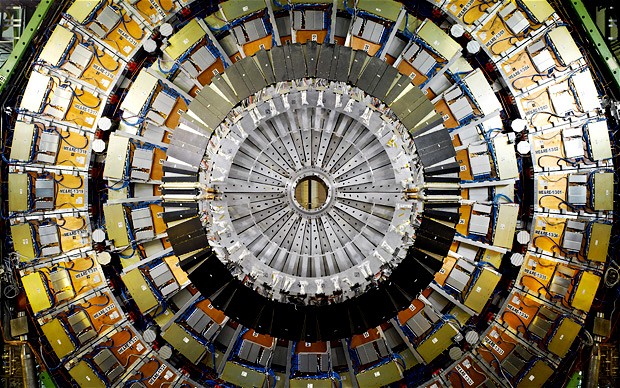
Scientists said on Thursday they recorded particles travelling faster than light – a finding that could overturn one of Einstein’s fundamental laws of the universe. Antonio Ereditato, spokesman for the international group of researchers, saidthat measurements taken over three years showed neutrinos pumped from CERN near Geneva to Gran Sasso in Italy had arrived 60 nanoseconds quicker than light would have done.
“We have high confidence in our results. We have checked and rechecked for anything that could have distorted our measurements but we found nothing,” he said. „We now want colleagues to check them independently.”
If confirmed, the discovery would undermine Albert Einstein’s 1905 theory of special relativity, which says that the speed of light is a „cosmic constant” and that nothing in the universe can travel faster. That assertion, which has withstood over a century of testing, is one of the key elements of the so-called Standard Model of physics, which attempts to describe the way the universe and everything in it works. The totally unexpected finding emerged from research by a physicists working on an experiment dubbed OPERA run jointly by the CERN particle research centre near Geneva and the Gran Sasso Laboratory in central Italy.

A total of 15,000 beams of neutrinos – tiny particles that pervade the cosmos – were fired over a period of three years from CERN towards Gran Sasso 730 (500 miles) km away, where they were picked up by giant detectors. Light would have covered the distance in around 2.4 thousandths of a second, but the neutrinos took 60 nanoseconds – or 60 billionths of a second – less than light beams would have taken.
“It is a tiny difference,” said Ereditato, who also works at Berne University in Switzerland, “but conceptually it is incredibly important. The finding is so startling that, for the moment, everybody should be very prudent.”

Ereditato declined to speculate on what it might mean if other physicists, who will be officially informed of the discovery at a meeting in CERN on Friday, found that OPERA’s measurements were correct.
“I just don’t want to think of the implications,” he said. “We are scientists and work with what we know.”Much science-fiction literature is based on the idea that, if the light-speed barrier can be overcome, time travel might theoretically become possible. The existence of the neutrino, an elementary sub-atomic particle with a tiny amount of mass created in radioactive decay or in nuclear reactions such as those in the Sun, was first confirmed in 1934, but it still mystifies researchers.
It can pass through most matter undetected, even over long distances, and without being affected. Millions pass through the human body every day, scientists say. To reach Gran Sasso, the neutrinos pushed out from a special installation at CERN – also home to the Large Hadron Collider probing the origins of the universe – have to pass through water, air and rock.
The underground Italian laboratory, some 120 km (75 miles) to the south of Rome, is the largest of its type in the world for particle physics and cosmic research. Around 750 scientists from 22 different countries work there, attracted by the possibility of staging experiments in its three massive halls, protected from cosmic rays by some 1,400 metres (4,200 feet) of rock overhead.
What has happened at CERN?
Scientists say they have clocked neutrinos – tiny particles smaller than atoms – travelling at 300,006 kilometres per second, slightly faster than the speed of light.
What does that mean?
Einstein’s theory of special relativity says nothing can travel faster than the speed of light in a vacuum, because photons – light particles – have no mass. Proof that neutrinos, mysterious subatomic particles which have a tiny amount of mass, can travel faster would be inconsistent with Einstein’s theory.
What are the knock-on effects?
Einstein’s theory is critical to the Standard Model of physics that helps explain everything we know about how the universe works, from black holes to the big bang. If it is shown to be flawed, virtually everything in modern physics and the fundamental laws of nature would have to be rethought.
Have the results been proven?
The findings were such a shock that CERN’s scientists spent months checking their data before making their announcement. But they have asked American and Japanese teams to confirm the results before they are declared an actual discovery. The data will also be put online overnight so that it can be scrutinised by experts across the world.
Does this mean E does not equal MC squared?
The theory of special relativity was used to spawn the theory that energy is equal to mass multiplied by the speed of light squared. It is premature to discount the most famous equation of all time, but the latest discovery suggests one key assumption it relies on – that nothing can accelerate faster than light – may not be wholly accurate.
Science And Nature
Oamenii de știință au declarat joi că au înregistrat particule care călătoresc mai repede decât lumina – o constatare care ar putea răsturna una din legile fundamentale ale universului Einstein. Antonio Ereditato, purtătorul de cuvânt al grupului internațional de cercetători, a declarat că măsurătorile efectuate pe parcursul a trei ani au arătat că neutrinii pompați de la CERN, lângă Geneva spre Gran Sasso, în Italia au ajuns cu 60 de nanosecunde mai repede decât ar fi făcut lumina.
„Avem încredere mare în rezultatele noastre. Am verificat și răsverificat tot ce ne-ar fi putut denatura măsurătorile, dar nu am găsit nimic „, a spus el. Vrem ca și colegii să le verifice în mod independent.”
Dacă se confirmă, descoperirea ar submina teoria lui 1904 a relativității speciale a lui Albert Einstein, care spune că viteza luminii este o „constantă cosmică” și că nimic din univers nu poate călători mai repede. Această afirmație, care a rezistat peste un secol de testare, este unul dintre elementele cheie ale așa-numitului model standard de fizică, care încearcă să descrie modul în care funcționează universul și tot ceea ce se află în el. Descoperirea total neașteptată a apărut în urma cercetărilor efectuate de un fizician care lucrează la un experiment numit OPERA derulat în comun de centrul de cercetare a particulelor CERN, lângă Geneva și laboratorul Gran Sasso din centrul Italiei.
Un total de 15.000 de fascicule de neutrini au fost trase pe o perioadă de trei ani de la CERN către Gran Sasso la 730 km (500 mile) distanță, unde au fost așteptate de detectori giganți. Lumina ar fi acoperit distanța în aproximativ 2,4 miimi de secundă, dar neutrinilor le-au luat 60 de nanosecunde mai puțin decât razele de lumină.
„Este o diferență minusculă”, a spus Ereditato, care lucrează și la Universitatea Berna din Elveția, „dar conceptual este incredibil de important. Constatarea este atât de uimitoare încât, deocamdată, toată lumea ar trebui să fie foarte prudentă. ”
Ereditato a refuzat să speculeze ce ar putea însemna dacă și alți fizicieni, care vor fi informați oficial despre descoperire în cadrul unei reuniuni de la CERN, vineri, vor constatata că măsurătorile OPERA sunt corecte.
„Chiar nu vreau să mă gândesc la implicații”, a spus el. „Suntem oameni de știință și lucrăm cu ceea ce știm.”
Multă literatură SF se bazează pe ideea că, dacă bariera de viteză a luminii poate fi depășită, călătoria în timp ar putea deveni teoretic posibilă. Existența neutrinului, o particulă elementară sub-atomică cu o cantitate mică de masă creată prin descompunerea radioactivă sau în reacții nucleare, cum ar fi cele din Soare, a fost confirmată pentru prima dată în 1934, dar încă uimește cercetătorii.
Poate trece nedetectat prin cele mai multe materii , chiar și pe distanțe lungi și fără a fi afectat. Milioane trec prin corpul uman în fiecare zi, spun oamenii de știință. Pentru a ajunge la Gran Sasso, neutrinii alungați dintr-o instalație specială la CERN (Colizorul de Hadroni Mari care verifică originile universului) trebuie să treacă prin apă, aer și stâncă.
Laboratorul subteran italian, la aproximativ 120 km (75 mile) spre sudul Romei, este cel mai mare de acest tip din lume pentru fizica particulelor și cercetarea cosmică. Aproximativ 750 de oameni de știință din 22 de țări diferite lucrează acolo, atrași de posibilitatea realizării de experimente în cele trei săli masive ale acestuia, protejate de razele cosmice de aproximativ 1.400 de metri de stâncă.
Ce s-a întâmplat la CERN?
Oamenii de știință spun că au cronometrat neutrini – particule mult mai mici decât atomii – călătorind cu 300.006 kilometri pe secundă, puțin mai rapizi decât viteza luminii.
Ce inseamna asta?
Teoria relativității speciale a lui Einstein spune că nimic nu poate călători mai repede decât viteza luminii în vid, deoarece fotonii – particule de lumină – nu au nici o masă. Dovada faptului că neutrinii, particule misterioase subatomice, care au o cantitate mică de masă, pot călători mai repede, ar fi în contradicție cu teoria lui Einstein.
Care sunt efectele secundare?
Teoria lui Einstein este critică pentru modelul standard al fizicii care ajută la explicarea a tot ceea ce știm despre modul în care funcționează universul, de la găurile negre la big bang. Dacă se dovedește a fi incorectă, practic totul în fizica modernă și legile fundamentale ale naturii ar trebui regândit.
Au fost dovedite rezultatele?
Descoperirile au fost un astfel de șoc, încât oamenii de știință ai CERN au petrecut luni întregi verificându-și datele înainte de a face anunțul. Dar au cerut echipelor americane și japoneze să confirme rezultatele înainte de a fi declarate o descoperire reală. De asemenea, datele vor fi puse online, la noapte, astfel încât să poată fi examinate de experți din întreaga lume.
Aceasta înseamnă că E nu este egală cu MC pătrat?
Teoria relativității speciale a fost folosită pentru a genera teoria că energia este egală cu masa înmulțită cu viteza luminii pătrate. Este prematur să reducem ecuația cea mai faimoasă din toate timpurile, dar cea mai recentă descoperire sugerează că o presupunere cheie pe care se bazează – că nimic nu poate accelera mai repede decât lumina – s-ar putea să nu fie în totalitate exactă.



 Mihail stories
