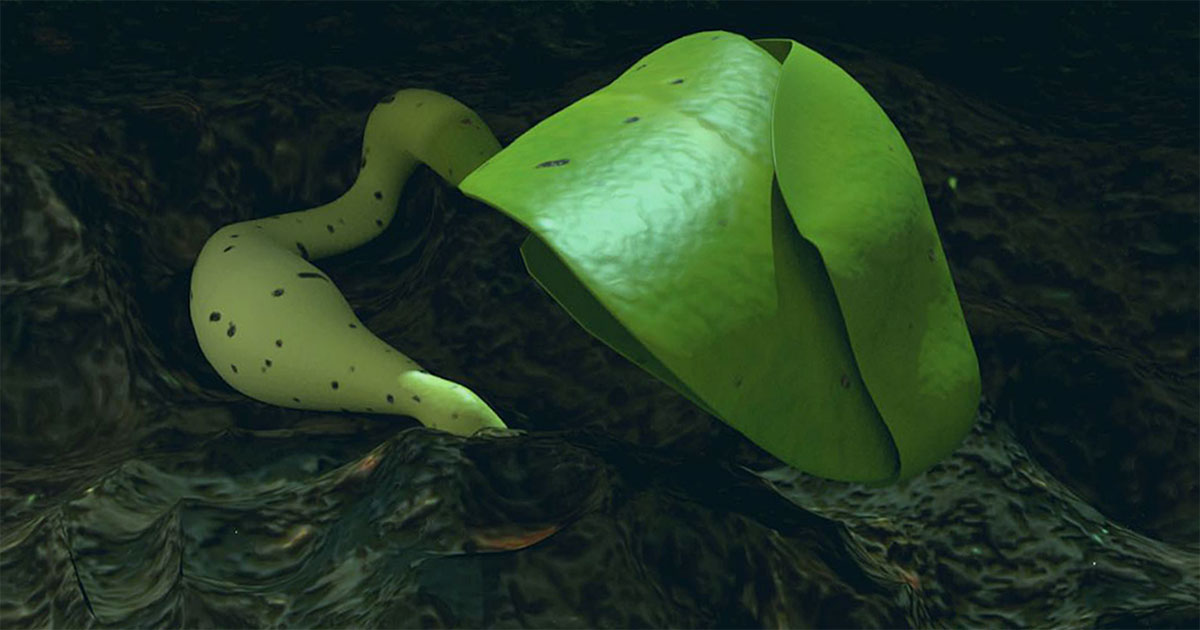
When China’s Chang’e-4 spacecraft landed on the lunar far side on January 3rd 2019, it made history. It was the first spacecraft to visit that part of the Moon, and among its payload was a 2.6 kg (5.7 lb) mini-biosphere called the Lunar Micro Ecosystem (LME).
The sealed, cylindrical biosphere is only 18 cm (7.1 in) long and 16 cm (6.3 in) in diameter. The LME carried six lifeforms, kept in mostly Earth-like conditions except for micro-gravity and lunar radiation.
The LME carried:
cotton seeds
potato seeds
rape seeds
yeast
fruit fly eggs
Arabidopsis thaliana, a common, hardy weed
This ground-breaking work by China is the first biological growth experiment on the Moon. Only the cotton seeds produced positive results.
This experiment took place back in January 2019 when the lander made it to the Moon. At that time, the team behind this experiment thought that there was only one leaf, but now data indicates there were two. The image is a 3D reconstruction based on data analysis and image processing, and it clearly shows two leaves.
None of the other organisms produced any results.
The LME was unheated, so after the first lunar day—about 14 Earth days— the cotton sprout died when the temperatures plunged to minus 190 Celsius (-310 F.) But the experiment continued, to test the longevity of the LME itself.
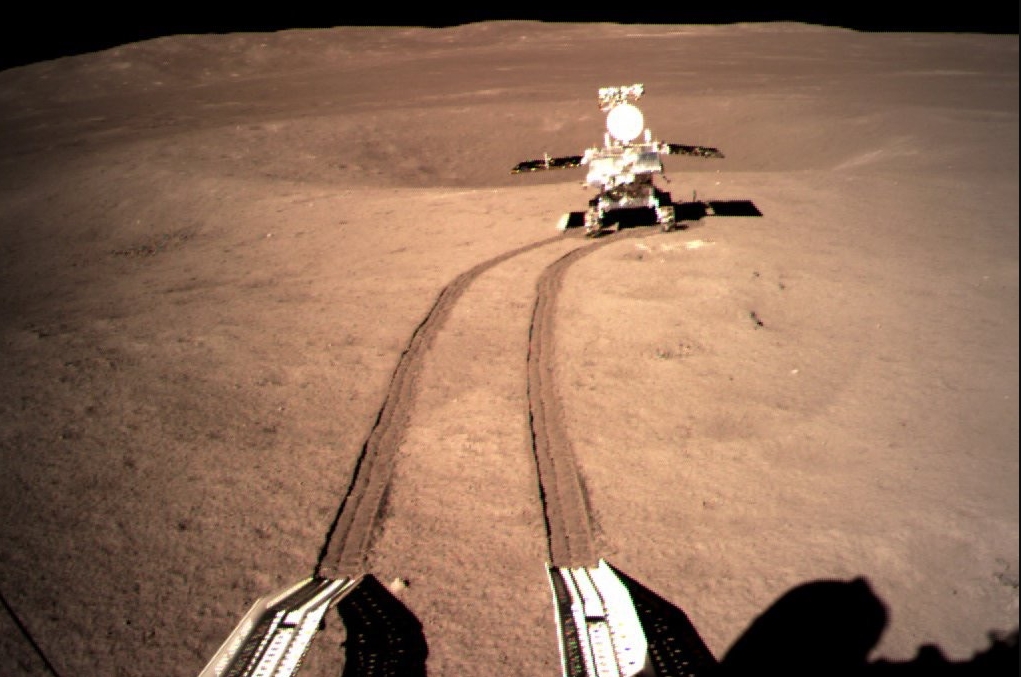
The leader of the experiment is Xie Gengxin of the advanced Technology Research Institute at Chongqing University. While there will be no scientific papers published from the experiment, Xie hopes to build on this work.
During the planning stages there was talk of sending a small tortoise to the Moon, but mission constraints prevented it.
In an interview with IEEE Spectrum Xie said, “The weight of the Chang’e-4 probe demanded that the weight [of the experiment] can’t exceed three kilograms.” It would have been a hard, brutish life for any tortoise that made the trip. Not only would it have died when the temperature plunged, but oxygen would’ve run out in about 20 days.
It wouldn’t have been the first tortoise in space. That honour goes to the two tortoises on the Soviet Union’s Zond 5 mission in 1968. Alongside the two turtles were fruit flies and plants. (The two turtles were deprived of food as part of the experiment, and they suffered from starvation when they returned to Earth, but they were alive.)
But while the Zond 5 mission was the first mission to carry any Earthlings beyond Earth’s orbit, the Chang’e-4 mission was the first to carry some to the Moon (other than astronauts, of course.) And it won’t be China’s last.

Xie and his team are looking ahead to the next Moon mission, when they hope to send more lifeforms there. If the mission allows for a larger payload, they may send more complex life forms, though they haven’t specified what they’ll be.
China has already planned Chang’e-6, a sample return mission to the Moon, sometime in the mid-2020s. In 2018 China invited international partners to become involved in an additional 10 kg. of scientific payload for the mission. Chang’e-6 is a backup mission to Chang’e-5, which is scheduled to be China’s first sample-return mission.
There’s bound to be more of these lunar biological experiments. Not only are China, the United States, Russia, India, the European Space Agency, and Japan all planning missions to the Moon, but so are private companies. And with long-duration visits to the Moon in the future, and even a continuous human presence there, scientists will keep studying how organisms respond to that environment.

Când nava spațială China’s Chang’e-4 a ajuns pe data de 3 ianuarie 2019 pe cealaltă parte a lunii, s-a scris istorie. A fost prima navă spațială care a vizitat acea parte a Lunii, iar printre sarcinile sale utile a fost o mini-biosferă de 2,6 kg (5,7 lb) numită Micro-ecosistemul lunar (LME).
Biosfera cilindrică sigilată are doar 18 cm (7,1 in) lungime și 16 cm (6,3 in) în diametru. LME a purtat șase forme de viață, păstrate în majoritatea condițiilor asemănătoare Pământului, cu excepția micro-gravitației și a radiațiilor lunare.
LME transportat:
semințe de bumbac
seminte de cartofi
semințe de rapiță
drojdie
fructe ouă de muste
Arabidopsis thaliana, o buruiană comună, rezistentă
Acesta este primul experiment de creștere biologică pe Lună. Doar semințele de bumbac au obținut rezultate pozitive.
Acest experiment a avut loc în ianuarie 2019, când pământul a ajuns pe Lună. La acel moment, echipa din spatele acestui experiment credea că a crescut o singură frunză, dar acum datele indică faptul că erau două. Imaginea este o reconstrucție 3D bazată pe analiza datelor și procesarea imaginii și arată clar două frunze.
Niciunul dintre celelalte organisme nu au dat rezultate.
LME a fost neîncălzit, astfel încât după prima zi lunară – aproximativ 14 zile de Pământ – germenul de bumbac a murit atunci când temperaturile au scăzut la minus 190 Celsius (-310 F.) Dar experimentul a continuat, pentru a testa longevitatea LME în sine.
Foto: Imagine a roverului Yutu-2 care se îndepărtează de zona de aterizare a misiunii Chang-4. Credit: CNSA
Liderul experimentului este Xie Gengxin de la Institutului de Cercetări Tehnologice avansate al Universității Chongqing. Deși nu vor fi publicate lucrări științifice din experiment, Xie speră să se bazeze pe această lucrare.
În etapele de planificare s-a vorbit despre trimiterea unei mici broaște țestoase pe Lună, însă constrângerile misiunii au împiedicat-o.
Într-un interviu acordat de IEEE Spectrum Xie, „Greutatea sondei Chang’e-4 a cerut ca greutatea [experimentului] să nu depășească trei kilograme.” Ar fi fost o viață grea și brutală pentru orice țestoasă care a făcut călătoria. Nu numai că ar fi murit când temperatura a scăzut, dar oxigenul s-ar fi epuizat în aproximativ 20 de zile.
Nu ar fi fost prima broască țestoasă în spațiu. Această onoare se referă la cele două broaște țestoase din misiunea Zond 5 a Uniunii Sovietice în 1968. Alături de cele două țestoase erau muște și plante de fructe. (Cele două țestoase au fost private de hrană ca parte a experimentului și au suferit de înfometare când s-au întors pe Pământ, dar erau în viață.)
Dar, în timp ce misiunea Zond 5 a fost prima misiune care a dus orice Pământ dincolo de orbita Pământului, misiunea Chang’e-4 a fost prima care a transportat unele pe Lună (altele decât astronauții, desigur.) Și nu va fi China ultima.
Foto:Landing-ul Chinei Chang’e-4 pe suprafața lunară. Credit imagine: CNSA / CLEP
Xie și echipa sa așteaptă cu nerăbdare următoarea misiune pe Lună, când speră să trimită mai multe forme de viață acolo. Dacă misiunea permite o sarcină utilă mai mare, ei pot trimite forme de viață mai complexe, deși nu au specificat care vor fi.
China a planificat deja Chang-6, cândva la mijlocul anilor 2020. În 2018, China a invitat partenerii internaționali să se implice într-un supliment de 10 kg. de sarcină științifică pentru misiune. Chang’e-6 este o misiune de rezervă pentru Chang-5, care este programată să fie prima misiune de retur-eșantion din China.
Nu trebuie să fie mai multe din aceste experimente biologice lunare. Nu numai că China, Statele Unite, Rusia, India, Agenția Spațială Europeană și Japonia planifică misiuni pe Lună, dar sunt și companii private. Și cu vizite de lungă durată pe Lună în viitor și chiar o prezență continuă a omului acolo, oamenii de știință vor continua să studieze modul în care organismele reacționează la acel mediu.
***





 Mihail stories