
Oldies but goldies
Australian Physicists Prove That Time Travel Is Possible
Scientists from the University of Queensland have used photons (single particles of light) to simulate quantum particles travelling through time. The research is cutting edge and the results could be dramatic! Their research, entitled “Experimental simulation of closed timelike curves”, is published in the latest issue of Nature Communications.

The grandfather paradox states that if a time traveler were to go back in time, he could accidentally prevent his grandparents from meeting, and thus prevent his own birth. However, if he had never been born, he could never have traveled back in time, in the first place. The paradoxes are largely caused by Einstein’s theory of relativity, and the solution to it, the Gödel metric.
How relativity works
Einstein’s theory of relativity is made up of two parts – general relativity and special relativity. Special relativity posits that space and time are aspects of the same thing, known as the space-time continuum, and that time can slow down or speed up, depending on how fast you are moving, relative to something else.
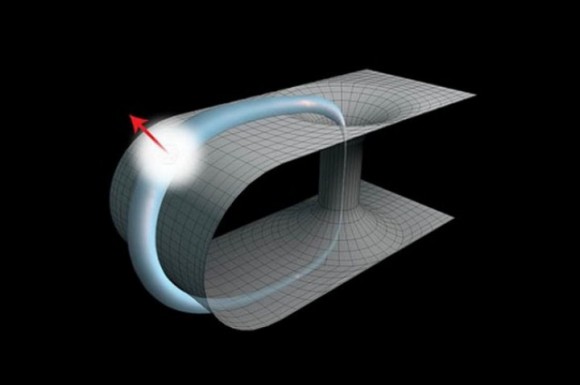
Gravity can also bend time, and Einstein’s theory of general relativity suggests that it would be possible to travel backwards in time by following a space-time path, i.e. a closed timeline curve that returns to the starting point in space, but arrives at an earlier time. It was predicted in 1991 that quantum mechanics could avoid some of the paradoxes caused by Einstein’s theory of relativity, as quantum particles behave almost outside the realm of physics.

“The question of time travel features at the interface between two of our most successful yet incompatible physical theories – Einstein’s general relativity and quantum mechanics. Einstein’s theory describes the world at the very large scale of stars and galaxies, while quantum mechanics is an excellent description of the world at the very small scale of atoms and molecules.” said Martin Ringbauer, a PhD student at UQ’s School of Mathematics and Physics and a lead author of the paper.
Simulating time travel
The scientists simulated the behavior of two photons interacting with each other in two different cases. In the first case, one photon passed through a wormhole and then interacted with its older self. In the second case, when a photon travels through normal space-time and interacts with another photon trapped inside a closed timeline curve forever.
“The properties of quantum particles are ‘fuzzy’ or uncertain to start with, so this gives them enough wiggle room to avoid inconsistent time travel situations,” said co-author Professor Timothy Ralph. “Our study provides insights into where and how nature might behave differently from what our theories predict.”
Although it has been possible to simulate time travel with tiny quantum particles, the same might not be possible for larger particles or atoms, which are groups of particles.

Fizicienii australieni dovedesc că această călătorie este posibilă.
Oamenii de știință de la Universitatea din Queensland au folosit fotoni (particule singulare de lumină) pentru a simula particulele cuantice care călătoresc în timp. Cercetarea este de ultimă oră și rezultatele ar putea fi dramatice! Cercetarea lor, intitulată „Simularea experimentală a curbelor închise în timp”, este publicată în ultimul număr al Nature Communications.
Paradoxul bunicului precizează că, dacă un călător de timp ar trebui să se întoarcă în timp, el ar putea să-i împiedice în mod accidental pe bunicii săi să se întâlnească și astfel să-și împiedice nașterea. Cu toate acestea, dacă n-ar fi fost niciodată născut, nu ar fi putut călători în timp, în primul rând. Paradoxurile sunt cauzate în mare măsură de teoria relativității lui Einstein și de soluția la acesta, măsura Gödel.
Cum funcționează relativitatea
Teoria relativității lui Einstein este compusă din două părți – relativitatea generală și relativitatea specială. Relativitatea specifică presupune că spațiul și timpul sunt aspecte ale aceluiași lucru, cunoscut sub numele de continuum spațiu-timp, și că timpul poate încetini, sau accelera, în funcție de cât de repede se mișcă, față de altceva.
Gravitatea poate, de asemenea, să îndoaie timpul și teoria relativității generale a lui Einstein sugerează că ar fi posibil să călătorești înapoi în timp urmând o cale spațio-temporală, adică o curbă închisă care se întoarce la punctul de plecare din spațiu, timp. A fost prevăzută în 1991 că mecanica cuantică ar putea evita unele dintre paradoxurile cauzate de teoria relativității lui Einstein, deoarece particulele cuantice se comportă aproape în afara domeniului fizicii.
„Problema trăsăturilor de călătorie temporală la interfața dintre două dintre cele mai reușite teorii fizice încă incompatibile – relativitatea generală și mecanica cuantică a lui Einstein. Teoria lui Einstein descrie lumea la o scară foarte largă a stelelor și a galaxiilor, în timp ce mecanica cuantică este o descriere excelentă a lumii la scară foarte mică de atomi și molecule „, a spus Martin Ringbauer, student la UQ’s School of Mathematics and Physics și un autor principal al lucrării.
Simularea călătoriei în timp
Oamenii de știință au simulat comportamentul a doi fotoni care interacționează între ei în două cazuri diferite. În primul caz, un foton a trecut printr-o gaură de vierme și apoi a interacționat cu sinele său mai vechi. În cel de-al doilea caz, atunci când un foton se deplasează prin spațiu-timp normal și interacționează cu un alt foton prins în interiorul unei curbe închise temporal pentru totdeauna.
„Proprietățile particulelor cuantice sunt confuze, sau incerte pentru început, astfel încât acest lucru le oferă suficient spațiu de manevră pentru a evita situații inconsecvente de călătorie în timp”, a declarat co-autor profesorul Timothy Ralph. „Studiul nostru oferă perspective asupra locului și modului în care natura se poate comporta diferit de ceea ce prezic teoriile noastre”.
Deși a fost posibil să se simuleze călătoria în timp cu particule cuantice mici, același lucru s-ar putea să nu fie posibil pentru particule mai mari, sau atomi, care sunt grupuri de particule.
Epic
Nici o faptă bună nu rămâne nepedepsită…
Epic
E roșie – Ba-i albastră! – Băăăă, daltoniștilor, e galbenă toată ziua!
Epic
Starea Natiei — Invictus

Am creat acest blog pentru a informa in special romanii din tara, si din strainatate, despre ceea ce se intampla in lume si mass-media aservita nu prezinta, nu spune. Pentru articolele publicate in Facebook sunt blocata permanent 30 de zile, cand „ispasesc pedeapsa” ma lasa o zi si a doua zi ma blocheaza iarasi 30 […]
Epic
 Mihail stories