Last year, a global collaboration of scientists made history by unveiling the
very first direct image of a black hole. Now, we have a magnificent follow-up – the closest-ever look at a violent jet spewed forth by a supermassive black hole.
That supermassive
black hole sits at the heart of a quasar 5 billion light-years away from Earth, the extremely luminous 3C 279. Quasars are amongst the brightest cosmic objects we know of: galaxies with colossal
black holes that emit intense radiation as gas in their accretion disk falls towards the event horizon.
The newly published results actually come from the same observation run that yielded the historic black hole image, conducted by the Event Horizon Telescope (EHT) team in April 2017. 3C 279 was one of the four secondary objects in this run – and now we finally get to see the exciting results.
We already know that when matter falls towards the nothingness of a hungry supermassive black hole, a fraction of this material – surrounding gas and dust –
gets accelerated almost to the speed of light. As a result, the black hole produces
relativistic jets of the fastest-travelling particles in the known Universe.
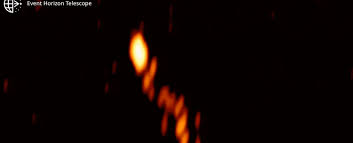
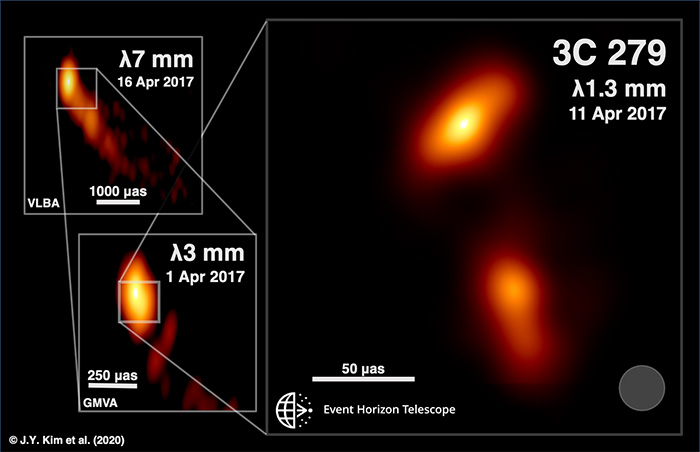
It’s one of these bursting jets that the EHT team has now resolved in unprecedented detail, tracing it all the way down to the accretion disk of the black hole in 3C 279. It might look somewhat blurry to us, but there’s a wealth of information in the data.
For one, the team has uncovered a bit of a surprise: while the jet is supposed to be straight, the data actually reveal what seems to be a bend at its base, along with an elongated structure that is perpendicular to the direction of the jet.
„This morphology can be interpreted as either a broad resolved jet base or a spatially bent jet,” the team
writes in their paper that sports a whopping 351 authors.
And, because the observations occurred on several days, the researchers could also discern fine changes that could well be the smoking gun of something that’s been predicted by simulations, but never directly observed – the rotation of the accretion disk and shredding of material as it falls into the black hole.
(J.Y. Kim (MPIfR)/Boston University Blazar Program (VLBA and GMVA)/EHT Collaboration)
It’s no accident that 3C 279 was chosen as one of the objects for EHT to do its magic on. The M87 galaxy, for all the glory of its supermassive black hole we saw last year, is actually a relatively weak source of gamma-ray emission.
More powerful active galactic nuclei – such as 3C 279 – tend to be at much larger
luminosity distances, meaning they’re harder for us to discern in the night sky. But 3C 279 is one of the brightest sources of gamma rays we’ve ever observed. Helpfully, it’s also a blazar, which means its wonderfully prominent, highly variable jet is directed towards the observer (that’s us).
The team trained EHT on 3C 279 on four nights in April 2017, gathering data from eight stations at six geographic sites. Those data had to be carefully transported to supercomputers at the Max Planck Institute for Radio Astronomy (MPIfR) and MIT for extensive analysis.
„For 3C 279, the combination of the transformative resolution of the EHT and new computational tools for interpreting its data have proved revelatory,”
says astrophysicist Avery Broderick from the Perimeter Institute in Canada.
„What was a single radio ‘core’ is now resolved into two independent complexes. And they move – even on scales as small as light-months, the jet in 3C 279 is speeding toward us at more than 99.5 percent of light speed!”
These are extraordinary findings for black hole science – having relied on simulations and low-resolution observations for so long, there’s still plenty we don’t understand about how these enigmatic objects function, and what actually powers the jets that we can see.
„More details of the source properties, such as the magnetic field configuration and detailed jet energy balance, will be subject to follow-up studies,” the authors
conclude in the paper.
When the world finally met the eye of M87*, astronomers were just getting started with their powerful new toys.
Sadly, the latest EHT observation run slated for March/April this year was cancelled because of the ongoing COVID-19 pandemic. But the collaboration gathered plenty of data in 2017 and 2018, so there’s more where this came from.
„Last year we could present the first image of the shadow of a black hole,”
says Anton Zensus, director of the MPIfR and chair of the EHT collaboration board.
„Now we see unexpected changes in the shape of the jet in 3C 279, and we are not done yet. As we told last year: this is just the beginning.”

Anul trecut, o colaborare la nivel mondial a oamenilor de știință a făcut istorie dezvăluind prima imagine directă a unei găuri negre. Acum, avem o monitorizare magnifică – cea mai apropiată privire efectuată vreodată a unui jet violent lansat de o gaură neagră supermasivă.
Acestă gaură neagră supermasivă 3C 279 se află în inima unui quasar, extrem de luminos, aflat la 5 miliarde de ani lumină de Pământ. Quasarii sunt printre cele mai strălucitoare obiecte cosmice despre care știm: galaxii cu găuri negre colosale care emit radiații intense sub formă de gaz în discul de acreție care cade spre orizontul evenimentului
Rezultatele recent publicate provin de fapt din aceeași set de observații care a dat imaginea istorică a găurii negre, realizată de echipa Event Horizon Telescope (EHT) în aprilie 2017. 3C 279 a fost unul dintre cele patru obiecte secundare din acest studiu – și acum suntem în sfârșit în măsură a vedea rezultate interesante.
Știm deja că atunci când materia se prăbușește spre orificiul negru al unei blackhole supermasive, o parte din acest material – gaz înconjurător și praf – se accelerează aproape până la viteza luminii. Drept urmare, gaura neagră produce jeturi relativiste ale particulelor care circulă super rapid prin Universul cunoscut.
Acesta este unul dintre aceste jeturi explozive, cel pe care echipa EHT l-a relevat acum în detalii fără precedent, urmărindu-l până la discul de acumulare a găurii negre din 3C 279. S-ar putea să ne pară oarecum neclar, dar există o mulțime de informații în aceste date.
Astfel, echipa a avut o surpriză: în timp ce se presupunea că jetul este drept, datele relevă de fapt ceea ce pare a fi o curbură la baza sa, împreună cu o structură alungită care este perpendiculară pe direcția jetului. .
„Această morfologie poate fi interpretată fie ca o bază cu o rezoluție largă de jet , fie ca un jet îndoit spațial”, scrie în lucrarea lor echipa care cuprinde nu mai puțin de 351 de autori.
Și, pentru că observațiile au durat câteva zile, cercetătorii au putut, de asemenea, să constate modificări fine care ar putea foarte bine să fie urma de fum a ceva ce s-a prevăzut prin simulări, dar niciodată direct observat – rotația discului de acumulare și mărunțirea materialului pe măsură ce cade în gaura neagră.
Nu este întâmplător faptul că 3C 279 a fost ales ca unul dintre obiectele pentru ca EHT să își facă magia. Galaxia M87, pe care am văzut-o anul trecut – cu toată gloria găurii sale super-masive – este de fapt o sursă relativ slabă de emisie a razelor gamma.
Mai puternici nuclei galactici activi – cum ar fi 3C 279 – tind să fie la distanțe mult mai mari de luminozitate, ceea ce înseamnă că ne este mai greu să-i discernem pe cerul nopții. Dar 3C 279 este una dintre cele mai strălucitoare surse de raze gamma pe care le-am observat vreodată. În mod util, este, de asemenea, un blazar, ceea ce înseamnă că jetul său extraordinar de proeminent, extrem de variabil, este îndreptat către observator (adică spre noi).
Echipa a observat cu EHT pe 3C 279 timp de patru nopți în aprilie 2017, adunând date de la opt stații din șase situri geografice. Aceste date trebuiau transferate cu atenție la supercomputerele din Institutul Max Planck pentru Radio Astronomie (MPIfR) și MIT pentru o analiză extinsă.
„Pentru 3C 279, combinația dintre rezoluția EHT și noile instrumente de calcul pentru interpretarea datelor s-a dovedit revelatoare”, spune astrofizicianul Avery Broderick, de la Institutul Perimetru din Canada.
„Ceea ce părea a fi un singur nucleu radio este acum desfăcut în două complexe independente. Și acestea se deplasează – chiar și pe scale mai mici decât o lună-lumină, jetul din 3C 279 se îndreaptă spre noi cu mai mult de 99,5 la sută din viteza luminii!”
Acestea sunt descoperiri extraordinare pentru știința găurilor negre – după ce s-au bazat pe simulări și observații cu rezoluție scăzută atât de mult timp, încă nu înțelegeam modul în care funcționează aceste obiecte enigmatice și ce pot alimenta de fapt jeturile pe care le putem vedea.
„Mai multe detalii despre proprietățile sursei, cum ar fi configurația câmpului magnetic și echilibrul detaliat al energiei jetului, vor fi supuse unor studii de urmărire”, concluzionează autorii în lucrare.
Pe când lumea observa în sfârșit ochiul M87 *, astronomii tocmai își primeau jucăriile lor puternice și noi.
Din păcate, ultima derulare a observației EHT a fost anulată în martie / aprilie a acestui an din cauza pandemiei COVID-19 în curs. Însă colaborarea a adunat o mulțime de date în 2017 și 2018, așa că știm mai multe despre acest fenomen.
„La anul am putea prezenta prima imagine a umbrei unei găuri negre”, spune Anton Zensus, directorul MPIfR și președinte al consiliului de colaborare EHT.
„Acum vedem schimbări neașteptate în forma jetului în 3C 279 și nu am terminat încă. Așa cum am spus anul trecut: acesta este doar începutul.”
The results have been published in Astronomy & Astrophysics.





 Mihail stories